On 1 June 2026 Anthropic became one of the most closely watched events on the financial markets — the company confidentially filed a draft of its registration document (a draft S-1) for a stock-market listing, at a private valuation approaching a trillion dollars. If the IPO goes ahead as the bankers expect, it will be the single most important test yet of how public investors can value a company built on artificial-intelligence research — a field whose commercial potential is enormous but whose appetite for capital is unprecedented.
Dario Amodei, co-founder and CEO of Anthropic, had long declined to confirm a specific timetable for the IPO, but the confidential filing changed the picture fundamentally. Going public is now a question of when, not whether — with speculation pointing to a listing as soon as autumn 2026, a move with which Anthropic has stepped ahead of its biggest rival, OpenAI. In its most recent funding round (the Series H closed at the end of May 2026) the company reached a valuation of 965 billion dollars, making it the world’s most valuable AI startup. Investment bankers expect the firm to debut at the IPO itself well above the one-trillion-dollar mark, which would instantly place it among the roughly fifteen most valuable companies on the planet.
*The financial figures used in this article are based on estimates and information from publicly available sources (including Anthropic’s own announcements and reporting by the WSJ and The Information), the accuracy of which cannot be guaranteed. Many of the projections come from internal materials shared as part of the fundraising process and have not been audited.
Anthropic’s business model
Anthropic is not a typical technology startup with a single product. It is a commercial AI platform whose business rests on several interlocking pillars. Each has a different revenue dynamic, a different margin profile and a specific risk profile. The common thread is explosive growth: by the end of May 2026 the annualised revenue run-rate had passed 47 billion dollars, against roughly 9 billion at the end of 2025. The software industry has never seen anything like that pace.
The Claude API, Claude Code and enterprise services
The main revenue engine and the core of the valuation is the Claude family of models, serving tens of thousands of corporate customers through the API and, increasingly, the agentic tool Claude Code. Claude Code is the breakout product of the whole story — it crossed 1 billion dollars in annualised revenue within six months of launch and became the de facto standard for agentic programming in the enterprise, where it now accounts for the bulk of its revenue. Gross margin is estimated at around 50%, with the company aiming to push it towards 77% over the next few years, as internal projections shared with investors suggest. Anthropic’s structural advantage is that the marginal cost of serving each additional customer falls with every new generation of model, which delivers greater compute efficiency — and it is precisely this operating leverage that lies at the heart of the investment case.
Compared with its rivals, Anthropic puts a heavy emphasis on AI safety — an approach it calls Constitutional AI. This is not merely a marketing flourish but a strategic position that opens the door to clients in regulated industries — banking, healthcare, pharmaceuticals and the public sector. These are precisely the highest-margin segments with the strongest customer loyalty. The strength of that position shows up in hard numbers: more than a thousand customers now spend over a million dollars a year on Claude, and their number doubled in under two months in April 2026. With that, Anthropic is moving beyond being a supplier of AI models and is starting to build a position as a trusted AI infrastructure for critical enterprise applications, which dramatically widens its addressable market.
Claude as a consumer product
The consumer version of Claude — via the web interface and mobile apps — generates subscription revenue (the Pro and Max plans). Anthropic reports a sharp rise in consumer usage, which in itself puts a strain on the company’s infrastructure. The paradox is that the consumer segment is economically less attractive than the enterprise API and Claude Code, yet it is absolutely vital for the brand — this is where awareness is built and trust in the technology is formed. The launch of the Claude Opus 4.8 model at the end of May 2026 also showed that Anthropic is keeping pace at the top of the performance leaderboards.
Strategic partnerships and cloud platforms
Anthropic is deeply integrated with Amazon Web Services (AWS) through Amazon Bedrock and the Claude Platform, and it also works with Google Cloud. Strategic investments from Amazon totalling 13 billion dollars (with the potential to reach 33 billion) and from Google in the billions create powerful distribution channels — but at the same time they create dependence and potential conflicts of interest. More than 100,000 customers now run Claude on Amazon Bedrock, which secures access to a vast base of enterprise clients without the need to build a sales operation from scratch.
Research, safety and compute infrastructure
Anthropic ploughs a substantial share of its revenue back into fundamental research and, above all, into compute capacity. This is a strategically essential but extraordinarily capital-hungry pillar — internal projections assume the company will need to sustain roughly 80 billion dollars of spending on cloud infrastructure through to 2029. This pillar generates no direct revenue, but it is the precondition for staying competitive, and it is exactly what makes the path to durable profitability uneven.
| Metric | Value |
|---|---|
| Revenue run-rate (end 2025 → May 2026) | $9bn → $47bn (+420%) |
| Projected operating profit Q2 2026 | ≈ $559m (revenue ≈ $10.9bn) |
| Revenue projection 2028 | ≈ $70bn |
| Projected operating cash flow 2028 | ≈ $17bn |
| Gross margin (today → target) | ≈ 50% → 77% |
| Cloud-infrastructure spend through 2029 | ≈ $80bn |
Strategic partnerships with Amazon and Google

The structure of Anthropic’s capital relationships is unusual for the technology industry. Amazon has invested 13 billion dollars in the company in total — 8 billion in earlier years and another 5 billion in April 2026 — and has committed to a potential further investment of up to 20 billion dollars tied to commercial milestones, which could take its total exposure to 33 billion. Google has contributed billions more. These investments come with deep integration agreements: in return, Anthropic has committed to spend more than 100 billion dollars on AWS technology over the coming decade and has locked in up to 5 gigawatts of compute capacity (among other things via Trainium chips and the joint Rainier project, one of the largest compute clusters in the world). The Series H round also brought in Samsung, SK Hynix and Micron as strategic infrastructure partners.
For investors weighing up a stake in the IPO, it is essential to grasp that these partnerships are simultaneously Anthropic’s greatest strength and its biggest structural risk. On the one hand they provide distribution, capital and compute infrastructure at a scale Anthropic could never reach on its own. On the other they create dependence on platforms that are themselves developing rival AI models — Amazon with its Nova family and Google with Gemini.
The question every investor has to answer is this: is Anthropic a strategic partner of the cloud giants, or an insurance policy those giants are paying for in case their own AI development falls short? The answer probably lies somewhere in between.
From a purely commercial standpoint, these partnerships are unambiguously positive for the short and medium term. Anthropic gains access to the billion-dollar customer base of AWS and Google Cloud without having to build its own sales and distribution machine. As a result, Claude models are available to more than a hundred thousand businesses that already use the cloud services of both platforms. These synergies are real and measurable. Over the long run, however, there is a risk that the strategic priorities of Amazon and Google shift in a way that harms Anthropic — especially given the enormous mutual financial entanglement, where the scale of cloud spending dwarfs the scale of investment received.
At an IPO valuation above a trillion dollars, a substantial part of the price assumes these partnerships continue and deepen — an assumption over which the investor has no control whatsoever.
Competitive advantage, or just a temporary position?
In generative AI there is a crucial difference between a company that has the best model today and one whose position is sustainable over the long term. Anthropic has strong arguments for both.
The research moat
This lies in a concentration of top-tier talent and a distinctive approach to AI safety. Anthropic was founded in 2021 by former senior figures from OpenAI — Dario and Daniela Amodei — and the company attracts some of the best researchers in the field. The Constitutional AI approach and the emphasis on model interpretability create a competitive advantage that resonates particularly with enterprise customers facing strict compliance requirements.
The distribution and product moat
This is potentially even more important. The integration of Claude into AWS Bedrock and Google Cloud, together with the spread of Claude Code, creates switching costs for the tens of thousands of corporate customers building their internal processes, developer workflows and products on Claude models. Replicating such a position would require not just a comparable model but comparable distribution agreements too — and the number of cloud hyperscalers willing to integrate an external AI model this deeply is limited. It is precisely its dominance in agentic programming through Claude Code that today sets Anthropic apart from rivals more focused on the consumer market.
A full analysis has to weigh three scenarios for how things develop:
- Sustainable-leadership scenario (estimated probability 35%): Anthropic holds its place among the top three AI labs, keeps scaling the enterprise segment and Claude Code, the operating leverage comes through in full, and its safety approach becomes an industry standard, cementing its position in regulated sectors.
- Commoditisation scenario (45%): The performance gaps between the leading models gradually narrow. OpenAI, Google (Gemini), xAI (Grok), Mistral, Meta and others close the technology gap. Anthropic keeps its market share, but margins fall under the pressure of price competition.
- Marginalisation scenario (20%): Better-capitalised rivals (Google, Meta and Amazon with their own models) squeeze Anthropic out of its position as an independent leader. The company effectively becomes a supplier to the cloud platforms with limited bargaining power.
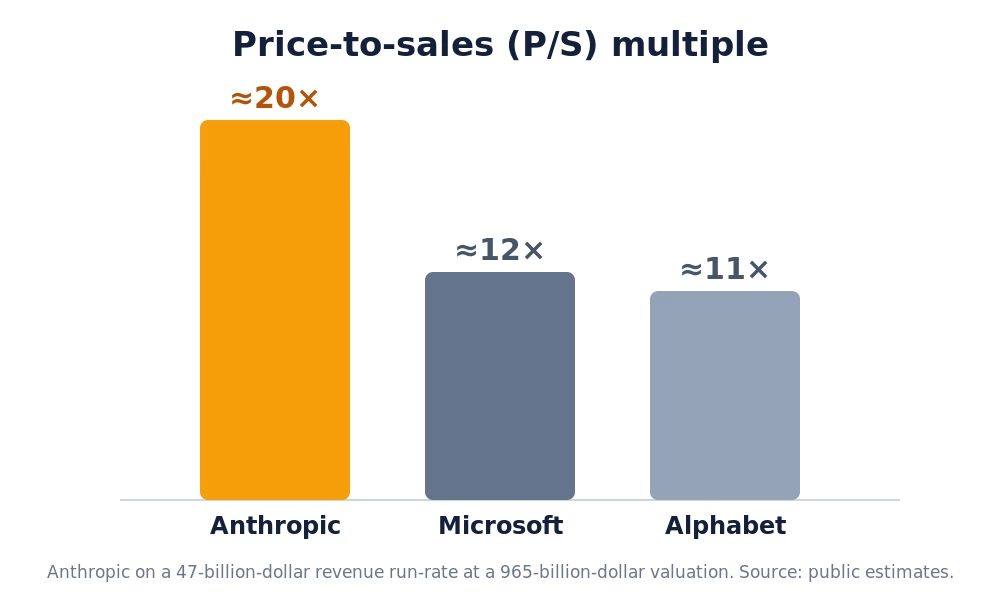
A comparison with established technology companies exposes the heart of the debate: at a private valuation of 965 billion dollars and an annualised revenue run-rate of around 47 billion, the implied P/S multiple sits at roughly 20× — far less than earlier estimates from a time when revenue was an order of magnitude lower. On the basis of revenue actually reported in the accounts, however, the multiple is many times higher, and it is worth bearing in mind that the way revenue is recognised (gross vs. net) can inflate headline figures relative to competitors. For a rough comparison, Microsoft trades at around 12× revenue and Alphabet at around 11×. Whether such a valuation is justified depends almost entirely on Anthropic’s ability to prove that generative AI is not a commodity technology but a platform layer with durable differentiation and expanding margins.
Assessing the management
Any assessment of Anthropic has to start with the founding team — Dario and Daniela Amodei. Unlike many technology firms, where the founder is primarily a visionary and managerial execution is left to a hired team, at Anthropic the leadership is deeply technical and directly involved in steering the company’s research. The financial side of the IPO preparations is run by CFO Krishna Rao.
Dario Amodei has a reputation as an exceptionally analytical and disciplined leader. His decision to leave OpenAI in 2021 over disagreements about the approach to AI safety has, in hindsight, proved strategically astute. As president of the company, Daniela Amodei handles operational management and investor relations. The pairing offers an unusual combination of research depth and operational competence.
Anthropic is registered as a Public Benefit Corporation and presents itself as a company whose primary mission is the safe development of AI — not merely the maximisation of profit. For private investors who share that mission, this has not so far been a problem. For public shareholders measuring performance by quarterly results, this value framework could be a source of frustration, particularly if safety-driven caution leads to slower rollout of new features than at less cautious rivals.
Anthropic’s corporate structure also includes specific mechanisms — among them a special governing body (the Long-Term Benefit Trust) — through which the founders and management can prioritise AI safety over shareholders’ short-term financial interests. The structure is understandable in mission terms, but for investors it means limited influence over strategic decisions and potential conflicts between the company’s mission and the interests of its public shareholders. The details of this structure will have to be clarified only in the full text of the prospectus (the S-1).
Risks, valuation and regulation
The primary risk is one of valuation, not technology. If Anthropic goes public at a valuation above a trillion dollars, investors are implicitly betting that the company will deliver an extraordinarily ambitious growth trajectory. Internal projections shared with investors assume revenue of around 70 billion dollars and operating cash flow of around 17 billion dollars by 2028, conditional on gross margin improving from today’s roughly 50% towards 77%. Even at history’s most successful technology firms, multiples this high have been sustainable only with growth above 40–50% a year for several years, accompanied by a marked improvement in operating margins. Anthropic, meanwhile, operates in an industry where the cost of compute infrastructure rises just as fast as revenue — the company itself warns that although it projects a first quarterly operating profit (roughly 559 million dollars in Q2 2026 on revenue of around 10.9 billion), planned data-centre spending could push the following quarter back into a loss.
The scenario nobody likes to talk about: Anthropic goes public above a trillion dollars, ships best-in-class models, wins millions of customers — and the stock falls anyway, because flawless execution was already priced in at the IPO and margins fail to expand as fast as the market assumed.
Secondary risks include:
- Commoditisation risk: if the performance gaps between the leading AI models keep narrowing, price competition could compress margins across the whole industry. Open-source models from Meta (Llama) and others add to the pressure on API pricing.
- Regulatory risk: the EU AI Act, forthcoming US legislation and regulatory frameworks in other jurisdictions could significantly constrain the deployment of AI models.
- Capital intensity: training new generations of models and running inference demands enormous spending — internal projections assume sustaining roughly 80 billion dollars of cloud-infrastructure costs through to 2029. This capex will stay high for many years.
- Dependence on partners: any shift in Amazon’s or Google’s strategic stance towards Anthropic — whether scaling back investment, favouring their own models or changing commercial terms — would have an immediate impact on revenue.
Underappreciated risks include the way revenue is recognised (gross vs. net), which can inflate headline figures; potential liability exposure linked to the outputs of AI models in regulated industries; the possibility of a fundamental breakthrough in the approach to AI (for example neuro-symbolic systems) that would devalue the current large-language-model architecture; and rising geopolitical tension around the export of AI technology and compute infrastructure.
The investment case: bull and bear perspectives
The bull case rests on the conviction that generative AI is a transformative technology comparable to the internet — and that Anthropic is one of the few companies with a genuine shot at becoming its infrastructure. If AI adoption accelerates in line with the optimistic projections and the total addressable market for AI services reaches 500 billion to 1 trillion dollars by 2030, then even a relatively modest market share would justify a high valuation. Claude models increasingly rank at the top of independent benchmarks, Claude Code dominates agentic programming, and the company’s safety approach could be the deciding factor in winning customers from regulated sectors. The first projected operating profit, moreover, shows that the operating leverage may be real.
What could surprise the market on the upside after the IPO: faster-than-expected adoption of AI agents in the enterprise; improving efficiency and costs (and with them margins, towards the 77% target); the signing of exclusive contracts with government bodies; or new generations of models with a markedly better performance-to-cost ratio.
The bear case does not question the quality of Anthropic as a superb company. It questions whether any price can deliver public investors an attractive return in an industry where the competitive landscape is still taking shape. Historically, investors in mega-IPOs of technology firms have earned above-average returns only in a minority of cases — most of the value was extracted in the private rounds before the listing. That is especially pronounced at Anthropic: the valuation jumped from 380 billion dollars in February 2026 to 965 billion in May, so the overwhelming majority of the gains have already accrued to private investors. The AI sector also shows the hallmarks of an investment bubble, where valuations rise faster than profitability.
At a valuation above a trillion dollars, Anthropic has to deliver growth roughly in line with the internal projections — that is, approach 70 billion dollars of annual revenue by 2028 — to justify the valuation at a normalised multiple. That requires today’s extraordinary pace to continue in an environment of intensifying competition and persistent pressure on margins.
Structural problems for long-term investors:
- The distinctive corporate structure (the Long-Term Benefit Trust, PBC) means the company’s leadership can prioritise the safety mission over the maximisation of shareholder value.
- The capital intensity of AI development is accelerating — unlike mature software firms, capex will not fall quickly as scale grows, because each new generation of models requires exponentially more compute.
- Dependence on a limited number of chip suppliers and on cloud partners (Amazon, Google) creates a structural risk on the cost side that Anthropic cannot fully control.
Where the story parts ways with the fundamentals
The media narrative around Anthropic is largely positive, underpinned by the performance of Claude models in independent evaluations, the rocket-like growth in the revenue run-rate, and a repeated emphasis on AI safety that resonates at a time of mounting fears about uncontrolled development.
There is broad agreement among analysts that Anthropic belongs to the top three AI labs in the world and that overtaking OpenAI both in valuation and in filing for an IPO was a symbolic moment. Sharp disagreement, however, surrounds the questions of valuation and the durability of the competitive position. Some argue for valuing it as a platform infrastructure company; others point out that AI models show commoditisation tendencies and that the way revenue is recognised, together with the lumpiness of profitability, warrants caution.
Retail investors probably underestimate the capital intensity of training new models, the risk of AI services being commoditised, the implications of the distinctive corporate structure that limits shareholder rights, the gap between run-rate and actually reported revenue, and the fact that a substantial part of the value in the AI chain still flows to infrastructure suppliers (Nvidia, the cloud hyperscalers) rather than solely to the model builders.
Institutional investors, by contrast, may underestimate the speed at which AI agents (and Claude Code in particular) could become standard enterprise infrastructure, the strength of safety differentiation as a regulatory moat in an era of growing AI legislation, and the potential of Claude models in sectors where trust and reliability outweigh price — healthcare, finance, legal services and the public sector.
The biggest gap between market sentiment and fundamental reality lies in the question of margins and the sustainability of profit. Sentiment assumes Anthropic will evolve into a software platform with margins approaching 77%. The fundamentals show a company that spends most of its revenue on compute infrastructure and research and whose path to durable profitability is uneven — a first projected operating profit could be followed by a return to losses. Both perspectives may be partly right — but the price at which you enter this story determines your return more than anything else.
Conclusion: a strategic approach to the Anthropic IPO
Having examined the revenue model, the competitive environment, the risk profile, the management and market sentiment, the following conclusion can be drawn: the Anthropic IPO — confidentially filed on 1 June 2026 and expected to debut in the autumn of the same year at a valuation above a trillion dollars — would in all likelihood come to market with a substantial premium reflecting the excitement around artificial intelligence.
This assessment rests on three pillars:
- The valuation arithmetic is demanding. At a P/S of around 20× on a run-rate basis (and far higher on reported revenue), Anthropic has to meet the internal projections pointing towards 70 billion dollars of revenue by 2028 to justify the valuation. That is not impossible, but it requires AI-services adoption to follow the optimistic scenarios and competitive pressure not to break down margins. The market is pricing in an ideal trajectory; reality rarely delivers one.
- Structural limits on shareholder rights. Public investors will have limited control over the company’s strategic direction, while Anthropic’s distinctive corporate structure (the PBC and the Long-Term Benefit Trust) explicitly allows the safety mission to be prioritised over financial performance.
- The historical patterns of tech-sector mega-IPOs. Most huge technology IPOs have come to market near the peak of the narrative cycle, and at Anthropic a substantial part of the value has already been extracted in the private rounds (the jump from 380 to 965 billion in three months).
And yet there is a scenario — with an estimated probability of 20–30% — in which the high entry valuation proves justified in hindsight. That scenario requires AI agents to transform enterprise processes faster than the market expects, Anthropic to demonstrate a sustainable technology lead and durable profitability (not just a single profitable quarter), and the total market for AI services to grow towards a trillion dollars a year by 2030. But basing an investment decision on the most optimistic scenario is not investing.
Strategically, the following approach is worth considering: wait for the price to stabilise in the first 6–12 months after the IPO, when the initial euphoria has historically faded and valuations have normalised, and build a position at a price reflecting a more sober revenue multiple. The flexibility to step in on a short-term price dip caused by disappointing quarterly results (for example a return to an operating loss), a regulatory intervention or negative news from the AI sector may represent the most attractive asymmetric opportunity for a long-term investor.
Risk warning: This article is purely informational and educational in nature and does not constitute an investment recommendation, investment advice, or an offer or solicitation to buy or sell any financial instrument within the meaning of the MiFID II directive. The author is not an investment adviser.
All financial figures (valuation, revenue, margins, scenario probabilities) are estimates based on publicly available sources and unaudited projections, the accuracy and completeness of which cannot be guaranteed and which may change at any time. Forward-looking figures are forecasts — actual developments may differ significantly from them.
Investing in shares, and especially in newly traded securities from an initial public offering (IPO), is highly risky. The share price after a listing can swing wildly, can be far more volatile than that of established stocks, and may fall below the offer price. The value of an investment can go down as well as up, and an investor may lose part or all of the amount invested. Past or modelled performance is no guarantee of future returns.
Before making any investment decision, consider your knowledge, experience, financial situation and investment objectives, and consult a qualified financial adviser where appropriate.