
There are moments when the attention of the entire financial world converges on a single event. The SpaceX IPO, scheduled for 12 June 2026, is exactly that kind of moment. The company set a fixed price of $135 per share before the roadshow even began, valuing the business at roughly $1.77 trillion. This is not merely a record-breaking primary offering — it is a fundamental test of whether public markets can meaningfully price a company straddling the line between industrial giant and civilisational project, one that is moreover deeply unprofitable today.
At $135 a share, SpaceX intends to sell about 555.6 million shares and raise around $75 billion, with no shares sold by existing owners. Underwriters hold an option to buy a further 83.33 million shares at the offer price — another $11.2 billion. By a wide margin this will be the largest primary offering in history: more than two and a half times Saudi Aramco’s 2019 record (roughly $25–29 billion) and about three times the largest US IPO, Alibaba. At a $1.77 trillion valuation, SpaceX would rank as the seventh-to-eighth most valuable US company by market capitalisation, just above Tesla (around $1.6 trillion). The analysis below offers a decision framework for judging whether taking part in such an IPO is an asymmetric opportunity or a structural trap dressed up in narrative enthusiasm.
*The financial figures used in this article are drawn from publicly available sources and SpaceX registration documents, the accuracy of which cannot be guaranteed.
The IPO terms: what exactly happens on 12 June
Before the business model, you need to understand the structure of the transaction, because it fundamentally determines what the public investor is actually buying — and what they will not get.
A fixed price instead of a roadshow. SpaceX set the $135 price before the official investor marketing round even started. That is a sharp departure from standard practice, where the final price is set only after the roadshow ends. It is a characteristically Musk approach — control the process rather than hand it to Wall Street’s traditional mechanism.
Minimal free float, maximum control. Just under 5% of the shares will trade publicly, far less than in a typical offering. After the deal Musk will retain over 82% of voting rights (around 42% of the economic stake) thanks to a dual-class share structure in which selected shares carry ten times the voting power. That qualifies SpaceX as a so-called “controlled company,” exempting it from some of the Nasdaq’s governance rules.
Bankers and ticker. The shares debut on the Nasdaq under the symbol SPCX. Goldman Sachs is lead underwriter, with Morgan Stanley, Bank of America, Citigroup and JPMorgan Chase also on the deal.
Indices. The company will not join the S&P 500 immediately — it fails several criteria, including the profitability requirement. It should, however, enter the Nasdaq within about 15 days. The exchange adjusted several rules for this case (allowing earlier inclusion, which normally takes 3–12 months, and relaxing the minimum free-float requirement) so the company could be added sooner. For passive funds that means forced buying, which can support the price short-term regardless of fundamentals.
The SpaceX business model
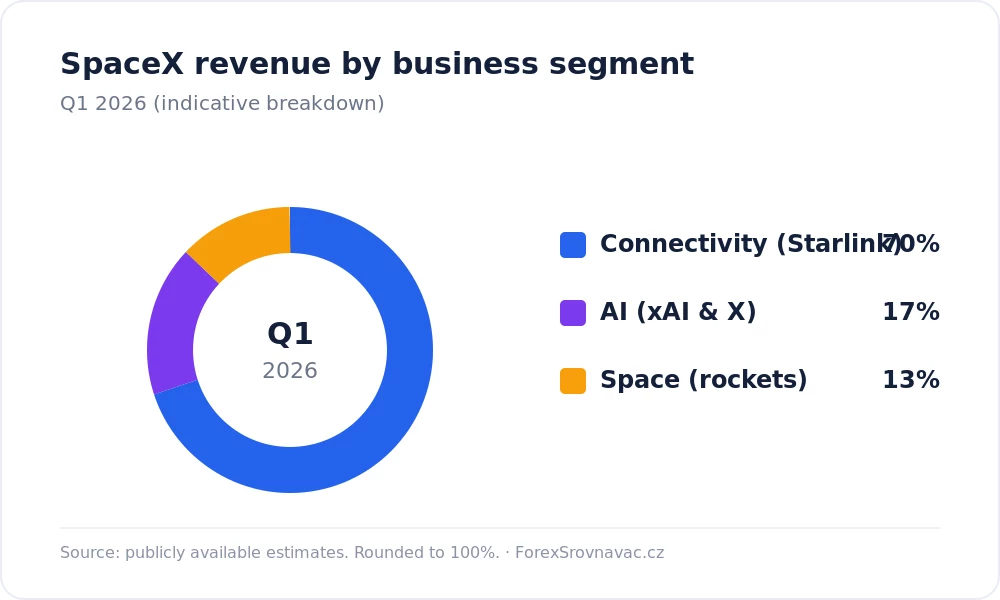
In its filings SpaceX now splits the business into three main categories: Connectivity (Starlink), Space (rockets) and AI (xAI and the social network X, following the February 2026 merger). Each pillar has different economics and a different risk profile — and right now each contributes to a combined loss.
Financially this is hard reading. For full-year 2025 SpaceX reported revenue of $18.674 billion, up 33% year on year, but a net loss of roughly $5 billion. The first quarter of 2026 is no cheerier: revenue of $4.7 billion and a loss of $4.3 billion. In other words, the company is going public at a valuation of about 95 times annual revenue while losing practically a dollar for every dollar it earns.
| Segment / period | Revenue | Profit / loss |
|---|---|---|
| Connectivity (Starlink) — Q1 2026 | $3.3B | −$1.2B |
| Space (rockets) — Q1 2026 | $619M (−28% YoY) | — |
| AI (xAI & X) — Q1 2026 | $818M (+12.5% YoY) | −$662M |
| Total Q1 2026 | $4.7B | −$4.3B |
| Total FY 2025 | $18.674B (+33%) | ≈ −$5B |
Connectivity (Starlink)
The largest segment and the main revenue engine. In Q1 2026 Connectivity generated $3.3 billion in revenue but lost $1.2 billion. Starlink operates in more than 150 countries and runs a constellation of roughly 10,000 satellites. Subscriber numbers keep climbing steadily, but the problem is ARPU — average revenue per user is falling because the company has to cut prices to sustain its growth trajectory.
Here lies the structural dilemma of the whole story. Starlink still isn’t cheap, and the wealthier part of the world is well served by cheaper, more stable terrestrial internet. It makes sense in developing countries and in remote corners of the developed world — but that is exactly where people have less money to spend on the service, or where there simply aren’t enough of them to keep growing exponentially. Rising subscriber volume alongside falling revenue per user is a tension the market has long underestimated.
Space (rockets)
The historic backbone, with falling revenue. The rocket segment posted $619 million of revenue in Q1 2026, a 28% year-on-year decline. The rockets launch payloads for Starlink itself and for government customers, and account for an estimated 80% of all material put into orbit. The paradox is that launch services are the least economically attractive but reputationally and strategically the most critical part of SpaceX.
What is genuinely interesting here is the vertical integration — SpaceX makes most of its components in-house and launches its own satellites. Over the long run, though, the whole segment (and indeed the satellite business) lives or dies on the success and scaling of Starship. That vehicle is not yet commercially operational, full reusability of the second stage has not been demonstrated, and Musk’s timelines have historically proved optimistic by a factor of 2–3×.
AI (xAI and X)
A new bet with an uncertain outcome. Following the February merger with xAI, artificial intelligence and the social network X form the third reported segment. In Q1 2026 it generated $818 million of revenue, up 12.5% year on year, but lost $662 million. This is an exceptionally capital-intensive race in which SpaceX faces the likes of Alphabet, Meta, Amazon, Microsoft and OpenAI. Competing with them will be extremely hard and costly — and here SpaceX has no proven track record.
The SpaceX–xAI merger
In February 2026 Elon Musk announced that SpaceX would absorb his AI startup xAI in a deal valuing the combined entity at $1.25 trillion. It was one of the largest mergers in history. Musk framed it as creating “the most ambitious, vertically integrated innovation engine on Earth and beyond” — an entity uniting rockets, satellite internet, AI models including the Grok chatbot, and the X platform under one roof.
This merger fundamentally changes the composition of what investors are buying at the IPO. It is no longer purely a space and telecoms company — it is a hybrid conglomerate that includes a highly capital-intensive AI business. The current $1.77 trillion valuation also assumes that the radio-spectrum transactions with EchoStar will close. EchoStar’s spectrum is key to the direct-to-cell service — the ability of phones to talk to satellites directly without ground towers, which opens Starlink a path into the world of mobile infrastructure.
The links between the companies in Musk’s ecosystem go further, creating an intricate web of mutual financial ties. Tesla owns just under 19 million SpaceX shares, and the xAI division bought hundreds of millions of dollars’ worth of Megapack battery systems from Tesla. The individual companies simply aren’t run as separate economic units, but as an interconnected whole subordinated to one owner’s central strategy. The synergies can be defended technologically; the financial risk, however, is borne primarily by SpaceX and therefore, ultimately, by its future public shareholders.
A competitive advantage, or merely temporary dominance?
There is a fundamental difference between a company with better technology and a company that is unstoppable. In the rocket business SpaceX has both — but not necessarily forever and not in every segment.
The technological moat lies primarily in vertical integration and iteration speed. Where traditional aerospace firms run sprawling supply chains with thousands of subcontractors, SpaceX makes most components in-house and operates in 12–24-month cycles versus 7–15 years at incumbents. Falcon 9 reusability is now a routine operation. That isn’t just a competitive edge; in launch services it is structural dominance.
The capital moat matters even more. Replicating SpaceX’s infrastructure — manufacturing capacity, Starlink’s global network of ground stations, a constellation of roughly 10,000 satellites — would take 10–15 years and tens of billions of dollars. Amazon is investing aggressively with Project Kuiper, but is at least 3–4 years behind.
This dominance in rockets and satellites does not, however, solve two things: that the company as a whole is deeply loss-making today, and that in AI it has no moat at all yet. For analytical completeness, three scenarios are worth weighing:
- Sustained-dominance scenario (estimated probability 45%): SpaceX keeps its lead thanks to Starship, extends Starlink into direct-to-cell and becomes a de-facto monopoly in orbital infrastructure, while the losses gradually turn into profit.
- Convergence scenario (40%): Amazon Kuiper, Chinese constellations and European projects gradually close the technology gap. SpaceX keeps the lead, but margins normalise under competitive pressure and the path to profitability lengthens.
- Disruption scenario (15%): An unexpected technological breakthrough or sustained losses in the AI segment damage SpaceX’s economics before Starship and Starlink become fully profitable.
An exceptionally ambitious vision. The roughly 300-page SpaceX registration document paints a dazzling future: space tourism, in-orbit manufacturing, transporting people and material to the Moon and Mars, space-based power generation and asteroid mining. The high point is the claim that the company has identified “the largest addressable market in the history of mankind” in AI, Starlink and space — worth $28.5 trillion, nearly the annual GDP of the entire United States. On paper it is breathtaking. From today’s reality it is miles away, and some parts don’t sound entirely logical. The company itself, after all, admits in its risk section that a substantial part of the plans rests on technologies that do not yet exist.
Assessing management
Any assessment of SpaceX must begin and end with Elon Musk. That is not a cliché — it is a structural reality. Musk is founder, CEO, chief engineer, largest shareholder and de-facto brand of the company in one person. After the IPO, thanks to the dual-class structure, he will control over 82% of the votes, so minority shareholders will have virtually no say over strategic decisions.
Musk’s vision is unquestionable in its boldness. When he founded SpaceX in 2002 with the goal of colonising Mars, the industry laughed at him. Today SpaceX dominates the global commercial-launch market and operates the largest satellite constellation in history. Execution discipline is, paradoxically, stronger than Musk’s public persona would suggest. Gwynne Shotwell, president and COO, is the quiet architect of operational excellence — her departure would be a material risk the market systematically underestimates.
There is, however, a tension that has not yet been tested. Musk has repeatedly stated that Mars is his real goal and that SpaceX exists primarily as a means to reach it. For private investors who share that vision, that is no problem. For public shareholders with a quarterly-results horizon — and a company currently losing billions — it can be a serious point of friction. Musk’s track record at Tesla suggests what to expect: sporadic communication, occasional controversial statements that move the share price, minimal interest in traditional investor relations, and a CEO’s attention diluted across six or seven companies at once.
Risk analysis: valuation, losses and regulation
The primary risk is one of valuation, amplified by current losses. At a $1.77 trillion valuation and revenue of around $18.7 billion, we are talking about a price-to-sales (P/S) multiple of roughly 95×. That is extreme even by the standards of the fastest-growing technology companies in history — and this is moreover a company that in the latest quarter lost almost as much as it earned in revenue. Traditional profit-based multiples (P/E, EV/EBITDA) cannot be applied meaningfully here, because both profit and EBITDA are currently negative.
The scenario nobody wants to hear: SpaceX lists at $1.77 trillion, meets most operational goals over the next five years — and yet the stock stagnates or falls, because flawless execution was already priced in at the IPO and the path to profitability turns out longer than the market hoped.
Secondary risks include:
- Path to profitability: Both Connectivity and AI are loss-making today, and the rocket segment is shrinking year on year. The market is pricing in future margins that have not yet been proven.
- Key-man risk: If Musk were unable to run SpaceX for any reason, the impact on the valuation could be a 30–50% immediate drop, because a substantial part of the premium is tied to his person.
- Regulatory risk: The FAA, FCC, EPA and SEC all have the power to significantly slow or limit operations. Environmental lawsuits, antitrust concerns and regulation of military satellite services are all real threats.
- Capital intensity: Starlink requires continuous constellation replacement (satellite lifespan 5–7 years), and developing Starship and AI infrastructure swallows tens of billions. Capex will stay high for many years.
- Geopolitical risk: Escalating international conflicts could limit Starlink’s global expansion and increase dependence on US government contracts.
Underappreciated risks include orbital debris (the Kessler syndrome), potential technological obsolescence of Starlink, and SpaceX’s unprecedented liability exposure as operator of the largest satellite constellation and the most active launch company in the world.
The investment thesis: bull and bear
The bull case rests on simple but powerful logic: SpaceX is building the physical internet of space — and whoever owns the infrastructure owns the future. Starlink revenue is growing, vertical integration is a real competitive advantage, and Starship, if it becomes fully operational, will fundamentally change the economics of orbital transport. Direct-to-cell, following the EchoStar deal, could materially expand the addressable market. From this perspective, the current losses are an investment in dominance, not a structural weakness.
The bear case is not that SpaceX is a bad company. It is that the price is high for public investors to achieve attractive returns — especially for a company that loses money today. At a P/S of around 95× and deep losses, the room for disappointment is enormous. The historical record is also a warning: the largest primary offerings in history have tended to come to market at the peak of the narrative cycle. The founder sells when the price is best, not when the opportunity is best for the new investor.
Structural problems for long-term investors:
- Musk’s control structure (over 82% of votes) means minority shareholders have minimal influence over strategic decisions, including potentially irrational capital allocation.
- SpaceX’s capital intensity is permanent, not temporary — unlike software firms, its capex will not fall once it reaches scale.
- Information asymmetry will be extreme after the IPO due to classified government contracts, the interconnected companies in Musk’s ecosystem and his personal approach to transparency.
Where the story diverges from the fundamentals
The media narrative around the IPO is predominantly bullish — almost unanimous enthusiasm, which from a contrarian standpoint is a warning sign. The secondary market, meanwhile, traded SpaceX shares both above and below $135 in the final week before the offering, showing that the market has not yet agreed on whether the IPO is priced expensively or cheaply. The fixed price of $135 is not a market-cleared value — the first day of trading on the Nasdaq will be the real price-discovery event.
Observers agree that SpaceX is technologically dominant in rockets and satellites. The sharp disagreement, however, is over valuation, losses and timing. Some argue for valuing it as a platform company; others insist it is still a hardware-intensive, capital-heavy business with physical constraints and a negative bottom line today.
The biggest mismatch between sentiment and fundamentals lies in the time horizon. Sentiment values SpaceX as a finished monopoly over the orbital economy of the future. The fundamentals say it is a company with revenue of around $18–19 billion that is currently losing billions and must clear enormous technological and regulatory hurdles over the next 5–10 years. Both can be true — but the price you pay for it will decide your return.
Conclusion: a strategic approach to a historic IPO
After analysing the business model, the financials, the competitive landscape, the risk profile, management and sentiment, we reach the following summary: the SpaceX IPO on 12 June 2026 at a $1.77 trillion valuation comes to market with a high probability of being overvalued because of narrative excess. Not because SpaceX is a bad company, but because the price reflects flawless execution of every ambitious plan over the next 5–10 years and a turnaround from today’s deep losses to high profitability, without adequately compensating for execution risk.
This assessment rests on three pillars:
- The valuation maths is demanding. At a P/S of around 95× and current losses, practically everything must go to plan. The market is pricing perfection; reality rarely delivers it.
- Structural asymmetry of information and control. Public investors will have systematically worse access to information than insiders, while the dual-class structure (over 82% of votes with Musk) denies them compensation in the form of control rights.
- The historical precedent of mega-IPOs. The largest primary offerings in history have tended to come to market at the peak of the narrative cycle.
Even so, there is a scenario — with an estimated probability of 25–30% — in which the $1.77 trillion valuation proves reasonable in hindsight. That scenario requires direct-to-cell services to expand the addressable market beyond current projections, Starship to reach full operational maturity, and the company to reach solid profitability within a few years. But investing on the basis of the most optimistic scenario is not investing — it is speculation.
Strategically, the following approach is worth considering: rather than buying at any price on day one, wait for the price discovery of the first 6–12 months after the IPO, where valuations have historically normalised once the initial euphoria fades. The flexibility to enter on a short-term price dislocation — caused by a technical failure, a regulatory problem or a Musk controversy — may represent the most attractive asymmetric opportunity.
Risk warning: This article is purely informational and educational and does not constitute investment advice, investment recommendation, or an offer or solicitation to buy or sell any financial instrument (including under the EU MiFID II framework). The author is not a financial adviser.
All financial figures (valuation, revenue, margins, scenario probabilities) are estimates drawn from publicly available sources and registration documents whose accuracy and completeness cannot be guaranteed and which may change at any time. Forward-looking figures are projections — actual developments may differ significantly.
Investing in shares, and especially in newly traded securities from a primary offering (IPO), is highly risky. After listing, a share price can be extremely volatile, far more volatile than established stocks, and may fall below the offer price. The value of an investment can go up as well as down, and an investor may lose part or all of the invested amount. Past or modelled performance is no guarantee of future returns.
Before any investment decision, consider your knowledge, experience, financial situation and investment objectives, and consult a qualified financial adviser where appropriate.