PVC price
PVC currently trades at US$732.24 per tonne (≈ €654.60 · £554.44) — 18.46% below the 12-month high. Over the past 12 months the price has gained 6.60%, with the annual range running from US$625.33 to US$898.02. In the past 24 hours the price has risen by 1.06%.

Invest in commodity ETFs from just $50
Gold, oil and even whole commodity sectors through ETFs, all in one account, kept simple.
eToro is a multi-asset investment platform. The value of your investments may go up or down. Your capital is at risk.
PVC chart
Interactive chart and 30-day overview
The PVC chart shows how the PVC price has moved over time. The interactive view lets you switch the timeframe (from 7 days up to MAX), the currency (USD / EUR / GBP) and overlay moving averages. Click any two points to measure the percentage change between those dates.
How is PVC priced?
PVC is priced per metric tonne (1 t = 1,000 kg) — the standard unit for industrial and bulk commodities on the London Metal Exchange (LME), CME and major European exchanges. Wholesale shipments move in containers or bulk vessels, typically in 25-tonne or 100-tonne lots.
At US$732.24 per tonne, one kilogram is worth US$0.7322. End-user pricing for processed goods includes refining margins, transport and tariffs on top of the wholesale benchmark.
What moves the price of PVC?
Construction demand is the main driver of the PVC market. Pipes, window profiles and exterior cladding together account for about two-thirds of global PVC consumption, so new housing, infrastructure projects and renovation cycles feed directly into resin prices. The Chinese property sector is especially important. China accounts for roughly 45% of global PVC capacity and consumption, so Beijing’s housing policy, developers’ financing conditions and local-government infrastructure spending are all important signals for prices on the Dalian Commodity Exchange.
Chlor-alkali economics are the second pillar of PVC margins. Producers run integrated ethylene, chlorine and sodium hydroxide units, so the profitability of a PVC plant depends not only on the selling price of the resin, but also on the caustic soda market and the internal transfer price of chlorine. Market participants often measure profitability using the ECU margin, or Electrochemical Unit margin, which reflects the combined margin available from chlorine and caustic soda. Electricity costs, especially in Europe, are also a direct price factor because chlor-alkali electrolysis is power-intensive.
The regulatory environment is the third structural factor. The EU’s REACH regulation and US regulators have introduced restrictions on DEHP, DINP and other phthalate-based plasticisers, especially in toys, medical devices and food-contact products. These changes push formulations towards bio-based plasticisers and phthalate-free alternatives such as DOTP and DINCH.
How to invest in PVC
There is no directly accessible retail CFD or ETF on PVC resin. Neither XTB nor eToro offers a PVC spot or futures product. Retail investors usually build market exposure through petrochemical equities: Westlake Corporation (WLK) is a US integrated chlorine and PVC producer; Shin-Etsu Chemical (4063.T) is the world’s largest PVC producer; Formosa Plastics (1301.TW) is based in Taiwan; and Mexico’s Orbia (ORBIA.MX) is also a significant producer. Diversified chemical groups such as Dow and LyondellBasell provide indirect exposure.
30-day price history
Chart and daily closing prices
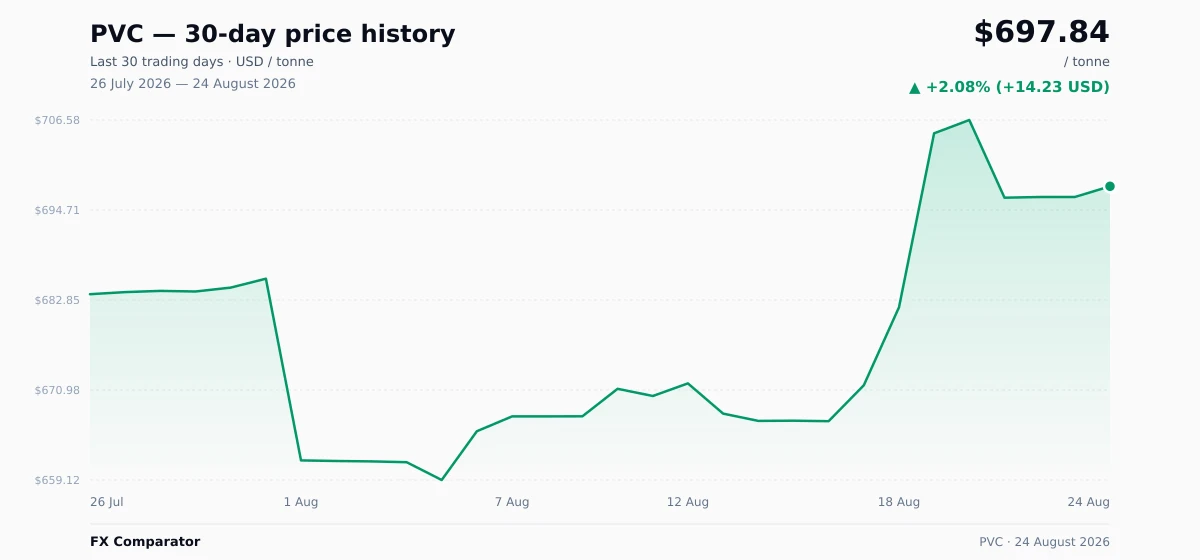
Download chart: WebP
Daily close
24 trading days
| Date | Price (USD) | Price (EUR) | Price (GBP) | Daily change |
|---|---|---|---|---|
| 8 Oct 2026 | US$732.24 | €654.60 | £554.44 | ▲ +1.06% |
| 7 Oct 2026 | US$724.54 | €647.72 | £548.61 | ▼ −0.01% |
| 5 Oct 2026 | US$724.55 | €647.73 | £548.62 | ▼ −0.01% |
| 2 Oct 2026 | US$724.59 | €647.77 | £548.65 | ▼ −1.04% |
| 1 Oct 2026 | US$732.20 | €654.56 | £554.40 | ▼ −0.01% |
| 30 Sept 2026 | US$732.25 | €654.61 | £554.45 | ▲ +2.67% |
| 29 Sept 2026 | US$713.20 | €637.58 | £540.02 | ▼ −0.49% |
| 28 Sept 2026 | US$716.75 | €640.75 | £542.70 | ▲ +0.43% |
| 27 Sept 2026 | US$713.67 | €638.00 | £540.38 | ▲ +0.04% |
| 26 Sept 2026 | US$713.36 | €637.72 | £540.14 | ▼ −0.01% |
| 25 Sept 2026 | US$713.42 | €637.78 | £540.19 | ▼ −0.03% |
| 24 Sept 2026 | US$713.65 | €637.98 | £540.36 | ▲ +0.23% |
| 23 Sept 2026 | US$711.98 | €636.49 | £539.10 | ▲ +0.41% |
| 21 Sept 2026 | US$709.07 | €633.89 | £536.89 | ▼ −2.40% |
| 20 Sept 2026 | US$726.52 | €649.49 | £550.11 | ▲ +0.01% |
| 18 Sept 2026 | US$726.44 | €649.41 | £550.04 | ▼ −0.32% |
| 17 Sept 2026 | US$728.74 | €651.47 | £551.79 | ▼ −1.01% |
| 16 Sept 2026 | US$736.19 | €658.13 | £557.43 | ▲ +0.01% |
| 15 Sept 2026 | US$736.15 | €658.09 | £557.40 | ▼ −1.31% |
| 14 Sept 2026 | US$745.94 | €666.85 | £564.81 | ▼ −1.68% |
| 13 Sept 2026 | US$758.67 | €678.23 | £574.45 | ▲ +0.05% |
| 11 Sept 2026 | US$758.30 | €677.90 | £574.17 | ▼ −0.17% |
| 10 Sept 2026 | US$759.58 | €679.04 | £575.14 | ▲ +0.30% |
| 9 Sept 2026 | US$757.34 | €677.04 | £573.44 | — |