Copper price
Copper currently trades at US$6.79 per pound (≈ €6.07 · £5.14) — close to the 12-month high. Over the past 12 months the price has gained 33.40%, with the annual range running from US$4.85 to US$6.93. In the past 24 hours the price has risen by 1.49%.

Invest in commodity ETFs from just $50
Gold, oil and even whole commodity sectors through ETFs, all in one account, kept simple.
eToro is a multi-asset investment platform. The value of your investments may go up or down. Your capital is at risk.
Copper chart
Interactive chart and 30-day overview
The Copper chart shows how the copper price has moved over time. The interactive view lets you switch the timeframe (from 7 days up to MAX), the currency (USD / EUR / GBP) and overlay moving averages. Click any two points to measure the percentage change between those dates.
How is copper priced?
What drives the copper price?
Copper is the most widely used raw material among industrial metals. About 50% of global copper consumption goes to China, where construction, power grids and electric-vehicle (EV) manufacturing are the main end-users. An electric car contains about 80 kg of copper, compared with roughly 20 kg in an internal-combustion car. The energy transition — EV adoption, renewable power and grid expansion — is a durable source of demand. Market jargon calls copper "Dr. Copper" because its price is one of the better gauges of the global industrial cycle.
On the supply side, Chilean and Peruvian mining dominate. Chile produces about 5.5 million tonnes a year, led by Codelco and BHP's Escondida. Peru produces about 2.4 million tonnes. Global mine output is roughly 22 million tonnes a year. Ore grades at major operating mines continue to decline. Average copper content has fallen below 0.5%, compared with more than 1% decades ago. That means more rock, more energy and higher unit costs for the same amount of metal, which structurally lifts the cost base.
In the short term, inventory levels move the price. Weekly warehouse data from the London Metal Exchange (LME), the Shanghai Futures Exchange (SHFE) and COMEX give a direct read on market tightness. Low inventories and strong Chinese demand data usually support prices. High warehouse stocks and weak manufacturing PMI readings tend to weigh on the market. The dollar and global real interest rates also affect copper, although less than they affect gold.
How to invest in copper
A European retail investor can get copper exposure in several ways. A copper CFD is the most direct form: a leveraged product based on the COMEX HG price that can be traded in both directions, but carries high risk. A copper miners ETF/ETP, such as a European UCITS-compliant copper mining fund, is one step removed from the underlying commodity and offers a diversified basket of mining companies. Among single stocks, market leader Freeport-McMoRan (FCX), Southern Copper (SCCO), Chile's Antofagasta and Switzerland's Glencore are among the most actively traded names. These stocks give operational leverage to the copper price. Physical copper is not common as a retail investment product because storage costs and the metal's low value per unit make it uneconomic.
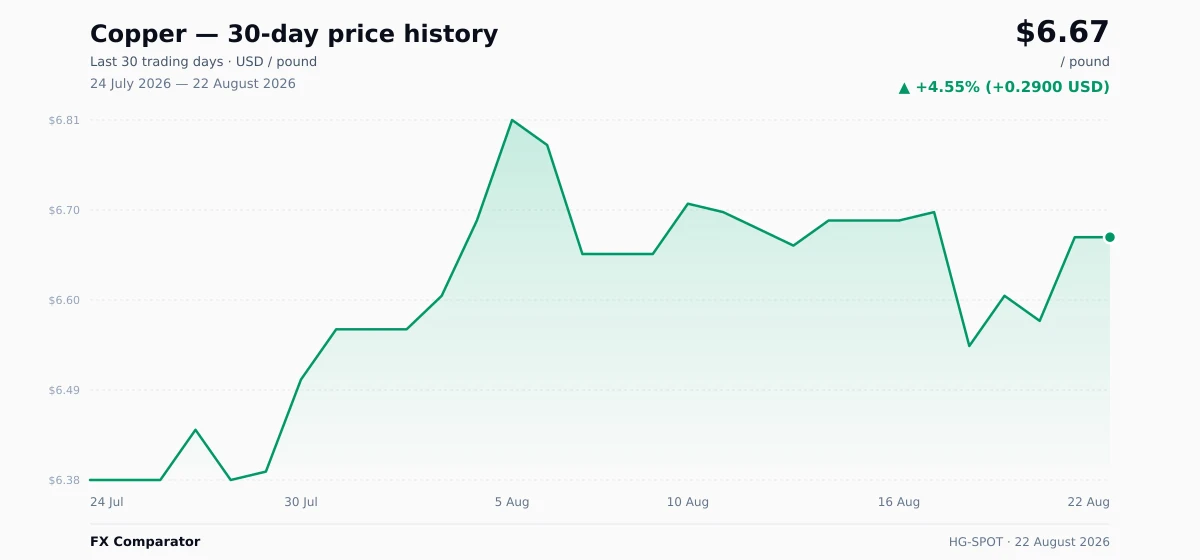
30-day price history
Chart and daily closing prices
Download chart: WebP
Daily close
21 trading days
| Date | Price (USD) | Price (EUR) | Price (GBP) | Daily change |
|---|---|---|---|---|
| 8 Oct 2026 | US$6.79 | €6.07 | £5.14 | ▲ +1.49% |
| 7 Oct 2026 | US$6.69 | €5.99 | £5.07 | ▼ −0.15% |
| 6 Oct 2026 | US$6.70 | €5.99 | £5.07 | ▲ +0.30% |
| 5 Oct 2026 | US$6.68 | €5.98 | £5.06 | ▲ +0.91% |
| 1 Oct 2026 | US$6.62 | €5.92 | £5.01 | ▼ −0.90% |
| 30 Sept 2026 | US$6.68 | €5.98 | £5.06 | ▼ −0.30% |
| 29 Sept 2026 | US$6.70 | €5.99 | £5.07 | ▲ +0.90% |
| 28 Sept 2026 | US$6.64 | €5.94 | £5.03 | ▼ −2.50% |
| 25 Sept 2026 | US$6.81 | €6.09 | £5.16 | ▲ +0.15% |
| 24 Sept 2026 | US$6.80 | €6.08 | £5.15 | ▼ −0.29% |
| 23 Sept 2026 | US$6.82 | €6.10 | £5.16 | ▼ −1.59% |
| 22 Sept 2026 | US$6.93 | €6.20 | £5.25 | ▲ +1.61% |
| 21 Sept 2026 | US$6.82 | €6.10 | £5.16 | ▲ +1.19% |
| 18 Sept 2026 | US$6.74 | €6.03 | £5.10 | ▲ +1.51% |
| 17 Sept 2026 | US$6.64 | €5.94 | £5.03 | ▲ +2.79% |
| 16 Sept 2026 | US$6.46 | €5.78 | £4.89 | ▼ −0.31% |
| 15 Sept 2026 | US$6.48 | €5.80 | £4.91 | ▲ +0.93% |
| 14 Sept 2026 | US$6.42 | €5.74 | £4.86 | ▼ −2.43% |
| 11 Sept 2026 | US$6.58 | €5.89 | £4.98 | ▲ +0.61% |
| 10 Sept 2026 | US$6.54 | €5.85 | £4.95 | ▼ −4.80% |
| 9 Sept 2026 | US$6.87 | €6.15 | £5.20 | — |