Zinc price
Zinc currently trades at US$3,810 per tonne (≈ €3,409 · £2,885) — close to the 12-month high. Over the past 12 months the price has gained 26.01%, with the annual range running from US$2,912 to US$4,037. In the past 24 hours the price has risen by 1.23%.


Invest in commodity ETFs from just $50
Gold, oil and even whole commodity sectors through ETFs, all in one account, kept simple.
eToro is a multi-asset investment platform. The value of your investments may go up or down. Your capital is at risk.
Zinc chart
Interactive chart and 30-day overview
The Zinc chart shows how the zinc price has moved over time. The interactive view lets you switch the timeframe (from 7 days up to MAX), the currency (USD / EUR / GBP) and overlay moving averages. Click any two points to measure the percentage change between those dates.
How is zinc priced?
Zinc is priced per metric tonne (1 t = 1,000 kg) — the standard unit for industrial and bulk commodities on the London Metal Exchange (LME), CME and major European exchanges. Wholesale shipments move in containers or bulk vessels, typically in 25-tonne or 100-tonne lots.
At US$3,810 per tonne, one kilogram is worth US$3.81. End-user pricing for processed goods includes refining margins, transport and tariffs on top of the wholesale benchmark.
What drives the price of zinc?
A dominant share of zinc demand comes from galvanised steel: about 60% of global zinc use goes into galvanising for corrosion protection. In hot-dip galvanising, steel sheet is immersed in a 450 °C bath of molten zinc. The coating then solidifies and protects the steel from rust for decades. Cyclical activity in construction, including roofing, frames and windows, the car industry, including body panels, and infrastructure, including guardrails, power-line pylons and pipelines, therefore feeds directly into LME zinc prices. Secondary uses include brass alloys at about 15%, die-cast products at about 15%, including automotive parts, locks and handles, and zinc-oxide-based chemicals.
On the supply side, there are two separate stages: mine production and smelter refining. Global mine output is about 13 million tonnes a year. China alone produces about 4.2 million tonnes, Peru about 1.4 million tonnes and Australia about 1.3 million tonnes, followed by India, the US, Mexico and Bolivia. Refining is far more geographically concentrated, with a large share of smelter capacity in China. The economic balance between mines and smelters is reflected in the treatment charge (TC) and refining charge (RC): the fee a mine pays a smelter to process concentrate. A high TC points to ample concentrate supply and strong smelter pricing power. A low TC signals tight mine supply.
The most direct gauge of market tightness is exchange warehouse inventory. Zinc stocks held in LME and SHFE warehouses give a daily snapshot of the physical supply-demand balance. Inventories equal to only a few days of global consumption signal a tight market and can put a lasting premium into spot prices. Zinc is also sensitive to the Chinese construction cycle, including credit activity in the property sector and infrastructure investment, global steel output and the strength of the US dollar. A geopolitical risk premium can appear if major mine capacity is disrupted, for example by a strike, flooding or a regulatory shutdown at a large Peruvian or Australian operation.
How to invest in zinc
A European retail investor can obtain zinc exposure in several ways. A zinc CFD is the most direct route: a leveraged product linked to the LME Zinc price, tradable in both directions, but with high risk. A pure zinc ETF is not available on the market; industrial metals basket ETFs, such as DBB — Invesco DB Base Metals Fund, include partial zinc exposure. Among individual shares, Switzerland-based Glencore (GLEN.L) is one of the world’s largest integrated zinc producers, Canada’s Teck Resources (TECK) is a major zinc miner through the Red Dog mine in Alaska, while Belgium’s Nyrstar and Sweden’s Boliden are also important smelting companies. Pure-play zinc stocks are rare. Most producers are diversified mining companies. Physical zinc is not common as a retail investment because of its low value per unit.
30-day price history
Chart and daily closing prices
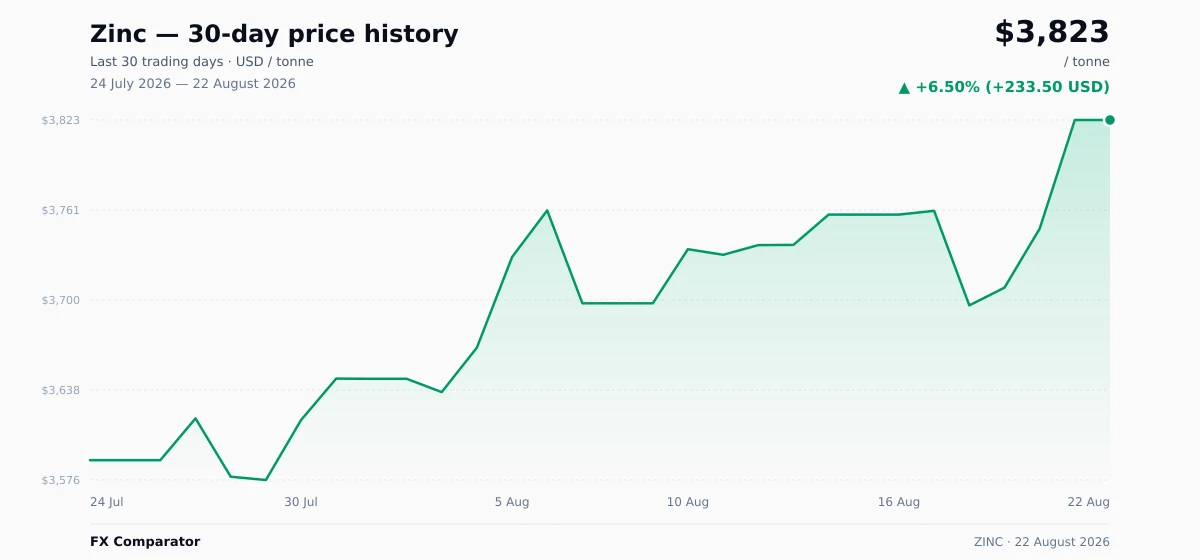
Download chart: WebP
Daily close
23 trading days
| Date | Price (USD) | Price (EUR) | Price (GBP) | Daily change |
|---|---|---|---|---|
| 8 Oct 2026 | US$3,810 | €3,409 | £2,885 | ▲ +1.23% |
| 7 Oct 2026 | US$3,764 | €3,367 | £2,850 | ▼ −0.21% |
| 6 Oct 2026 | US$3,771 | €3,374 | £2,856 | ▲ +0.78% |
| 5 Oct 2026 | US$3,742 | €3,348 | £2,834 | ▲ +1.19% |
| 2 Oct 2026 | US$3,698 | €3,309 | £2,801 | ▼ −0.75% |
| 1 Oct 2026 | US$3,726 | €3,334 | £2,822 | ▼ −2.63% |
| 30 Sept 2026 | US$3,827 | €3,424 | £2,898 | ▼ −0.99% |
| 29 Sept 2026 | US$3,865 | €3,458 | £2,927 | ▲ +0.14% |
| 28 Sept 2026 | US$3,860 | €3,453 | £2,923 | ▼ −1.18% |
| 26 Sept 2026 | US$3,906 | €3,495 | £2,958 | ▲ +0.04% |
| 25 Sept 2026 | US$3,904 | €3,493 | £2,957 | ▼ −1.82% |
| 24 Sept 2026 | US$3,977 | €3,558 | £3,011 | ▲ +1.96% |
| 23 Sept 2026 | US$3,900 | €3,489 | £2,954 | ▼ −0.26% |
| 22 Sept 2026 | US$3,910 | €3,499 | £2,961 | ▼ −0.63% |
| 21 Sept 2026 | US$3,935 | €3,521 | £2,980 | ▲ +0.04% |
| 18 Sept 2026 | US$3,934 | €3,520 | £2,979 | ▲ +1.16% |
| 17 Sept 2026 | US$3,889 | €3,479 | £2,945 | ▲ +2.03% |
| 16 Sept 2026 | US$3,811 | €3,410 | £2,886 | ▼ −0.24% |
| 15 Sept 2026 | US$3,820 | €3,418 | £2,893 | ▲ +0.45% |
| 14 Sept 2026 | US$3,803 | €3,403 | £2,880 | ▼ −1.62% |
| 11 Sept 2026 | US$3,866 | €3,458 | £2,927 | ▼ −0.28% |
| 10 Sept 2026 | US$3,876 | €3,468 | £2,936 | ▼ −3.99% |
| 9 Sept 2026 | US$4,037 | €3,612 | £3,058 | — |