Aluminium price
Aluminium currently trades at US$3,138 per tonne (≈ €2,808 · £2,377) — close to the 12-month high. 24-hour movement is minimal (±0.08%).

Invest in commodity ETFs from just $50
Gold, oil and even whole commodity sectors through ETFs, all in one account, kept simple.
eToro is a multi-asset investment platform. The value of your investments may go up or down. Your capital is at risk.
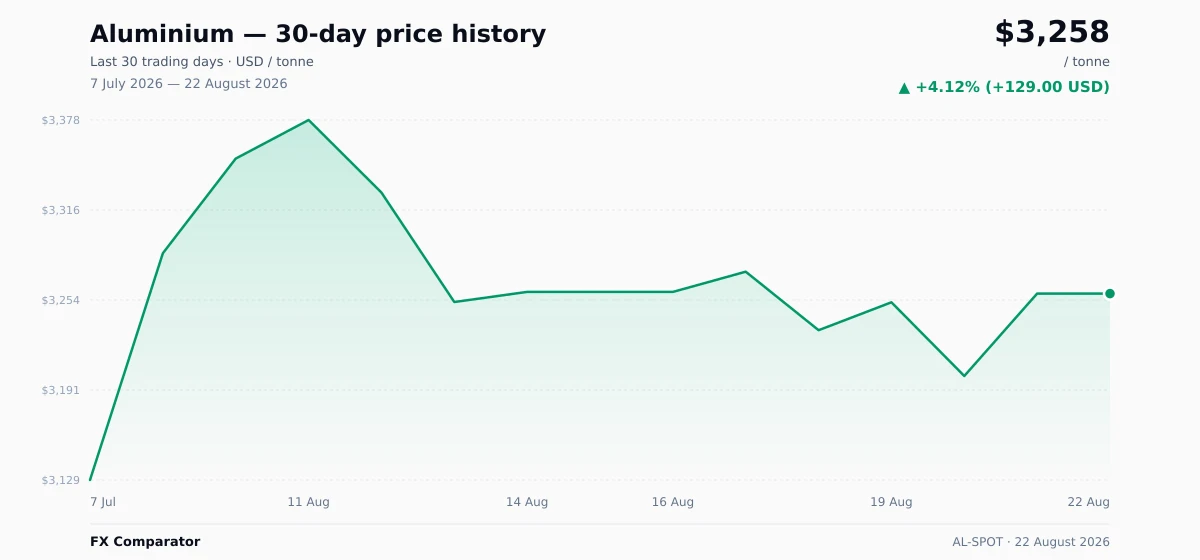
Aluminium chart
Interactive chart and 30-day overview
The Aluminium chart shows how the aluminium price has moved over time. The interactive view lets you switch the timeframe (from 7 days up to MAX), the currency (USD / EUR / GBP) and overlay moving averages. Click any two points to measure the percentage change between those dates.
How is aluminium priced?
Aluminium is priced per metric tonne (1 t = 1,000 kg) — the standard unit for industrial and bulk commodities on the London Metal Exchange (LME), CME and major European exchanges. Wholesale shipments move in containers or bulk vessels, typically in 25-tonne or 100-tonne lots.
At US$3,138 per tonne, one kilogram is worth US$3.14. End-user pricing for processed goods includes refining margins, transport and tariffs on top of the wholesale benchmark.
What drives the price of aluminium?
The aluminium price is almost directly tied to the price of electricity. Hall–Héroult electrolysis uses about 14 MWh of power to produce one tonne of primary aluminium, making it one of the most energy-intensive metallurgical processes in global industry. Energy accounts for 30–40% of a smelter’s per-tonne production cost. Chinese coal-fired capacity, Canadian and Norwegian hydro power, and European gas and power prices therefore feed directly into LME pricing. European smelters such as Aldel and Slovalco shut down during the European energy crisis because they could not absorb the cost of electricity.
The supply side is dominated by China. Of the world’s roughly 70 million tonnes of annual primary aluminium output, about 40 million tonnes comes from China, or around 58%, mainly from Shandong, Xinjiang and Yunnan provinces. India at about 4 Mt, Russia at about 3.7 Mt through Rusal, the largest producer outside China, Canada at about 3.2 Mt and the United Arab Emirates through EGA at about 2.7 Mt are the other major producers. Sanctions, trade restrictions and LME warrant bans affecting Russian aluminium have built a lasting supply premium into the market. Bauxite mining is led by Australia, Guinea and China.
On the demand side, aluminium use is clearly split by sector: construction ~25% for façade panels, windows, doors and roofing; transport ~25% for lightweight vehicles, aircraft and rail bodies; packaging ~15% for beverage cans and foil; and electrical equipment ~12% for cables and transformers. The rest goes into machinery, durable consumer goods and other uses. The shift to EVs and the expansion of renewable-energy grids structurally increase the share used by the automotive and cable industries. Secondary aluminium needs only about ~5% of the energy required for primary aluminium, so a higher recycling rate, currently around ~33%, also affects smelters’ pricing power.
How to invest in aluminium
European retail investors can get exposure to aluminium in several ways. An aluminium CFD is the most direct route: a leveraged product based on the LME spot price that can be traded in both directions, but carries high risk. The JJU ETN (iPath Series B Bloomberg Aluminum Subindex Total Return) is one step removed from the underlying commodity and offers an exchange-traded note format. Among single stocks, the main names include US-listed Alcoa (AA), an integrated bauxite, alumina and primary aluminium producer; Anglo-Australian Rio Tinto, which owns Canadian hydro-powered smelters; Norway’s Norsk Hydro (NHY), focused on downstream and lower-carbon aluminium; and Russia’s Rusal, which carries sanctions risk. Physical aluminium is not common as a retail investment because storage costs and the metal’s low value density make it uneconomic.
30-day price history
Chart and daily closing prices
Download chart: WebP
Daily close
22 trading days
| Date | Price (USD) | Price (EUR) | Price (GBP) | Daily change |
|---|---|---|---|---|
| 8 Oct 2026 | US$3,138 | €2,808 | £2,377 | ▲ +0.08% |
| 7 Oct 2026 | US$3,136 | €2,805 | £2,375 | ▼ −0.70% |
| 6 Oct 2026 | US$3,158 | €2,825 | £2,391 | ▲ +0.65% |
| 5 Oct 2026 | US$3,137 | €2,807 | £2,376 | ▲ +0.82% |
| 2 Oct 2026 | US$3,112 | €2,784 | £2,357 | ▼ −0.71% |
| 1 Oct 2026 | US$3,134 | €2,804 | £2,373 | ▼ −1.64% |
| 30 Sept 2026 | US$3,186 | €2,851 | £2,413 | ▼ −1.29% |
| 29 Sept 2026 | US$3,228 | €2,888 | £2,444 | ▼ −1.11% |
| 28 Sept 2026 | US$3,264 | €2,920 | £2,472 | ▼ −0.86% |
| 25 Sept 2026 | US$3,292 | €2,945 | £2,493 | ▲ +0.76% |
| 24 Sept 2026 | US$3,268 | €2,923 | £2,475 | ▲ +0.07% |
| 23 Sept 2026 | US$3,265 | €2,921 | £2,473 | ▼ −0.31% |
| 22 Sept 2026 | US$3,275 | €2,930 | £2,480 | ▼ −0.07% |
| 21 Sept 2026 | US$3,278 | €2,932 | £2,482 | ▼ −1.10% |
| 18 Sept 2026 | US$3,314 | €2,965 | £2,510 | ▲ +0.32% |
| 17 Sept 2026 | US$3,304 | €2,956 | £2,502 | ▲ +0.48% |
| 16 Sept 2026 | US$3,288 | €2,941 | £2,490 | ▲ +0.56% |
| 15 Sept 2026 | US$3,270 | €2,925 | £2,476 | ▲ +0.14% |
| 14 Sept 2026 | US$3,265 | €2,921 | £2,473 | ▼ −0.23% |
| 11 Sept 2026 | US$3,273 | €2,928 | £2,478 | ▼ −0.51% |
| 10 Sept 2026 | US$3,289 | €2,943 | £2,491 | ▼ −2.55% |
| 9 Sept 2026 | US$3,375 | €3,020 | £2,556 | — |