Nickel price
Nickel currently trades at US$15,681 per tonne (≈ €14,029 · £11,875) — 20.20% below the 12-month high. Over the past 12 months the price has gained 1.41%, with the annual range running from US$14,223 to US$19,649. In the past 24 hours the price has fallen by 0.31%.


Invest in commodity ETFs from just $50
Gold, oil and even whole commodity sectors through ETFs, all in one account, kept simple.
eToro is a multi-asset investment platform. The value of your investments may go up or down. Your capital is at risk.
Nickel chart
Interactive chart and 30-day overview
The Nickel chart shows how the nickel price has moved over time. The interactive view lets you switch the timeframe (from 7 days up to MAX), the currency (USD / EUR / GBP) and overlay moving averages. Click any two points to measure the percentage change between those dates.
How is nickel priced?
Nickel is priced per metric tonne (1 t = 1,000 kg) — the standard unit for industrial and bulk commodities on the London Metal Exchange (LME), CME and major European exchanges. Wholesale shipments move in containers or bulk vessels, typically in 25-tonne or 100-tonne lots.
At US$15,681 per tonne, one kilogram is worth US$15.68. End-user pricing for processed goods includes refining margins, transport and tariffs on top of the wholesale benchmark.
What drives the price of nickel?
Global nickel supply is unusually concentrated: Indonesia alone accounts for about 50% of annual mine production — roughly 1.8 million tonnes out of a global ~3.6 million tonnes. The Philippines (~0.4 Mt), Russia (~0.2 Mt, mainly Norilsk Nickel) and New Caledonia are the next major producers. Indonesia has banned exports of unprocessed nickel ore to keep more value in local smelting and refining capacity. The policy has drawn Chinese capital (Tsingshan, CATL) and Korean investment (LG, POSCO) into Sulawesi and Halmahera, reshaping the global supply map.
On the demand side, stainless steel dominates. About 65% of global nickel use goes into stainless steel, mainly 300-series austenitic grades. The second major segment is electric-vehicle batteries. An EV with an NMC (nickel-manganese-cobalt) or NCA (nickel-cobalt-aluminium) cathode contains about 30 kg of nickel; higher-nickel NMC 811 chemistry can use as much as 50 kg. Battery demand is therefore one of the main uncertainties for the nickel market. The spread of LFP (lithium iron phosphate) cells — especially in entry-level and Chinese models — works in the opposite direction, as they contain no nickel.
The market is split into two effectively separate segments. Class 1 nickel (≥99.8% purity, cathode nickel and briquettes) is deliverable on the LME and is typically used to make battery precursor material, such as nickel sulphate. Class 2 nickel — mainly Indonesian ferronickel (FeNi) and nickel pig iron (NPI, 4–15% nickel content) — is produced from laterite ore at lower cost and is suitable only for stainless-steel production. A persistent price premium exists for Class 1 material; the LME price refers to Class 1 nickel. Indonesia’s HPAL (High Pressure Acid Leach) production of MHP (mixed hydroxide precipitate) partly bridges the two categories, but remains controversial because of its higher energy and chemical intensity.
How to invest in nickel
European retail investors can get nickel exposure in several ways. A nickel CFD is the most direct route — a leveraged product based on the LME Nickel price, allowing long or short positions, but with high risk. Pure nickel ETFs are largely absent from the market; the Amplify Lithium & Battery Technology ETF (BATT) and similar battery-metals baskets offer partial nickel exposure. Among individual shares, Brazil’s Vale (VALE) is the largest Western nickel producer, Russia’s Norilsk Nickel is currently subject to sanctions, while BHP (BHP), with Australian nickel assets, and Japan’s Sumitomo Metal Mining are other significant names. Physical nickel is not common as a retail investment because of its low value density and high storage costs.
30-day price history
Chart and daily closing prices
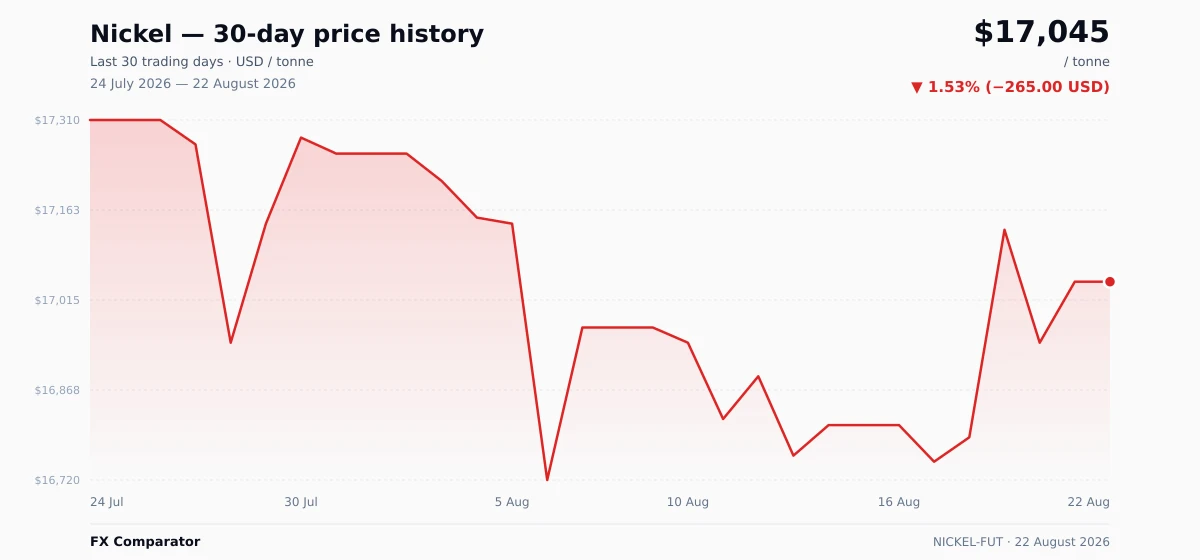
Download chart: WebP
Daily close
24 trading days
| Date | Price (USD) | Price (EUR) | Price (GBP) | Daily change |
|---|---|---|---|---|
| 8 Oct 2026 | US$15,681 | €14,029 | £11,875 | ▼ −0.31% |
| 7 Oct 2026 | US$15,730 | €14,073 | £11,912 | ▲ +0.38% |
| 6 Oct 2026 | US$15,670 | €14,020 | £11,867 | ▲ +0.16% |
| 5 Oct 2026 | US$15,645 | €13,997 | £11,848 | ▲ +0.74% |
| 2 Oct 2026 | US$15,530 | €13,895 | £11,761 | ▼ −0.51% |
| 1 Oct 2026 | US$15,610 | €13,966 | £11,822 | ▼ −1.95% |
| 30 Sept 2026 | US$15,920 | €14,243 | £12,056 | ▼ −0.41% |
| 29 Sept 2026 | US$15,985 | €14,302 | £12,106 | ▼ −1.11% |
| 28 Sept 2026 | US$16,165 | €14,463 | £12,242 | ▼ −1.34% |
| 27 Sept 2026 | US$16,385 | €14,659 | £12,409 | ▲ +0.15% |
| 26 Sept 2026 | US$16,360 | €14,637 | £12,389 | ▼ −0.15% |
| 25 Sept 2026 | US$16,385 | €14,659 | £12,409 | ▼ −0.88% |
| 24 Sept 2026 | US$16,530 | €14,789 | £12,518 | ▲ +0.30% |
| 23 Sept 2026 | US$16,480 | €14,744 | £12,480 | ▼ −0.51% |
| 22 Sept 2026 | US$16,565 | €14,821 | £12,545 | ▲ +1.10% |
| 21 Sept 2026 | US$16,385 | €14,659 | £12,409 | ▲ +0.92% |
| 18 Sept 2026 | US$16,235 | €14,525 | £12,295 | ▼ −0.18% |
| 17 Sept 2026 | US$16,265 | €14,552 | £12,318 | ▲ +0.71% |
| 16 Sept 2026 | US$16,150 | €14,449 | £12,231 | ▲ +1.32% |
| 15 Sept 2026 | US$15,940 | €14,261 | £12,072 | ▼ −3.04% |
| 14 Sept 2026 | US$16,440 | €14,709 | £12,450 | ▼ −0.51% |
| 11 Sept 2026 | US$16,525 | €14,785 | £12,515 | ▼ −0.60% |
| 10 Sept 2026 | US$16,625 | €14,874 | £12,590 | ▼ −1.48% |
| 9 Sept 2026 | US$16,875 | €15,098 | £12,780 | — |