WTI oil price
WTI oil currently trades at US$92.44 per barrel (≈ €82.64 · £69.99) — 20.10% below the 12-month high. Over the past 12 months the price has gained 48.81%, with the annual range running from US$55.61 to US$115.69. In the past 24 hours the price has sharply, risen by 4.51%.


Invest in commodity ETFs from just $50
Gold, oil and even whole commodity sectors through ETFs, all in one account, kept simple.
eToro is a multi-asset investment platform. The value of your investments may go up or down. Your capital is at risk.
WTI oil chart
Interactive chart and 30-day overview
The WTI oil chart shows how the WTI oil price has moved over time. The interactive view lets you switch the timeframe (from 7 days up to MAX), the currency (USD / EUR / GBP) and overlay moving averages. Click any two points to measure the percentage change between those dates.
How is WTI oil priced?
WTI oil is priced by the barrel (1 Bbl = 158.987 litres / 42 US gallons). The unit dates back to the 1860s Pennsylvania oil rush, when 42-gallon whiskey casks were repurposed for crude oil transport. It remains the industry standard for ICE Futures Europe (Brent) and NYMEX (WTI) futures contracts.
At US$92.44 per barrel, one litre of crude wholesales for roughly US$0.5814. Retail fuel prices at the pump are much higher because of refining margins, distribution costs and excise duty + VAT, which together make up a large share of the consumer price across the EU and UK.
What drives the WTI oil price?
WTI is driven above all by the supply flexibility of the US shale sector. Producers in the Permian Basin in Texas, the Bakken in North Dakota and Eagle Ford respond to the Baker Hughes Rig Count and the price level of hedging positions by raising or slowing output. The investment cycle typically stalls around a threshold of $50–$60 a barrel.
The Cushing storage level is the main short-term signal. The WTI contract is physically delivered to the Oklahoma hub. If the roughly 76 million-barrel capacity is more than 80% full, the prompt contract usually falls sharply relative to later months. Seasonal swings in refinery utilisation — the summer driving peak and winter maintenance — are also priced through weekly EIA data.
The Brent-WTI spread normally trades at $2–$5 in favour of Brent, but can widen above $10 during transport bottlenecks, including constraints on Cushing-Gulf pipelines and export terminal capacity. At the global level, OPEC+ quota discipline, the dollar index (DXY) and Chinese manufacturing demand set the longer-term framework. These are tracked in the OPEC Monthly Oil Market Report (MOMR) and the IEA Oil Market Report.
How to invest in WTI oil
Most retail investors do not hold crude oil physically. They track it through derivatives or ETFs. Brokers available to European and UK clients commonly offer CFDs on WTI, often under names such as OIL.WTI or USOIL, as well as access to oil ETFs listed in New York where permitted and shares in integrated oil companies.
30-day price history
Chart and daily closing prices
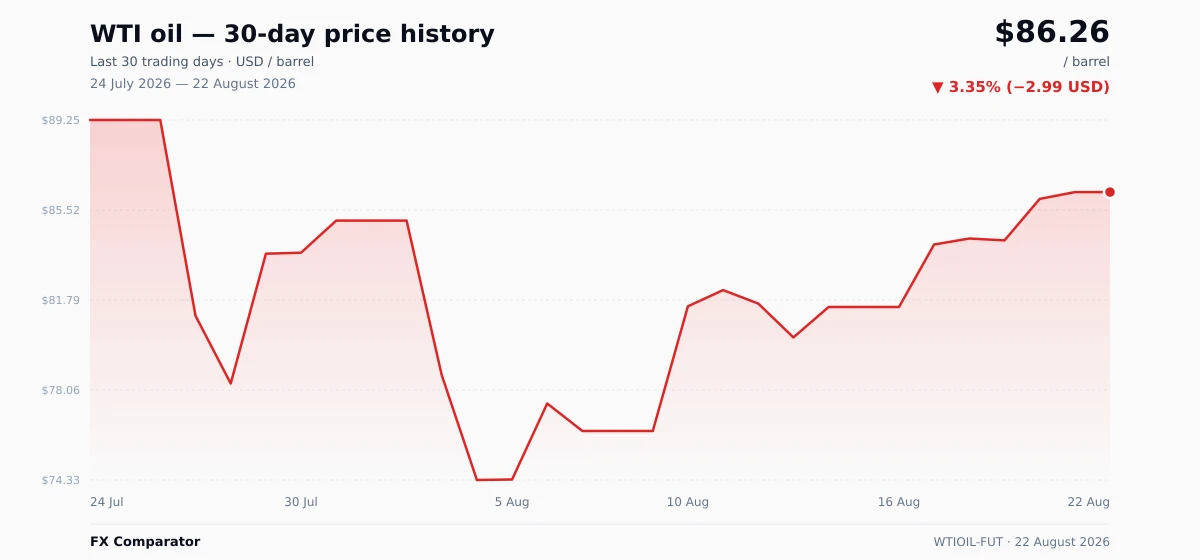
Download chart: WebP
Daily close
22 trading days
| Date | Price (USD) | Price (EUR) | Price (GBP) | Daily change |
|---|---|---|---|---|
| 8 Oct 2026 | US$92.44 | €82.64 | £69.99 | ▲ +4.51% |
| 7 Oct 2026 | US$88.45 | €79.07 | £66.97 | ▼ −0.91% |
| 6 Oct 2026 | US$89.26 | €79.80 | £67.59 | ▲ +0.79% |
| 5 Oct 2026 | US$88.56 | €79.17 | £67.06 | ▼ −1.94% |
| 2 Oct 2026 | US$90.31 | €80.73 | £68.38 | ▼ −1.80% |
| 1 Oct 2026 | US$91.97 | €82.22 | £69.64 | ▲ +2.76% |
| 30 Sept 2026 | US$89.50 | €80.01 | £67.77 | ▲ +1.57% |
| 29 Sept 2026 | US$88.12 | €78.78 | £66.72 | ▼ −4.29% |
| 28 Sept 2026 | US$92.07 | €82.31 | £69.71 | ▲ +0.84% |
| 25 Sept 2026 | US$91.30 | €81.62 | £69.13 | ▼ −2.87% |
| 24 Sept 2026 | US$94.00 | €84.03 | £71.17 | ▲ +1.90% |
| 23 Sept 2026 | US$92.25 | €82.47 | £69.85 | ▲ +3.04% |
| 22 Sept 2026 | US$89.53 | €80.04 | £67.79 | ▼ −2.31% |
| 21 Sept 2026 | US$91.65 | €81.93 | £69.40 | ▼ −3.75% |
| 18 Sept 2026 | US$95.22 | €85.12 | £72.10 | ▼ −1.40% |
| 17 Sept 2026 | US$96.57 | €86.33 | £73.12 | ▼ −0.87% |
| 16 Sept 2026 | US$97.42 | €87.09 | £73.76 | ▼ −3.43% |
| 15 Sept 2026 | US$100.88 | €90.18 | £76.38 | ▲ +2.77% |
| 14 Sept 2026 | US$98.16 | €87.75 | £74.32 | ▲ +1.69% |
| 11 Sept 2026 | US$96.53 | €86.29 | £73.09 | ▼ −4.29% |
| 10 Sept 2026 | US$100.86 | €90.17 | £76.37 | ▲ +6.88% |
| 9 Sept 2026 | US$94.37 | €84.36 | £71.46 | — |