Brent oil price
Brent oil currently trades at US$104.63 per barrel (≈ €93.54 · £79.22) — close to the 12-month high. Over the past 12 months the price has gained 58.79%, with the annual range running from US$58.59 to US$116.20. In the past 24 hours the price has sharply, risen by 4.43%.


Invest in commodity ETFs from just $50
Gold, oil and even whole commodity sectors through ETFs, all in one account, kept simple.
eToro is a multi-asset investment platform. The value of your investments may go up or down. Your capital is at risk.
Brent oil chart
Interactive chart and 30-day overview
The Brent oil chart shows how the Brent oil price has moved over time. The interactive view lets you switch the timeframe (from 7 days up to MAX), the currency (USD / EUR / GBP) and overlay moving averages. Click any two points to measure the percentage change between those dates.
How is Brent oil priced?
Brent oil is priced by the barrel (1 Bbl = 158.987 litres / 42 US gallons). The unit dates back to the 1860s Pennsylvania oil rush, when 42-gallon whiskey casks were repurposed for crude oil transport. It remains the industry standard for ICE Futures Europe (Brent) and NYMEX (WTI) futures contracts.
At US$104.63 per barrel, one litre of crude wholesales for roughly US$0.6581. Retail fuel prices at the pump are much higher because of refining margins, distribution costs and excise duty + VAT, which together make up a large share of the consumer price across the EU and UK.
What drives the Brent oil price?
The Brent price reflects the balance between global oil demand and supply. World oil consumption is roughly 100 million barrels per day (mbpd). About 60% is used in transport (road, aviation and shipping), with the rest going into petrochemicals (plastics and fertilisers), heating and thermal power generation. Supply is split into two large blocs. OPEC+ (OPEC members plus Russia, Mexico and other allies) accounts for about 40% of global supply and manages the market through production quotas — cuts tend to support prices, while higher output tends to weigh on them. The other bloc is non-OPEC supply, including US shale oil, which tends to become economic around USD 50–60 a barrel and can respond flexibly to price levels.
A geopolitical premium is also priced in. Brent is sensitive to events that affect the security of maritime shipping routes. Around 17–20 million barrels a day pass through the Strait of Hormuz, while Bab-el-Mandeb and the Suez Canal are also critical chokepoints. Western sanctions on Russia, restrictions on Iranian exports, Middle East conflicts and sanctions on Venezuela can all move marginal supply. Brent usually trades at a USD 2–5 premium to WTI because seaborne delivery gives it access to a broader market, while WTI is tied to inland US pipeline logistics.
The third macro factor is the strength of the dollar and inventory levels. Brent is priced in dollars, so a stronger dollar makes oil imports more expensive for non-dollar economies, which can curb demand and pressure prices. EIA weekly inventory data on US crude and product stocks, as well as strategic petroleum reserves (SPR) in OECD countries, also move short-term prices. A larger-than-expected inventory build tends to push prices lower; a larger-than-expected draw tends to support them.
How to invest in Brent oil
European retail investors can get Brent exposure in several ways. The most common is a Brent CFD — direct price speculation with leverage, a high-risk product mainly used for shorter-term positions. For longer horizons, oil ETFs and ETCs are available: European Brent ETCs such as WisdomTree Brent Crude Oil (BRNT) provide Brent exposure through futures contracts, but their returns can differ from the spot price because of the shape of the forward curve (contango or backwardation). A third route is through oil-company shares — Shell, BP, ExxonMobil, Chevron and TotalEnergies. These companies may pay dividends and reflect the economics of the whole value chain, including production, refining and retail, not only the crude price.
30-day price history
Chart and daily closing prices
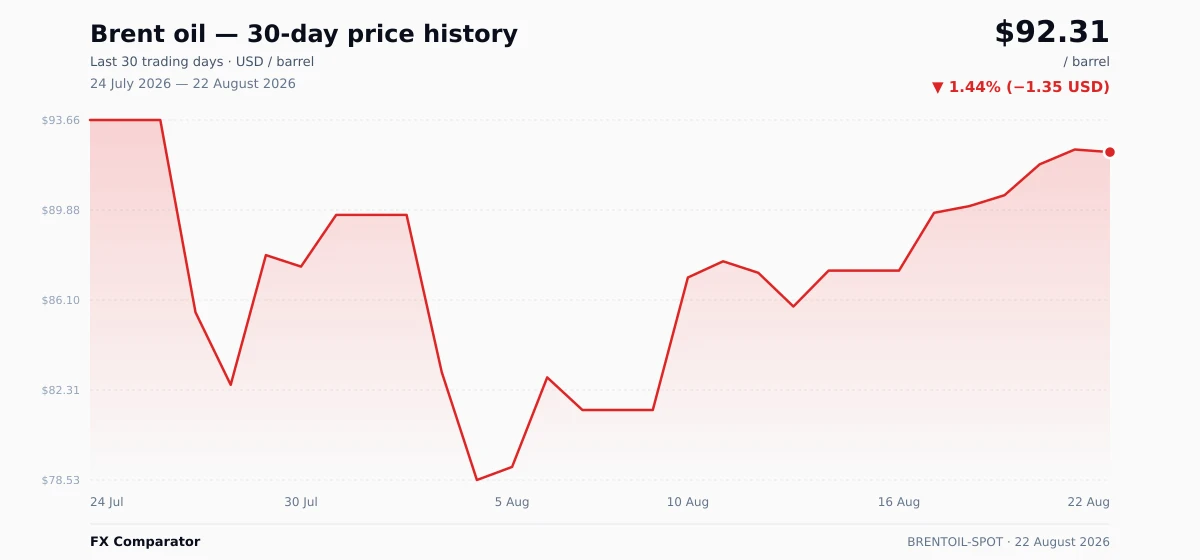
Download chart: WebP
Daily close
26 trading days
| Date | Price (USD) | Price (EUR) | Price (GBP) | Daily change |
|---|---|---|---|---|
| 8 Oct 2026 | US$104.63 | €93.54 | £79.22 | ▲ +4.43% |
| 7 Oct 2026 | US$100.19 | €89.57 | £75.86 | ▼ −0.21% |
| 6 Oct 2026 | US$100.40 | €89.75 | £76.02 | ▲ +0.80% |
| 5 Oct 2026 | US$99.60 | €89.04 | £75.42 | ▼ −2.29% |
| 3 Oct 2026 | US$101.93 | €91.12 | £77.18 | ▼ −0.31% |
| 2 Oct 2026 | US$102.25 | €91.41 | £77.42 | ▲ +0.26% |
| 1 Oct 2026 | US$101.98 | €91.17 | £77.22 | ▲ +4.24% |
| 30 Sept 2026 | US$97.83 | €87.46 | £74.07 | ▲ +2.27% |
| 29 Sept 2026 | US$95.66 | €85.52 | £72.43 | ▼ −3.60% |
| 28 Sept 2026 | US$99.23 | €88.71 | £75.13 | ▲ +1.77% |
| 26 Sept 2026 | US$97.50 | €87.16 | £73.83 | ▼ −1.18% |
| 25 Sept 2026 | US$98.66 | €88.20 | £74.70 | ▼ −4.01% |
| 24 Sept 2026 | US$102.78 | €91.88 | £77.82 | ▲ +2.35% |
| 23 Sept 2026 | US$100.42 | €89.77 | £76.04 | ▲ +5.43% |
| 22 Sept 2026 | US$95.25 | €85.15 | £72.12 | ▼ −1.31% |
| 21 Sept 2026 | US$96.51 | €86.28 | £73.08 | ▼ −3.14% |
| 19 Sept 2026 | US$99.64 | €89.08 | £75.45 | ▼ −0.21% |
| 18 Sept 2026 | US$99.85 | €89.26 | £75.60 | ▼ −0.81% |
| 17 Sept 2026 | US$100.67 | €90.00 | £76.23 | ▼ −1.35% |
| 16 Sept 2026 | US$102.05 | €91.23 | £77.27 | ▼ −3.43% |
| 15 Sept 2026 | US$105.68 | €94.47 | £80.02 | ▲ +2.14% |
| 14 Sept 2026 | US$103.47 | €92.50 | £78.35 | ▲ +1.79% |
| 12 Sept 2026 | US$101.65 | €90.87 | £76.97 | ▼ −0.40% |
| 11 Sept 2026 | US$102.06 | €91.24 | £77.28 | ▼ −4.56% |
| 10 Sept 2026 | US$106.94 | €95.60 | £80.97 | ▲ +6.75% |
| 9 Sept 2026 | US$100.18 | €89.56 | £75.85 | — |