UK natural gas price
UK natural gas currently trades at US$196.15 per therm (≈ €175.35 · £148.52) — close to the 12-month high. Over the past 12 months the price has gained 134.32%, with the annual range running from US$69.46 to US$204.90. In the past 24 hours the price has risen by 0.95%.

Invest in commodity ETFs from just $50
Gold, oil and even whole commodity sectors through ETFs, all in one account, kept simple.
eToro is a multi-asset investment platform. The value of your investments may go up or down. Your capital is at risk.
UK natural gas chart
Interactive chart and 30-day overview
The UK natural gas chart shows how the UK natural gas price has moved over time. The interactive view lets you switch the timeframe (from 7 days up to MAX), the currency (USD / EUR / GBP) and overlay moving averages. Click any two points to measure the percentage change between those dates.
How is UK natural gas priced?
UK natural gas is priced per therm — the legacy UK gas-pricing unit (1 therm = 100,000 BTU ≈ 0.1 MMBtu ≈ 29.3 kWh). It remains the standard on ICE Futures Europe NBP gas contracts.
At US$196.15 per therm, one MMBtu costs around US$1,962. Wholesale gas in the EU trades in MWh on TTF, which often diverges from UK NBP prices based on cross-border pipeline flows.
What moves the UK natural gas price?
The structural challenge for the UK gas market is the persistent decline in North Sea production. Fields on the UK Continental Shelf (UKCS) — Forties, Brent, Elgin and others — are in mature production phases, and domestic gas output has roughly halved over the longer term. Total UK gas consumption is about 70 bcm a year, of which domestic production now covers only around 30 bcm. The rest has to be imported, making the UK market structurally import-dependent. Any slowdown at a new field or maintenance outage is quickly reflected in the NBP price.
The second pillar of supply is LNG import capacity. Three operating regasification terminals — Isle of Grain in Kent, South Hook in Wales and Dragon in Wales — can together receive about 50 bcm of liquefied gas a year, while actual use is around 20 bcm a year. Most incoming cargoes come from Qatari producers such as QatarEnergy and US producers such as Cheniere and Venture Global. The timing of LNG arrivals, especially in winter, directly affects the NBP spot price: a missed cargo or a diverted vessel can widen the spread against TTF within days.
The third price driver is the NBP-TTF spread. The bidirectional Interconnector UK pipeline between Bacton and Zeebrugge and the BBL Pipeline between Bacton and Balgzand arbitrage between the UK and continental gas hubs. If TTF is tighter than NBP, gas flows to the continent; if the reverse is true, it flows back to the UK. UK gas typically trades at a smaller discount to TTF when continental Europe is tight, and at a premium when UK storage capacity, still limited despite the partial restart of the Rough field, cannot absorb winter peak demand. Norwegian pipeline imports through Langeled, FLAGS and SAGE add about 25 bcm a year to the balance.
How to invest in UK natural gas
European retail investors can get exposure to UK NBP natural gas in several ways. CFDs are offered by some brokers through a UK Natural Gas (NBP) contract, giving direct leveraged price exposure with high volatility and high risk. There is no UK-specific natural gas ETF on the market; UNG and USGAS provide exposure to US Henry Hub gas, not NBP. Equity exposure is available through companies linked to the UK gas sector: Centrica plc (CNA.L), the parent company of British Gas, is a major UK residential and business gas supplier; Shell (SHEL) and BP (BP) are integrated energy companies with large NBP-linked gas portfolios; and Cheniere Energy (LNG) supplies significant LNG volumes to UK terminals.
30-day price history
Chart and daily closing prices
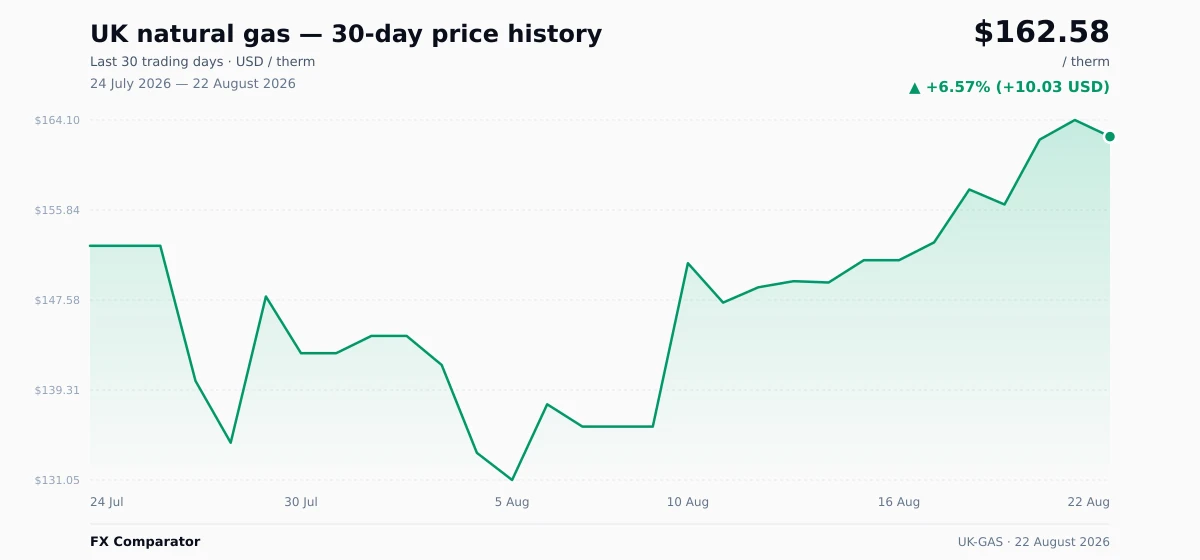
Download chart: WebP
Daily close
26 trading days
| Date | Price (USD) | Price (EUR) | Price (GBP) | Daily change |
|---|---|---|---|---|
| 8 Oct 2026 | US$196.15 | €175.35 | £148.52 | ▲ +0.95% |
| 7 Oct 2026 | US$194.31 | €173.71 | £147.13 | ▲ +2.08% |
| 6 Oct 2026 | US$190.35 | €170.17 | £144.13 | ▲ +3.44% |
| 5 Oct 2026 | US$184.02 | €164.51 | £139.34 | ▼ −2.17% |
| 3 Oct 2026 | US$188.10 | €168.16 | £142.43 | ▼ −1.62% |
| 2 Oct 2026 | US$191.20 | €170.93 | £144.77 | ▲ +4.17% |
| 1 Oct 2026 | US$183.54 | €164.08 | £138.97 | ▲ +0.30% |
| 30 Sept 2026 | US$183.00 | €163.60 | £138.56 | ▲ +4.01% |
| 29 Sept 2026 | US$175.95 | €157.29 | £133.23 | ▼ −2.63% |
| 28 Sept 2026 | US$180.70 | €161.54 | £136.82 | ▼ −1.28% |
| 26 Sept 2026 | US$183.04 | €163.63 | £138.59 | ▲ +2.75% |
| 25 Sept 2026 | US$178.14 | €159.25 | £134.88 | ▼ −5.97% |
| 24 Sept 2026 | US$189.45 | €169.36 | £143.45 | ▲ +3.67% |
| 23 Sept 2026 | US$182.75 | €163.37 | £138.37 | ▲ +0.32% |
| 22 Sept 2026 | US$182.17 | €162.85 | £137.94 | ▼ −0.27% |
| 21 Sept 2026 | US$182.66 | €163.29 | £138.31 | ▼ −7.82% |
| 19 Sept 2026 | US$198.16 | €177.15 | £150.04 | ▲ +0.74% |
| 18 Sept 2026 | US$196.70 | €175.84 | £148.94 | ▲ +0.54% |
| 17 Sept 2026 | US$195.65 | €174.91 | £148.14 | ▲ +1.39% |
| 16 Sept 2026 | US$192.97 | €172.51 | £146.11 | ▼ −3.31% |
| 15 Sept 2026 | US$199.58 | €178.42 | £151.12 | ▼ −2.22% |
| 14 Sept 2026 | US$204.12 | €182.48 | £154.56 | ▲ +2.96% |
| 12 Sept 2026 | US$198.26 | €177.24 | £150.12 | ▼ −0.72% |
| 11 Sept 2026 | US$199.69 | €178.52 | £151.20 | ▼ −2.54% |
| 10 Sept 2026 | US$204.90 | €183.17 | £155.15 | ▲ +4.41% |
| 9 Sept 2026 | US$196.25 | €175.44 | £148.60 | — |