Ural oil price
Ural oil currently trades at US$123.93 per barrel (≈ €110.79 · £93.84) — close to the 12-month high. Over the past 12 months the price has gained 102.67%, with the annual range running from US$49.22 to US$128.30. In the past 24 hours the price has sharply, risen by 2.10%.

Invest in commodity ETFs from just $50
Gold, oil and even whole commodity sectors through ETFs, all in one account, kept simple.
eToro is a multi-asset investment platform. The value of your investments may go up or down. Your capital is at risk.
Ural oil chart
Interactive chart and 30-day overview
The Ural oil chart shows how the Ural oil price has moved over time. The interactive view lets you switch the timeframe (from 7 days up to MAX), the currency (USD / EUR / GBP) and overlay moving averages. Click any two points to measure the percentage change between those dates.
How is Ural oil priced?
Ural oil is priced by the barrel (1 Bbl = 158.987 litres / 42 US gallons). The unit dates back to the 1860s Pennsylvania oil rush, when 42-gallon whiskey casks were repurposed for crude oil transport. It remains the industry standard for ICE Futures Europe (Brent) and NYMEX (WTI) futures contracts.
At US$123.93 per barrel, one litre of crude wholesales for roughly US$0.7795. Retail fuel prices at the pump are much higher because of refining margins, distribution costs and excise duty + VAT, which together make up a large share of the consumer price across the EU and UK.
What drives the price of Urals crude?
The first and most important driver of Urals pricing is the Western sanctions regime. The European Union’s ban on seaborne crude imports cut Russia off from its traditional European buyers, which had previously bought about half of Russian crude exports. At the same time, the G7 introduced a price cap: tankers insured by Western insurers or sailing under Western flags may carry Russian crude only if the price stays below the set threshold. The cap was originally 60 USD / barrel; under the later dynamic system it is tied to the six-month average Urals price and set 15 % below that level. The mechanism seeks to limit Russian export revenue through Western insurance and shipping chains without stopping the flow of oil itself.
The second factor is Asian buyer demand. Since the start of the war, India and China have replaced European buyers. India’s Russian crude imports rose from effectively zero to about ~1.7 million barrels a day, while China buys roughly 2 million barrels a day. Together, the two countries absorb the bulk of Russian crude exports (~4–5 mbpd). Indian refiners such as Reliance, Indian Oil and Nayara have strong bargaining power because they can source from alternative Middle Eastern suppliers. The actual premium or discount is therefore negotiated cargo by cargo. Market data indicate that cargoes from Primorsk arriving in India typically trade at a 5–10 USD / barrel discount to Brent, while China tends to take more heavily discounted cargoes carried by the sanctioned shadow fleet.
The third factor is the capacity of the shadow fleet. These are usually older tankers that are not insured by Western insurers, and whose flags and owners are often obscured through offshore structures. That places them outside the reach of the G7 price cap. The fleet expanded steadily after sanctions were imposed, and data from the Centre for Research on Energy and Clean Air show that a significant share of Russian fossil-fuel exports has been carried by shadow tankers. The larger the shadow fleet, the less pressure Russian exporters face to sell below the official price cap. Its expansion therefore narrows the realised Brent-Urals discount.
investingTitle:
How can investors get exposure to Urals crude?
A European retail investor cannot in practice buy Urals crude directly. European brokers such as XTB and eToro do not offer Urals CFDs because the Russian energy market is covered by the Western sanctions regime. The shares of major Russian energy companies such as Rosneft, Lukoil and Gazprom have been removed from the London market and trading has been suspended. Investors seeking general crude-oil exposure can use Brent or WTI CFDs. These are the main global crude benchmarks, and Urals also moves in relation to Brent through a discount. Another route is through Western oil majors such as Shell, BP, ExxonMobil, Chevron and TotalEnergies. These companies have, however, largely withdrawn from Russia since the sanctions, so they no longer carry direct Russian oil-market risk. At the retail level, direct Urals exposure is not available as an investment product; its main relevance is as a pricing mechanism, especially the Brent-Urals spread.
30-day price history
Chart and daily closing prices
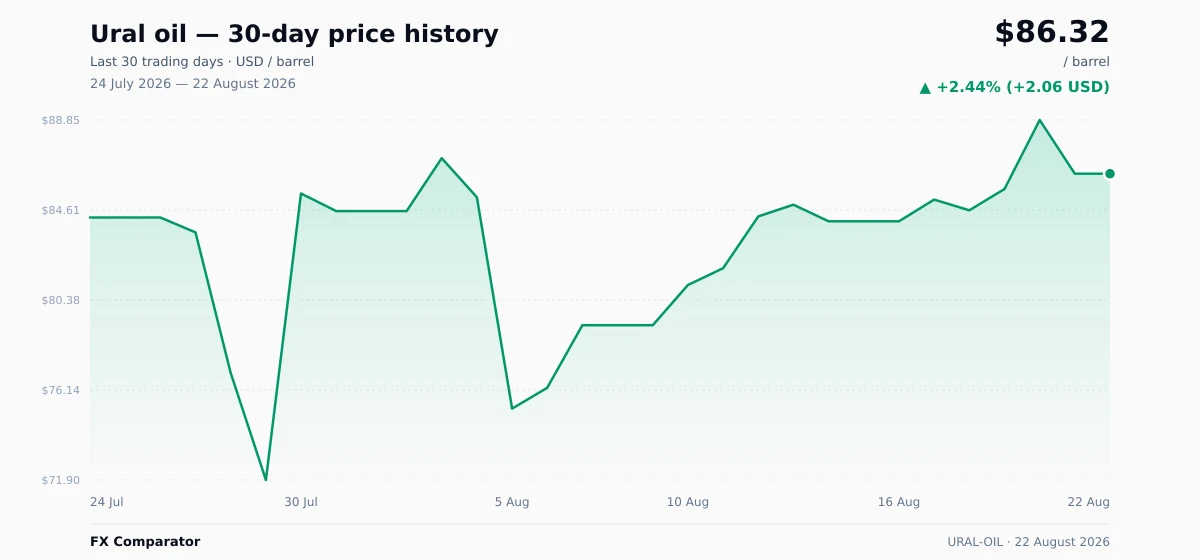
Download chart: WebP
Daily close
22 trading days
| Date | Price (USD) | Price (EUR) | Price (GBP) | Daily change |
|---|---|---|---|---|
| 8 Oct 2026 | US$123.93 | €110.79 | £93.84 | ▲ +2.10% |
| 7 Oct 2026 | US$121.38 | €108.51 | £91.91 | ▼ −5.39% |
| 6 Oct 2026 | US$128.30 | €114.70 | £97.15 | ▲ +11.80% |
| 5 Oct 2026 | US$114.76 | €102.59 | £86.89 | ▲ +8.73% |
| 2 Oct 2026 | US$105.55 | €94.36 | £79.92 | ▼ −1.07% |
| 1 Oct 2026 | US$106.69 | €95.38 | £80.78 | ▼ −3.36% |
| 30 Sept 2026 | US$110.40 | €98.69 | £83.59 | ▼ −0.49% |
| 29 Sept 2026 | US$110.94 | €99.18 | £84.00 | ▲ +0.36% |
| 28 Sept 2026 | US$110.54 | €98.82 | £83.70 | ▼ −2.70% |
| 25 Sept 2026 | US$113.61 | €101.56 | £86.02 | ▲ +3.57% |
| 24 Sept 2026 | US$109.69 | €98.06 | £83.06 | ▲ +2.29% |
| 23 Sept 2026 | US$107.23 | €95.86 | £81.19 | ▼ −0.25% |
| 22 Sept 2026 | US$107.50 | €96.10 | £81.40 | ▼ −6.88% |
| 21 Sept 2026 | US$115.44 | €103.20 | £87.41 | ▲ +1.79% |
| 18 Sept 2026 | US$113.41 | €101.39 | £85.87 | ▼ −6.74% |
| 17 Sept 2026 | US$121.61 | €108.72 | £92.08 | ▲ +8.80% |
| 16 Sept 2026 | US$111.77 | €99.92 | £84.63 | ▲ +5.00% |
| 15 Sept 2026 | US$106.45 | €95.16 | £80.60 | ▲ +1.82% |
| 14 Sept 2026 | US$104.55 | €93.46 | £79.16 | ▲ +0.82% |
| 11 Sept 2026 | US$103.70 | €92.70 | £78.52 | ▲ +8.31% |
| 10 Sept 2026 | US$95.74 | €85.59 | £72.49 | ▲ +4.82% |
| 9 Sept 2026 | US$91.34 | €81.66 | £69.16 | — |