US natural gas price
US natural gas currently trades at US$3.33 per MMBtu (≈ €2.98 · £2.52) — 37.99% below the 12-month high. Over the past 12 months the price has lost 8.26%, with the annual range running from US$2.66 to US$5.37. In the past 24 hours the price has fallen by 1.48%.


Invest in commodity ETFs from just $50
Gold, oil and even whole commodity sectors through ETFs, all in one account, kept simple.
eToro is a multi-asset investment platform. The value of your investments may go up or down. Your capital is at risk.
US natural gas chart
Interactive chart and 30-day overview
The US natural gas chart shows how the US natural gas price has moved over time. The interactive view lets you switch the timeframe (from 7 days up to MAX), the currency (USD / EUR / GBP) and overlay moving averages. Click any two points to measure the percentage change between those dates.
How is US natural gas priced?
US natural gas is priced per MMBtu (one million British thermal units), the standard unit on the NYMEX Henry Hub natural-gas contract. One MMBtu equals roughly 293 kWh of thermal energy or 0.293 MWh.
At US$3.33 per MMBtu, one MWh is worth about US$11.37 and one kWh about US$0.0114. EU prices are typically quoted in MWh on TTF rather than MMBtu — the two markets often diverge based on shipping and pipeline routing.
What drives the price of US natural gas?
US natural gas is one of the world’s largest energy markets, with production of about 105 Bcf (billion cubic feet) a day. In the short term, the Henry Hub price is driven most strongly by weather: an unusually cold winter in the US north-east can lift heating demand, while a hot summer can raise power demand for air conditioning. Gas-fired power plants account for about 40% of US electricity generation. Weekly changes in storage inventories are published by the EIA Weekly Natural Gas Storage Report every Thursday at 10:30 eastern time. Any deviation from the typical 1,500–4,000 Bcf range is quickly reflected in prices.
The medium-term price level is shaped by the expansion of LNG export capacity. US liquefaction capacity has risen to about 14 Bcf/d, meaning 13–14% of domestic production is now exported. New LNG terminals, including Sabine Pass, Corpus Christi, Plaquemines and Rio Grande LNG, link Henry Hub more closely to Europe’s TTF and Asia’s JKM benchmarks. If the European gas market comes under stress — for example because of a loss of Russian pipeline gas or a cold European winter — US LNG arbitrage can also pull Henry Hub higher.
Over the longer term, the dynamics of shale gas production exert downward pressure on prices. The Marcellus in Pennsylvania and West Virginia, the Haynesville in Louisiana and Texas, and the Permian Basin in Texas and New Mexico, where gas is produced alongside oil, account for about 75% of US output. Drilling activity, tracked by the Baker Hughes Rig Count, and the number of drilled but uncompleted wells (DUCs) tend to follow prices with a lag of six to 12 months, creating periods of surplus or shortage.
How can investors get exposure to US natural gas?
European retail investors can gain exposure to Henry Hub natural gas in several ways. Through CFDs, usually labelled NATGAS or USGAS, brokers offer direct leveraged price speculation. This can suit short-term trading, but it is a high-risk product because natural gas is one of the most volatile exchange-traded commodities, with annual price swings of 50–80% not unusual. Through ETF-CFDs or similar exchange-traded products, investors can also access natural gas exposure, although roll costs from futures contracts can weigh heavily on long-term returns when the market is in contango. Producer and LNG-exporter shares, such as EQT, Chesapeake Energy, Cheniere Energy and Southwestern Energy, provide indirect exposure. Their advantage is an operating business and, in some cases, dividends; their drawback is company-specific risk, including debt levels and hedging policy.
30-day price history
Chart and daily closing prices
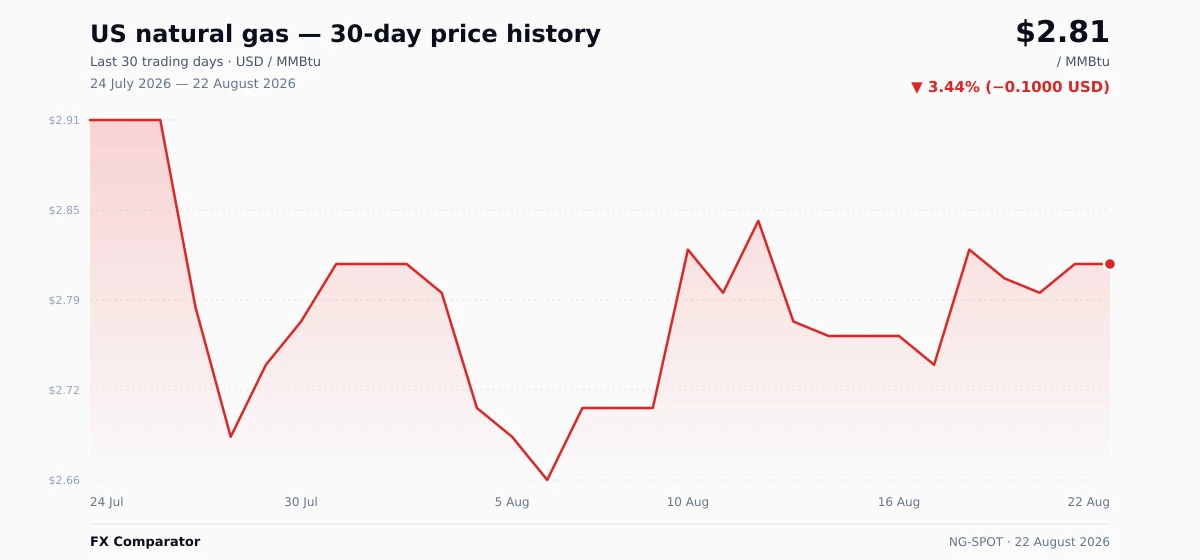
Download chart: WebP
Daily close
21 trading days
| Date | Price (USD) | Price (EUR) | Price (GBP) | Daily change |
|---|---|---|---|---|
| 8 Oct 2026 | US$3.33 | €2.98 | £2.52 | ▼ −1.48% |
| 7 Oct 2026 | US$3.38 | €3.02 | £2.56 | ▲ +3.36% |
| 6 Oct 2026 | US$3.27 | €2.92 | £2.48 | ▲ +1.55% |
| 5 Oct 2026 | US$3.22 | €2.88 | £2.44 | ▲ +1.58% |
| 2 Oct 2026 | US$3.17 | €2.83 | £2.40 | ▲ +3.59% |
| 1 Oct 2026 | US$3.06 | €2.74 | £2.32 | ▼ −1.92% |
| 30 Sept 2026 | US$3.12 | €2.79 | £2.36 | ▲ +0.65% |
| 29 Sept 2026 | US$3.10 | €2.77 | £2.35 | ▼ −3.73% |
| 28 Sept 2026 | US$3.22 | €2.88 | £2.44 | ▼ −3.01% |
| 25 Sept 2026 | US$3.32 | €2.97 | £2.51 | ▼ −0.90% |
| 24 Sept 2026 | US$3.35 | €2.99 | £2.54 | ▲ +4.69% |
| 23 Sept 2026 | US$3.20 | €2.86 | £2.42 | ▲ +0.63% |
| 22 Sept 2026 | US$3.18 | €2.84 | £2.41 | ▲ +6.35% |
| 21 Sept 2026 | US$2.99 | €2.67 | £2.26 | ▼ −1.32% |
| 18 Sept 2026 | US$3.03 | €2.71 | £2.29 | ▲ +1.34% |
| 17 Sept 2026 | US$2.99 | €2.67 | £2.26 | ▼ −0.33% |
| 16 Sept 2026 | US$3.00 | €2.68 | £2.27 | ▼ −1.64% |
| 15 Sept 2026 | US$3.05 | €2.73 | £2.31 | ▲ +1.67% |
| 14 Sept 2026 | US$3.00 | €2.68 | £2.27 | ▲ +2.04% |
| 10 Sept 2026 | US$2.94 | €2.63 | £2.23 | ▲ +1.73% |
| 9 Sept 2026 | US$2.89 | €2.58 | £2.19 | — |