DAP fertiliser price
DAP fertiliser currently trades at US$800.00 per tonne (≈ €715.18 · £605.74) — effectively at the 12-month high. Over the past 12 months the price has gained 4.10%, with the annual range running from US$610.00 to US$802.50. In the past 24 hours the price has fallen by 0.31%.

Invest in commodity ETFs from just $50
Gold, oil and even whole commodity sectors through ETFs, all in one account, kept simple.
eToro is a multi-asset investment platform. The value of your investments may go up or down. Your capital is at risk.
DAP fertiliser chart
Interactive chart and 30-day overview
The DAP fertiliser chart shows how the DAP fertiliser price has moved over time. The interactive view lets you switch the timeframe (from 7 days up to MAX), the currency (USD / EUR / GBP) and overlay moving averages. Click any two points to measure the percentage change between those dates.
How is DAP fertiliser priced?
DAP fertiliser is priced per metric tonne (1 t = 1,000 kg) — the standard unit for industrial and bulk commodities on the London Metal Exchange (LME), CME and major European exchanges. Wholesale shipments move in containers or bulk vessels, typically in 25-tonne or 100-tonne lots.
At US$800.00 per tonne, one kilogram is worth US$0.8000. End-user pricing for processed goods includes refining margins, transport and tariffs on top of the wholesale benchmark.
What drives the price of DAP fertiliser?
The deepest structural driver of DAP pricing is the concentration of phosphate rock mining. According to the US Geological Survey Mineral Commodity Summaries, about 70% of global phosphate rock reserves are in Morocco and Western Sahara, and they are mined almost entirely by the state-owned OCP Group in the Khouribga and Boucraâ-Laâyoune basins. Other major producers — China (~85 Mt of phosphate rock a year), Morocco (~40 Mt), the United States (~20 Mt, mainly from Florida’s Bone Valley and North Carolina mines), Russia (~14 Mt) and Jordan (~10 Mt) — together do not hold reserves on the same scale as OCP alone. This concentration makes OCP’s export pricing the de facto reference point for the global DAP market.
Another source of price volatility is the system of Chinese export quotas and export taxes. China is the world’s largest DAP producer. Of global annual DAP output of about ~35 Mt, Chinese plants produce ~13 Mt, the US group Mosaic produces ~7 Mt, OCP produces ~3 Mt and PhosAgro also produces ~3 Mt. But the Chinese government regularly restricts exports during domestic spring and autumn sowing periods through export quotas and higher export taxes, in order to secure phosphate supply for local farmers and protect food security. A quota announcement can move Argus FOB Tampa and FOB Saudi Arabia assessments within days, because China accounts for a material share of global DAP trade.
Demand is led by South Asia and Latin America. India is the world’s largest DAP importer, bringing in about ~10 Mt a year and covering most domestic use through imports. Purchases are co-ordinated through Indian Potash Limited and the government subsidy system. The Department of Fertilizers sets a maximum retail price each year, while the central budget covers the gap between the global FOB price and the domestic controlled price. This subsidy mechanism dulls India’s price sensitivity, but the scale of import demand means new tender announcements have an immediate market impact. Brazil, with about ~5 Mt of DAP imports a year, is also a net importer. The rapid expansion of Brazilian soybean and maize acreage is one of the more persistent drivers of global phosphate demand. The International Fertilizer Association (IFA) and Fertilizer Week publish these trade flows quarterly.
How to invest in DAP fertiliser exposure
In the absence of a liquid retail futures market for DAP, access is usually indirect, through listed phosphate and fertiliser producers. The main listed companies are Mosaic Company (MOS — the largest US DAP/MAP producer, listed on the New York Stock Exchange) and Nutrien (NTR — a Canadian-US integrated phosphate and potash producer, listed on the NYSE and TSX). Norway’s Yara International (YAR.OL — Oslo) focuses mainly on nitrogen fertilisers, but it also has phosphate products. OCP Group is not listed and remains owned by the Moroccan state. PhosAgro is not available through many European brokers because of western sanctions. Two regulated brokers with English-language platforms where Mosaic, Nutrien and Yara shares are available:
30-day price history
Chart and daily closing prices
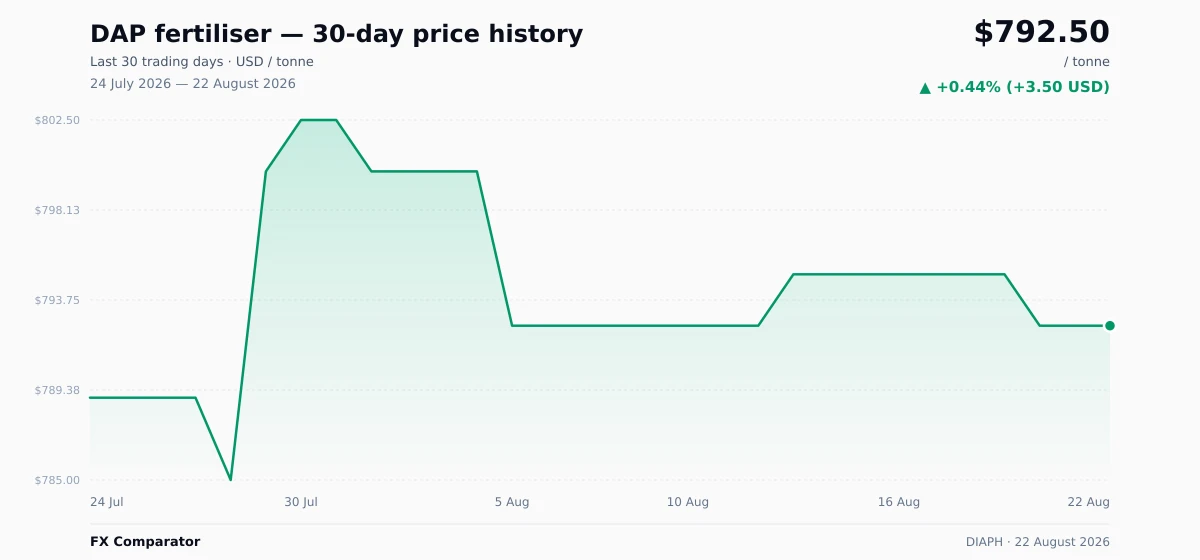
Download chart: WebP
Daily close
4 trading days
| Date | Price (USD) | Price (EUR) | Price (GBP) | Daily change |
|---|---|---|---|---|
| 8 Oct 2026 | US$800.00 | €715.18 | £605.74 | ▼ −0.31% |
| 19 Sept 2026 | US$802.50 | €717.41 | £607.64 | ▲ +0.31% |
| 10 Sept 2026 | US$800.00 | €715.18 | £605.74 | ▲ +0.95% |
| 9 Sept 2026 | US$792.50 | €708.47 | £600.07 | — |