Soft commodities · CT

Cotton price

US$0.7800 / pound
≈ €0.6634 ≈ £0.5813 Unchanged 24h 62% within the 52-week range
FX Editorial Team · Data updated: · Editorially verified
Cotton (CT) price today US$0.7800 / pound, ↑ +0.00% (24h)

Cotton chart

Interactive chart and 30-day overview

7 days
▼ −3.70%
−US$0.0300
30 days
▼ −3.70%
−US$0.0300
1 year
▲ +16.42%
+US$0.1100
52-week range
US$0.6200 62% US$0.8800
Cotton (CT) 30-day price chart — USD, EUR, GBP

The Cotton chart shows how the cotton price has moved over time. The interactive view lets you switch the timeframe (from 7 days up to MAX), the currency (USD / EUR / GBP) and overlay moving averages. Click any two points to measure the percentage change between those dates.

What drives the price of cotton?

Cotton’s main structural risk is polyester substitution. Cotton’s share of the global textile-fibre market has steadily declined over recent decades in favour of oil-based synthetic fibres, mainly polyester (PET). Polyester now accounts for the dominant share of global textile-fibre consumption, while cotton’s share is only slightly above 20–25%. The PET/cotton price spread is therefore priced directly into the market. When oil prices fall, polyester fibre becomes cheaper, and textile buyers — especially large mills in China, Vietnam and Bangladesh — can switch quickly. Because of this indirect link to oil, one of cotton’s most important market references is not an agricultural variable but an energy one. The market closely follows the annual ICAC (International Cotton Advisory Committee) Cotton This Month report to track the supply-demand balance.

In the short term, the largest price driver is the Chinese state strategic cotton reserve. China holds huge volumes of cotton in national reserves — a significant share of global ending stocks — and periodic government auction releases or purchases can move New York prices sharply. When Beijing releases large volumes from the reserve, the market treats it as an increase in global supply and prices come under pressure. When it launches a purchase programme, the effect is the opposite. The market also follows the monthly USDA Cotton WASDE, the USDA Foreign Agricultural Service Cotton: World Markets and Trade report, and weekly ICE certified stocks data for exchange-approved warehouse inventories.

Global cotton output is about 25 million tonnes of fibre a year. Production and consumption are dominated by a narrow group of countries. India (~6 Mt), China (~6 Mt), the United States (~3.5 Mt), Brazil (~3 Mt) and Pakistan (~1.5 Mt) together account for about 80% of world production. On the processing side, the main buyers are the textile industries of China, India, Pakistan, Bangladesh and Vietnam, where much of the global apparel industry’s spinning and weaving capacity is located. The expansion of Brazil is a key structural shift in the market. Rapid growth in the Brazilian cerrado has gradually challenged US export dominance, and Brazil is now one of the world’s largest cotton exporters. Exchange rates — especially the Indian rupee, Brazilian real and Pakistani rupee against the dollar — directly affect exporter competitiveness and domestic producer prices relative to the New York benchmark.

How to invest in cotton

Retail investors can access the cotton market in several ways. The most direct route is a cotton CFD on the New York Cotton No. 2 price. Among exchange-traded products, the iPath Bloomberg Cotton Subindex (BAL ETN) is the classic instrument, although its liquidity is limited. Large textile and fashion stocks offer indirect exposure: Inditex (ITX.MC) is the parent company of Zara, Hennes & Mauritz (HM-B.ST) owns H&M, and VF Corporation owns a portfolio that includes Wrangler, Lee, The North Face and Vans. For these stocks, cotton prices affect procurement costs, so the exposure is often inverse: lower cotton prices can support gross margins. Two regulated brokers where cotton CFDs, the BAL ETN and textile-related stocks may be available are:

30-day price history

Chart and daily closing prices
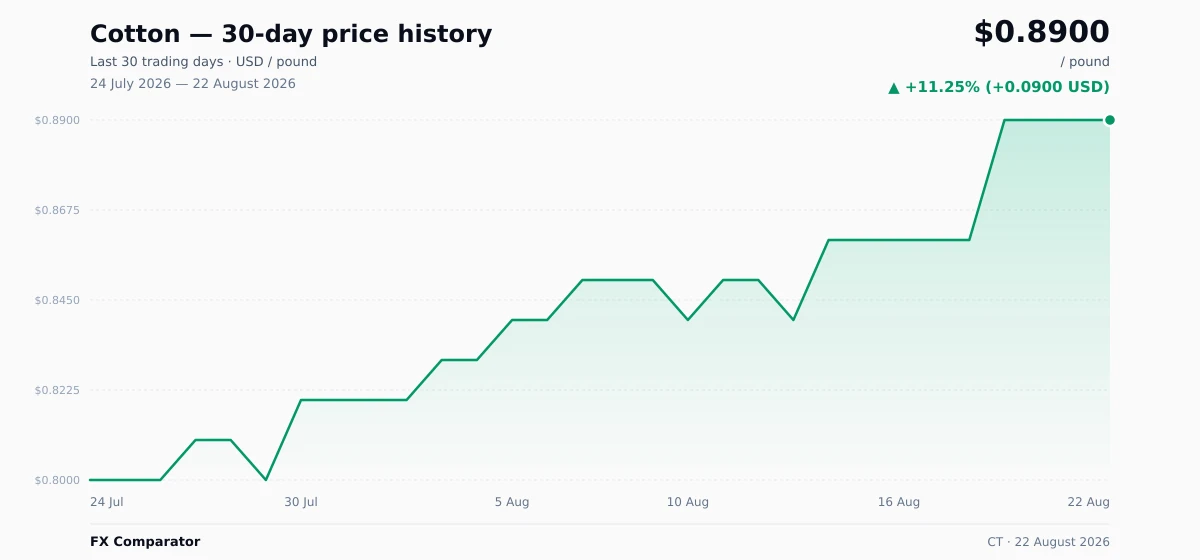
Cotton (CT) 30-day price chart — USD, EUR, GBP

Daily close

30 trading days

Date Price (USD) Price (EUR) Price (GBP) Daily change
22 May 2026 US$0.7800 €0.6634 £0.5813 ▼ −1.27%
21 May 2026 US$0.7900 €0.6719 £0.5888 ▼ −3.66%
19 May 2026 US$0.8200 €0.6974 £0.6111 ▼ −1.20%
18 May 2026 US$0.8300 €0.7059 £0.6186 ▲ +2.47%
15 May 2026 US$0.8100 €0.6889 £0.6037 ▼ −3.57%
14 May 2026 US$0.8400 €0.7144 £0.6261 ▼ −4.55%
12 May 2026 US$0.8800 €0.7484 £0.6559 ▲ +2.33%
11 May 2026 US$0.8600 €0.7314 £0.6410 ▲ +1.18%
5 May 2026 US$0.8500 €0.7229 £0.6335 ▲ +1.19%
2 May 2026 US$0.8400 €0.7144 £0.6261 ▲ +1.20%
1 May 2026 US$0.8300 €0.7059 £0.6186 ▲ +1.22%
30 Apr 2026 US$0.8200 €0.6974 £0.6111 ▲ +2.50%
25 Apr 2026 US$0.8000 €0.6804 £0.5962 ▼ −1.23%
22 Apr 2026 US$0.8100 €0.6889 £0.6037 ▲ +1.25%
21 Apr 2026 US$0.8000 €0.6804 £0.5962 ▲ +1.27%
20 Apr 2026 US$0.7900 €0.6719 £0.5888

Cotton FAQ

Why is cotton priced in pounds? +
The New York ICE Futures US Cotton No. 2 futures contract — the global benchmark for cotton — is quoted in US cents per pound (US¢/Lb) because it comes from US agricultural commodity-market convention and uses US units of measurement. 1 pound = 0.4536 kg, so the pound-to-kilogram conversion factor is about 2.2046 (1 kg = 2.2046 pounds). 1 tonne of cotton = 2,204.6 pounds. In European textile procurement, purchase prices are often quoted per tonne or per bale. Freight, processing and quality premiums account for the difference versus the New York price.
What is Cotton No. 2 and how does it differ from long-staple cotton? +
Cotton No. 2 is the name of the ICE Futures US futures contract for short-staple upland cotton (Gossypium hirsutum). This accounts for about 90% of global output and is the main raw material for mass-market textiles. It differs from long-staple cottonEgyptian (Giza) and US Pima (Gossypium barbadense) — which has a staple length above 35 mm, can be spun into finer yarn and trades in the premium segment at a significant premium. The two markets move separately. The ICE Cotton No. 2 price does not reflect Giza or Pima prices, but the price of the mass-market textile raw material.
How large is a cotton bale and how many T-shirts can it make? +
The world-market standard bale contains 480 pounds = 217.7 kg of cleaned cotton fibre, or lint, after ginning has removed seeds and impurities. A standard ICE Cotton No. 2 futures contract is 50,000 pounds, or roughly 100 bales. Industry estimates suggest one bale can make about 1,200 cotton T-shirts, or about 250 metres of average denim fabric. This shows that raw cotton typically accounts for only a few per cent of the final retail price of a garment. Spinning, weaving, dyeing, sewing, brand margin and retail mark-up dominate the consumer price.
How does the price of polyester affect the cotton market? +
Polyester (PET) is cotton’s main competitor. Polyester’s share of the global textile-fibre market exceeds 50%, while cotton’s share is around 20–25%. Polyester is an oil-based synthetic fibre, so its price is directly linked to oil prices and petrochemical feedstocks such as paraxylene, PTA and MEG. When oil prices fall, polyester fibre becomes cheaper, and textile buyers — especially large mills in China, Vietnam and Bangladesh — can switch quickly from cotton to synthetic fibre. The PET/cotton price spread is therefore one of the cotton market’s most important longer-term variables. A narrowing spread reduces demand for cotton; a widening spread supports it.
Why is China’s cotton reserve so important for the market? +
China holds huge volumes of cotton in its national strategic reserve, the China National Cotton Reserve. A significant share of global ending stocks is held there. Periodic Chinese state auction releases or purchases are among the largest short-term drivers of the New York price. When Beijing releases large volumes from the reserve, the market treats it as an increase in global supply and prices come under pressure. When it launches a purchase programme, for example to support domestic producers, the effect is the opposite. Transparency around Chinese policymaking is limited, so reserve-related announcements often cause abrupt price moves.
Who is the world’s largest cotton producer and consumer? +
Global cotton output is about 25 million tonnes of fibre a year. Production is led by India (~6 Mt) and China (~6 Mt), which together account for almost half of world output. They are followed by the United States (~3.5 Mt), Brazil (~3 Mt) and Pakistan (~1.5 Mt). The five largest producers together account for about 80% of global output. On the processing side, the textile industries of China, India, Pakistan, Bangladesh and Vietnam absorb most of the crop. Much of the global apparel industry’s spinning and weaving capacity is located there. Brazil is the fastest-growing exporter; production in the cerrado region has multiplied over the longer term, and the country is now one of the world’s largest cotton exporters.
What does the USDA Cotton WASDE show, and why does the market follow it? +
The USDA Cotton WASDE (World Agricultural Supply and Demand Estimates) is a monthly publication from the US Department of Agriculture that updates the global supply-demand balance for cotton and other agricultural crops. It includes crop estimates, mill use, exports, imports and ending stocks by country. On publication days — usually in the second week of the month — the New York Cotton No. 2 price can move within seconds if the data differ from market-survey averages. The market also closely follows the monthly USDA Foreign Agricultural Service Cotton: World Markets and Trade report and the ICAC (International Cotton Advisory Committee) Cotton This Month publication.
Cotton CFD, BAL ETN or textile stocks — how do they differ? +
Each has a different risk-return profile. A cotton CFD tracks the New York Cotton No. 2 price directly, is leveraged and is used for short-term speculation. Financing costs and the risk of leveraged losses are material. The BAL ETN (iPath Bloomberg Cotton Subindex) is an exchange-traded product that offers longer-held cotton exposure, but liquidity is limited and it carries issuer credit risk. It is an ETN, not an ETF, meaning it is a debt obligation of the issuer. Textile stocks (Inditex, Hennes & Mauritz, VF Corporation) provide indirect and often inverse exposure. Cotton prices feed through procurement costs, so lower cotton prices can support gross margins. Company-specific business risks — fashion trends, retail sales and supply-chain issues — are also significant.