Soft commodities · CA

Arabica coffee price

US$2.68 / pound
≈ €2.28 ≈ £2.00 Unchanged 24h 4% within the 52-week range
FX Editorial Team · Data updated: · Editorially verified
Arabica coffee (CA) price today US$2.68 / pound, ↑ +0.00% (24h)

Arabica coffee chart

Interactive chart and 30-day overview

7 days
▲ +1.90%
+US$0.0500
30 days
▼ −7.59%
−US$0.2200
1 year
▼ −25.14%
−US$0.9000
52-week range
US$2.61 4% US$4.21
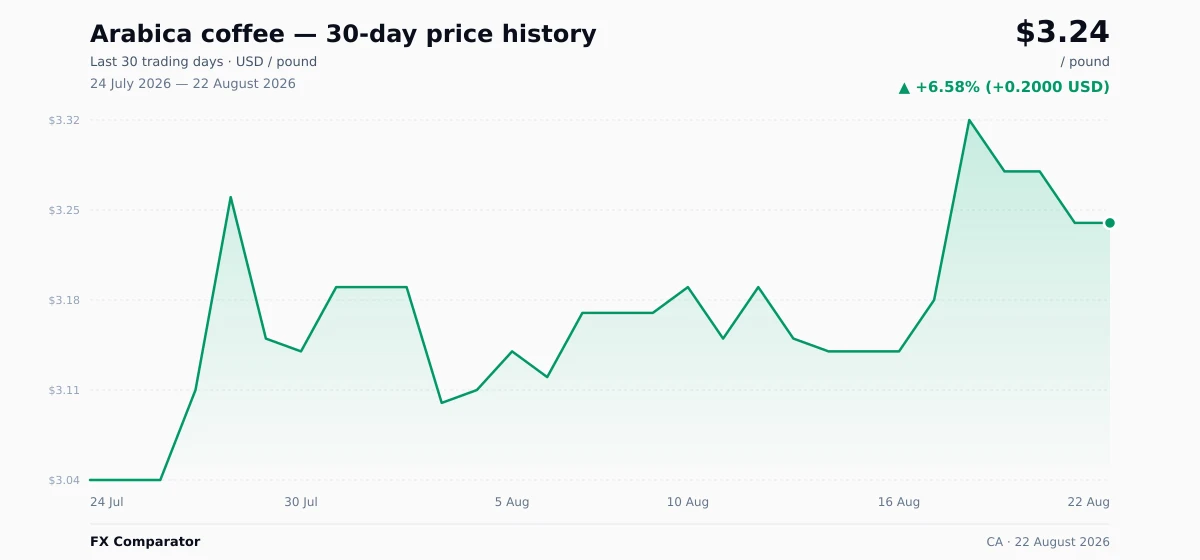
Arabica coffee (CA) 30-day price chart — USD, EUR, GBP

The Arabica coffee chart shows how the arabica coffee price has moved over time. The interactive view lets you switch the timeframe (from 7 days up to MAX), the currency (USD / EUR / GBP) and overlay moving averages. Click any two points to measure the percentage change between those dates.

What drives the price of arabica coffee?

Brazilian weather is the largest short-term risk for the arabica market. Brazil accounts for about 40% of global arabica production, with annual output estimated by CONAB and the USDA Foreign Agricultural Service at around 65 million 60 kg bags. In the south-eastern growing regions — Minas Gerais, São Paulo and Paraná — frosts (geadas) during the southern winter in June and July, or drought during flowering in September and October, can lift ICE prices by 30-50% within weeks. A severe frost wave in Brazil, for example, can push arabica prices sharply higher.

The arabica coffee tree follows a natural biennial crop cycle: a higher-yielding year is typically followed by a lower-yielding one, as the tree reserves energy for the next season. This biennial pattern is clearly visible in Brazilian crop data and is priced by the market in advance. Expectations of a lower-yielding year after a strong harvest can by themselves push futures prices higher. Total global coffee production is about 170 million 60 kg bags a year, or roughly 10 million tonnes, according to the International Coffee Organization (ICO). The arabica-to-robusta split is about 60:40.

Substitution between arabica and robusta is a secondary but material price factor. When Vietnam's robusta crop — about ~30 million bags a year across arabica and robusta, overwhelmingly robusta — faces supply pressure, some instant coffee and capsule makers temporarily use more arabica in blends, or the reverse. Colombian output of about 12 million bags of washed arabica, together with shipments from Ethiopia and Central America, also shapes pricing in the premium segment. A weaker Brazilian real against the dollar typically encourages exports and weighs on ICE arabica prices; falling ICE-certified warehouse stocks signal tighter supply.

How to invest in coffee

Coffee exposure is available without taking physical delivery through several routes: exchange-traded futures contracts (ICE Futures US KC), CFDs on arabica prices, the JO (iPath Bloomberg Coffee Subindex) ETN, and shares in large companies in the coffee value chain — Starbucks (SBUX), Keurig Dr Pepper (KDP), JM Smucker (J) and Switzerland's Nestlé (NESN.SW). Futures, KC CFDs and the JO ETN provide the more direct commodity exposure. Shares are more indirect and carry company-specific business risks. Examples of regulated brokers where coffee CFDs, the JO ETN and coffee-related shares may be available include:

30-day price history

Chart and daily closing prices
Arabica coffee (CA) 30-day price chart — USD, EUR, GBP

Daily close

30 trading days

Date Price (USD) Price (EUR) Price (GBP) Daily change
23 May 2026 US$2.68 €2.28 £2.00 ▼ −0.74%
22 May 2026 US$2.70 €2.30 £2.01 ▲ +0.37%
21 May 2026 US$2.69 €2.29 £2.00 ▲ +1.13%
19 May 2026 US$2.66 €2.26 £1.98 ▲ +1.92%
18 May 2026 US$2.61 €2.22 £1.95 ▼ −0.76%
16 May 2026 US$2.63 €2.24 £1.96 ▼ −0.38%
15 May 2026 US$2.64 €2.25 £1.97 ▼ −3.30%
14 May 2026 US$2.73 €2.32 £2.03 ▼ −1.80%
13 May 2026 US$2.78 €2.36 £2.07 ▲ +0.36%
12 May 2026 US$2.77 €2.36 £2.06 ▼ −1.07%
11 May 2026 US$2.80 €2.38 £2.09 ▲ +2.94%
10 May 2026 US$2.72 €2.31 £2.03 ▼ −3.20%
6 May 2026 US$2.81 €2.39 £2.09 ▼ −3.77%
5 May 2026 US$2.92 €2.48 £2.18 ▲ +2.82%
4 May 2026 US$2.84 €2.42 £2.12 ▼ −1.39%
2 May 2026 US$2.88 €2.45 £2.15 ▲ +1.77%
1 May 2026 US$2.83 €2.41 £2.11 ▼ −0.35%
30 Apr 2026 US$2.84 €2.42 £2.12 ▼ −2.41%
29 Apr 2026 US$2.91 €2.47 £2.17 ▲ +1.39%
27 Apr 2026 US$2.87 €2.44 £2.14 ▼ −2.38%
25 Apr 2026 US$2.94 €2.50 £2.19 ▲ +1.38%
22 Apr 2026 US$2.90 €2.47 £2.16 ▲ +2.84%
21 Apr 2026 US$2.82 €2.40 £2.10 ▼ −1.74%
20 Apr 2026 US$2.87 €2.44 £2.14

Coffee FAQ

Why is arabica coffee quoted per pound? +
The global benchmark price for arabica coffee is traded on ICE Futures US in New York, formerly NYBOT, under the KC ticker. It is quoted in US cents per pound under the Anglo-American measurement system (1 pound = 0.4536 kg). The convention is historical: 19th-century coffee trading in New York fixed the pound-based quotation, and the modern futures market inherited it. Conversion to tonnes uses a multiplier of 2,204.6, while conversion to kilograms uses 2.205. A quote of $3.00 per pound therefore equals about $6.62 per kg, or roughly $6,615 per tonne at wholesale level.
How much is 1 pound of coffee in kilograms and tonnes? +
1 pound (lb) = 0.4536 kg, so 1 kg = 2.205 pounds and 1 tonne = 2,204.6 pounds. To convert the international ICE quote from US cents per pound into dollars per kilogram, divide by 100 and multiply by 2.205. To convert it into dollars per tonne, divide by 100 and multiply by 2,204.6. One bag of coffee, the standard unit in global trade, is 60 kg, or 132.28 pounds. ICO and USDA statistics are also published in this unit.
What is the difference between arabica and robusta coffee? +
Arabica (Coffea arabica) accounts for about 60% of global coffee production. It grows at higher altitudes, typically 800-2,000 metres, and has a softer, more aromatic taste, higher acidity and lower caffeine content of about 1.5%. It is traded on ICE in New York under the KC ticker, in US cents per pound. Robusta (Coffea canephora) accounts for the remaining ~40%. It grows at lower altitudes in warmer and more humid areas, is more disease-resistant, and has a more bitter, fuller-bodied taste with higher caffeine content of about 2.5%. Robusta is traded on ICE Europe in London under the RC ticker, in dollars per tonne. Instant coffee and some coffee capsules contain a significant share of robusta.
Why is Brazilian weather important for the arabica market? +
Brazil accounts for about 40% of global arabica production, so its weather is directly reflected in ICE pricing. There are two main risk windows: the southern winter in June and July, when frost (geada) can hit higher-altitude coffee plantations in Minas Gerais and São Paulo, and the flowering period in September and October, when drought can damage crop formation. A severe frost wave in Brazil, for example, can push arabica prices sharply higher. The market follows Brazil's CONAB reports, INMET weather data and field surveys from trading houses such as Volcafé, ECOM and Marex.
What is the biennial cycle in coffee production? +
The arabica coffee tree naturally follows a two-year crop cycle: a higher-yielding year is typically followed by a lower-yielding one, as the plant reserves energy for the next season. This biennial effect is clear in Brazilian crop data. Yields in even and odd years can fluctuate significantly, and the market prices these expectations in advance. In a season following a high-yield year, the natural cycle alone can push futures prices higher, even without adverse weather.
Who are the world's largest arabica and robusta producers? +
Brazil leads arabica production, with about 40 million bags a year, or roughly 40% of the global arabica crop. It is followed by Colombia, with about 12 million bags of washed arabica, Ethiopia, with about 7-8 million bags and the historical origin of arabica, and Central American countries such as Honduras, Guatemala and Costa Rica. Vietnam dominates robusta, producing about 25-30 million bags a year, or around 40% of global robusta output. It is followed by Brazil as a conilon-robusta producer, Indonesia and Uganda. Total global coffee production is about 170 million 60 kg bags a year, or roughly 10 million tonnes, according to ICO data.
Why is roasted coffee in shops 3-5 times more expensive than the world market price of green coffee? +
The exchange-traded wholesale price of raw green coffee beans is only a fraction of the final retail price. During roasting, about 15-20% of the bean's mass is lost as water evaporates, so 1 kg of green coffee produces about 800-850 g of roasted coffee. Roasting costs, packaging, logistics, sales tax or VAT, retailer margins and brand premiums are then added. The price of a 200-250 g retail pack can therefore be influenced by the ICE arabica quote, local currency moves against the dollar and euro, and local taxes and distribution costs.
Coffee CFD, JO ETN or coffee-sector shares — how do they differ? +
They have different risk-return profiles. The JO (iPath Bloomberg Coffee Subindex Total Return) ETN tracks arabica futures contracts directly, so its moves are close to the spot price. But it carries issuer credit risk from Barclays, management fees, and futures roll effects from contango or backwardation that can cause long-term performance to diverge from the spot price. Coffee CFDs are leveraged and suited to short-term speculation, but financing costs and the risk of leveraged losses are material. Coffee-sector shares such as Starbucks, Keurig Dr Pepper, JM Smucker and Nestlé provide indirect exposure. They can react to coffee-market moves but also carry company-specific business risks, including brand performance, margins and foreign-exchange effects.