Cocoa price
Cocoa currently trades at US$5,762 per tonne (≈ €5,113 · £4,340) — 14.87% below the 12-month high. Over the past 12 months the price has lost 6.76%, with the annual range running from US$0.9100 to US$6,768. 24-hour movement is minimal (±0.01%).


Invest in commodity ETFs from just $50
Gold, oil and even whole commodity sectors through ETFs, all in one account, kept simple.
eToro is a multi-asset investment platform. The value of your investments may go up or down. Your capital is at risk.
Cocoa chart
Interactive chart and 30-day overview
The Cocoa chart shows how the cocoa price has moved over time. The interactive view lets you switch the timeframe (from 7 days up to MAX), the currency (USD / EUR / GBP) and overlay moving averages. Click any two points to measure the percentage change between those dates.
How is cocoa priced?
Cocoa is priced per metric tonne (1 t = 1,000 kg) — the standard unit for industrial and bulk commodities on the London Metal Exchange (LME), CME and major European exchanges. Wholesale shipments move in containers or bulk vessels, typically in 25-tonne or 100-tonne lots.
At US$5,762 per tonne, one kilogram is worth US$5.76. End-user pricing for processed goods includes refining margins, transport and tariffs on top of the wholesale benchmark.
What moves the price of cocoa?
A structural feature of the cocoa market is West African supply concentration. Côte d’Ivoire, with about 2.0 million tonnes a year, accounts for roughly 40% of global output. Ghana, with about 0.7 million tonnes a year, adds another 15%. Together, the two countries produce around 55% of the world’s cocoa beans. Global production is around 4.5 million tonnes a year, according to the International Cocoa Organization (ICCO). Most of the remaining supply comes from Ecuador (~0.4 Mt), Indonesia (~0.2 Mt), Nigeria and Cameroon. The concentration risk is compounded by ageing trees, with many farms still using older hybrids. Cocoa swollen shoot virus disease (CSSVD) has made tens of thousands of hectares in Ghana and Côte d’Ivoire persistently uneconomic. Younger farmers are also less willing to take over family plantations.
The main source of short-term price volatility is weather in West Africa’s cocoa belt. The main crop, harvested from November to March, is shaped by the December-February Harmattan wind. Dry, dusty air from the Sahara can reduce bean moisture and increase pod loss during a critical stage of pod development. For the summer-autumn mid-crop, the volume and distribution of the rainy season from June to September are decisive. Too much rain can spread black pod disease, a Phytophthora rot; too little rain weakens flowering. El Niño-Southern Oscillation (ENSO) cycles directly affect rainfall patterns around the Gulf of Guinea, so ICE Futures US cocoa prices are seasonally sensitive to forecasts from the NOAA Climate Prediction Center.
The demand and processing side is also unusually concentrated. About 60% of global cocoa-processing capacity is controlled by three companies: Cargill, Barry Callebaut and Olam Food Ingredients. They grind beans into cocoa liquor, cocoa butter and cocoa powder, which are then sold to chocolate makers. End demand is similarly concentrated. Three global chocolate groups — Mars, Mondelez (Cadbury, Milka, Toblerone) and Nestlé (KitKat, Smarties) — account for a large share of market turnover, while Hershey is a major player in North America. That means a few large hedging purchases or sales on the ICE contract can move prices materially. Processing, or grindings, data from the European Cocoa Association and the National Confectioners Association are closely watched market indicators.
How to invest in cocoa
Owning physical cocoa beans is not practical for retail investors. Beans are hygroscopic, vulnerable to mould and insects, require climate-controlled storage, and the market is mainly business-to-business, driven by confectionery procurement. A European retail investor typically gets cocoa exposure in three ways: cocoa CFDs that track the ICE Futures US Cocoa (CC) price; a thematic ETN, the best-known being the iPath Bloomberg Cocoa Subindex ETN — ticker: NIB; or individual shares in chocolate makers and cocoa processors, such as Mondelez International — MDLZ, Hershey — HSY, Barry Callebaut — BARN.SW and Nestlé — NESN.SW. Two regulated brokers where these instruments are available include:
30-day price history
Chart and daily closing prices
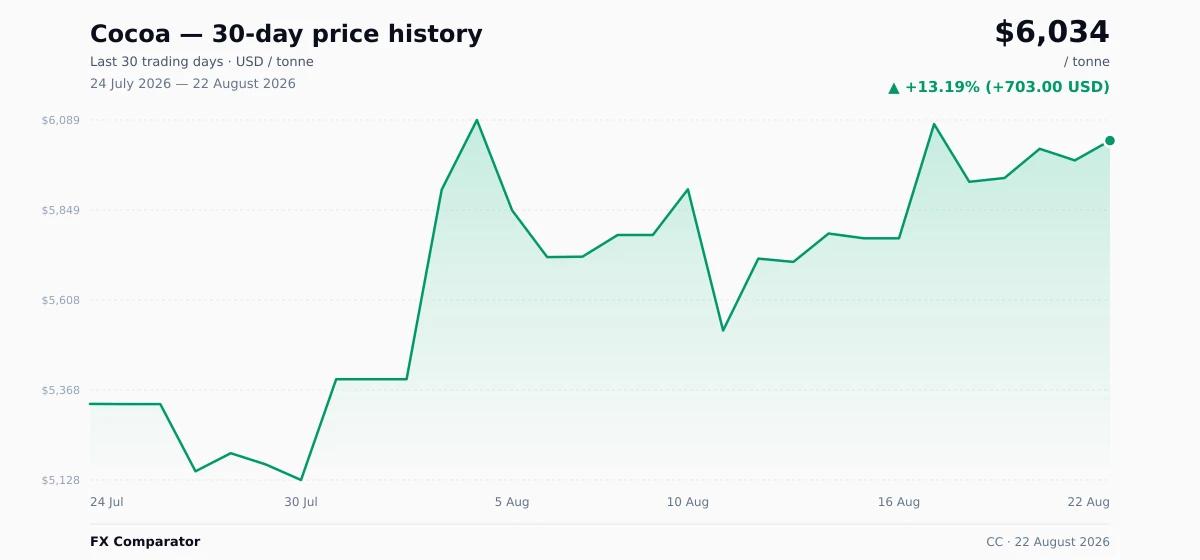
Download chart: WebP
Daily close
26 trading days
| Date | Price (USD) | Price (EUR) | Price (GBP) | Daily change |
|---|---|---|---|---|
| 7 Oct 2026 | US$5,762 | €5,113 | £4,340 | ▼ −0.01% |
| 6 Oct 2026 | US$5,762 | €5,113 | £4,340 | ▼ −1.54% |
| 5 Oct 2026 | US$5,852 | €5,193 | £4,408 | ▲ +3.21% |
| 3 Oct 2026 | US$5,670 | €5,032 | £4,271 | ▲ +1.09% |
| 2 Oct 2026 | US$5,609 | €4,977 | £4,225 | ▲ +2.96% |
| 1 Oct 2026 | US$5,448 | €4,835 | £4,104 | ▲ +2.06% |
| 30 Sept 2026 | US$5,338 | €4,737 | £4,021 | ▼ −0.30% |
| 29 Sept 2026 | US$5,354 | €4,751 | £4,033 | ▼ −4.51% |
| 28 Sept 2026 | US$5,607 | €4,976 | £4,223 | ▼ −0.21% |
| 26 Sept 2026 | US$5,619 | €4,986 | £4,232 | ▲ +0.29% |
| 25 Sept 2026 | US$5,603 | €4,972 | £4,220 | ▲ +0.16% |
| 24 Sept 2026 | US$5,594 | €4,964 | £4,214 | ▲ +1.36% |
| 23 Sept 2026 | US$5,519 | €4,898 | £4,157 | ▲ +1.85% |
| 22 Sept 2026 | US$5,419 | €4,809 | £4,082 | ▲ +2.11% |
| 21 Sept 2026 | US$5,307 | €4,709 | £3,997 | ▼ −0.38% |
| 19 Sept 2026 | US$5,327 | €4,727 | £4,012 | ▼ −0.06% |
| 18 Sept 2026 | US$5,330 | €4,730 | £4,015 | ▼ −5.16% |
| 17 Sept 2026 | US$5,620 | €4,987 | £4,233 | ▼ −5.56% |
| 16 Sept 2026 | US$5,951 | €5,281 | £4,482 | ▲ +1.55% |
| 15 Sept 2026 | US$5,860 | €5,200 | £4,414 | ▼ −2.80% |
| 14 Sept 2026 | US$6,029 | €5,350 | £4,541 | ▲ +1.14% |
| 12 Sept 2026 | US$5,961 | €5,290 | £4,490 | ▲ +0.81% |
| 11 Sept 2026 | US$5,913 | €5,247 | £4,454 | ▼ −0.47% |
| 10 Sept 2026 | US$5,941 | €5,272 | £4,475 | ▲ +0.07% |
| 9 Sept 2026 | US$5,937 | €5,268 | £4,472 | ▲ +0.17% |
| 8 Sept 2026 | US$5,927 | €5,260 | £4,464 | — |