Soft commodities · LS11

Sugar (US) price

Sugar (US) currently trades at US$14.68 per pound (≈ €12.48 · £10.94) — 26.86% below the 12-month high. Over the past 12 months it has lost 15.19%, with the annual range running from US$13.33 to US$20.07. 24-hour movement is minimal (±0.00%).
US$14.68 / pound
≈ €12.48 ≈ £10.94 Unchanged 24h 20% within the 52-week range
FX Editorial Team · Data updated: · Editorially verified
Sugar (US) (LS11) price today US$14.68 / pound, ↑ +0.00% (24h)

Sugar (US) chart

Interactive chart and 30-day overview

7 days
▼ −0.68%
−US$0.1000
30 days
▲ +10.13%
+US$1.35
1 year
▼ −15.19%
−US$2.63
52-week range
US$13.33 20% US$20.07
Sugar (US) (LS11) 30-day price chart — USD, EUR, GBP

The Sugar (US) chart shows how the sugar (us) price has moved over time. The interactive view lets you switch the timeframe (from 7 days up to MAX), the currency (USD / EUR / GBP) and overlay moving averages. Click any two points to measure the percentage change between those dates.

How is sugar (us) priced?

Sugar (US) is quoted per pound (1 lb = 0.4536 kg) on the major US futures exchanges, including the COMEX, CME and ICE. The pound is the legacy commercial unit for North American agricultural and metals contracts.

At US$14.68 per pound, one kilogram costs about US$32.36. Industrial buyers usually negotiate in tonnes, while retail or specialty trade still references the pound — particularly for soft commodities and base-metal cathodes.

What drives the price of raw sugar?

Brazil’s sugar-ethanol mix is the largest short-term price driver for the Sugar No. 11 market. Brazil accounts for about 23% of global sugar production, with annual output of roughly 42 million tonnes, according to estimates from UNICA (Brazilian Sugarcane Industry Association) and the USDA Foreign Agricultural Service. Mills in the Centre-South region (São Paulo, Minas Gerais, Paraná) decide during the harvest whether to process cane into sugar or ethanol. The choice depends on the relative prices of the two end-products. When Brent and Brazilian petrol prices rise, ethanol production becomes more attractive, less cane goes into sugar, and the Sugar No. 11 price tends to move higher. The indirect price link between sugar and oil is therefore a material macro risk for the market.

India’s crop and export policy are the second major factor. India accounts for about 18% of global sugar production, at around 33 million tonnes a year, and is the world’s largest domestic consumer. Depending on monsoon rainfall and domestic stock levels, the Indian government can impose export licensing or quotas. An announcement of tighter export restrictions can trigger a sharp move in New York prices within minutes. The E20 ethanol blending mandate, which requires 20% ethanol in petrol, also pushes sugar cane and sugar syrup towards ethanol production, reducing the volume of sugar available for export.

Thailand, EU beet sugar supply and weather complete the global balance. Thailand is the third-largest exporter, producing about 11 million tonnes a year from sugar cane, and Thai droughts have repeatedly caused sharp price moves. EU beet sugar output, at about 17 million tonnes a year, mainly from France, Germany and Poland, has a more direct effect on the white sugar contract (Sugar No. 5). But arbitrage between the two markets also feeds through to Sugar No. 11. A weaker Brazilian real (BRL) against the dollar typically encourages exports, bringing more sugar to the world market and weighing on Sugar No. 11 prices.

How to invest in sugar

Investors can gain exposure to sugar without holding the physical commodity through several routes: exchange-traded futures contracts (ICE Futures US Sugar No. 11, SB ticker), CFDs on the Sugar No. 11 price, the CANE (Teucrium Sugar Fund) ETF, and shares in major companies in the sugar value chain, including Cosan (CSAN3.SA), Brazil’s largest integrated sugar and ethanol group, and the UK’s Tate & Lyle (TATE.L), which focuses on industrial sweeteners. The futures contract, Sugar No. 11 CFD and CANE ETF offer the more direct commodity exposure. Shares are more indirect and carry company-specific business risks. Two regulated brokers where sugar CFDs, the CANE ETF and sugar-related shares may be available are:

30-day price history

Chart and daily closing prices
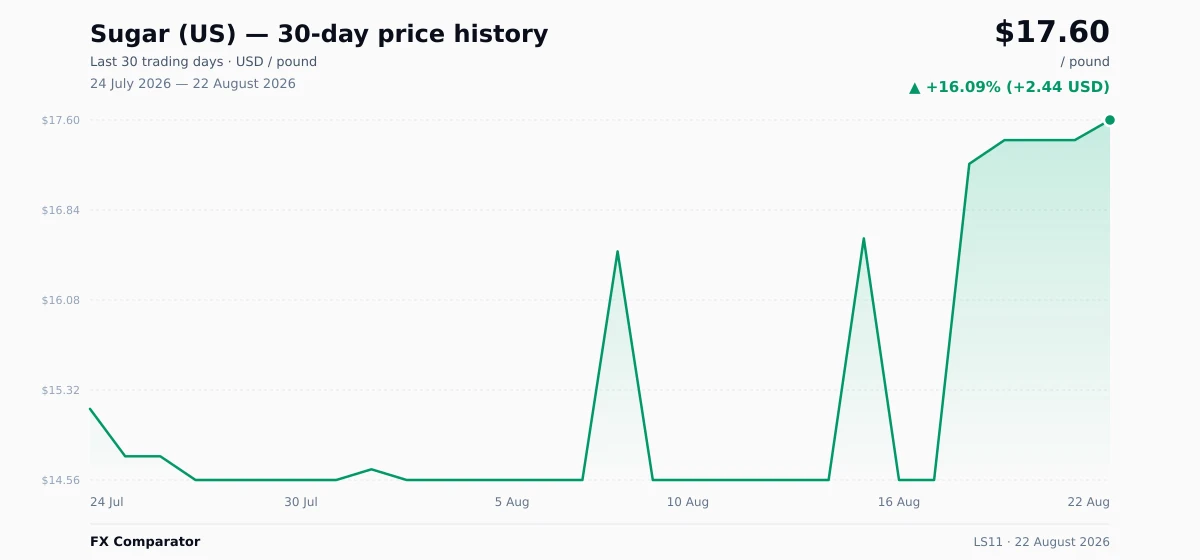
Sugar (US) (LS11) 30-day price chart — USD, EUR, GBP

Daily close

30 trading days

Date Price (USD) Price (EUR) Price (GBP) Daily change
23 May 2026 US$14.68 €12.48 £10.94 ▲ +0.07%
22 May 2026 US$14.67 €12.48 £10.93 ▼ −1.68%
21 May 2026 US$14.92 €12.69 £11.12 ▲ +1.08%
20 May 2026 US$14.76 €12.55 £11.00 ▼ −1.53%
19 May 2026 US$14.99 €12.75 £11.17 ▲ +1.90%
18 May 2026 US$14.71 €12.51 £10.96 ▼ −0.47%
16 May 2026 US$14.78 €12.57 £11.02 ▲ +0.34%
15 May 2026 US$14.73 €12.53 £10.98 ▼ −2.06%
14 May 2026 US$15.04 €12.79 £11.21 ▼ −1.96%
13 May 2026 US$15.34 €13.05 £11.43 ▲ +3.09%
12 May 2026 US$14.88 €12.65 £11.09 ▼ −0.27%
11 May 2026 US$14.92 €12.69 £11.12 ▲ +1.57%
10 May 2026 US$14.69 €12.49 £10.95 ▼ −0.94%
6 May 2026 US$14.83 €12.61 £11.05 ▼ −3.26%
5 May 2026 US$15.33 €13.04 £11.43 ▲ +0.66%
4 May 2026 US$15.23 €12.95 £11.35 ▲ +1.74%
2 May 2026 US$14.97 €12.73 £11.16 ▲ +0.27%
1 May 2026 US$14.93 €12.70 £11.13 ▲ +2.26%
30 Apr 2026 US$14.60 €12.42 £10.88 ▲ +3.33%
29 Apr 2026 US$14.13 €12.02 £10.53 ▲ +2.17%
28 Apr 2026 US$13.83 €11.76 £10.31 ▼ −0.58%
27 Apr 2026 US$13.91 €11.83 £10.37 ▼ −0.07%
25 Apr 2026 US$13.92 €11.84 £10.37 ▲ +4.43%
22 Apr 2026 US$13.33 €11.34 £9.93 ▼ −0.67%
21 Apr 2026 US$13.42 €11.41 £10.00 ▲ +0.68%
20 Apr 2026 US$13.33 €11.34 £9.93

Sugar FAQ

Why is raw sugar priced in pounds? +
The global benchmark for raw sugar is traded on ICE Futures US in New York, formerly NYBOT, as Sugar No. 11 under the SB ticker. It is quoted in US cents per pound under the Anglo-American measurement system (1 pound = 0.4536 kg). The reason is historical: 19th-century New York imports of Caribbean and Latin American sugar used the British-American system, and the futures market inherited that convention. Conversion to tonnes uses a multiplier of 2,204.6, while conversion to kilograms uses 2.205. A price of $0.20 per pound is therefore about $0.44 per kg, or roughly $441 per tonne, for wholesale FOB port delivery.
How much is 1 pound of sugar in kilograms and tonnes? +
1 pound (lb) = 0.4536 kg, so 1 kg = 2.205 pounds and 1 tonne = 2,204.6 pounds. The international ICE quote, in US cents per pound, can therefore be multiplied by 2.205 to obtain the dollar price per kilogram, and by 2,204.6 to obtain the dollar price per tonne. Global sugar market statistics from the ISO (International Sugar Organization), USDA FAS and UNICA are published in tonnes, so pound-to-tonne conversion is routine for traders, refiners and food-industry buyers.
What is the difference between Sugar No. 11 and Sugar No. 5? +
Sugar No. 11 is the global raw cane sugar benchmark on ICE Futures US in New York, traded under the SB ticker in US cents per pound for FOB port delivery. It is the pricing basis for more than 90% of global cane sugar trade. Sugar No. 5 is the refined white sugar contract on ICE Europe in London, quoted in dollars per tonne, also for FOB delivery. The spread between the two contracts is known as the white sugar premium. It reflects refining costs, refiner margins and regional demand for white sugar. Large refiners such as Tate & Lyle, ED&F Man and Südzucker often buy No. 11 and sell No. 5 at the same time for hedging purposes.
Why does the Brazilian sugar-ethanol arbitrage matter? +
Brazil accounts for about 23% of global sugar production, and cane mills in the Centre-South region can decide during the harvest whether to process cane into sugar or ethanol. The choice depends on the relative prices of the two end-products. When the price of Brazilian hydrous ethanol, linked to domestic petrol and crude oil prices, is higher than the return available from sugar, mills switch towards ethanol production. That leaves less sugar for the world market and can push Sugar No. 11 higher. UNICA publishes the Centre-South sugar/ethanol mix every week, and the figure is closely watched by the market.
How does India influence the global sugar market? +
India is the world’s second-largest sugar producer, with about 33 million tonnes a year, or roughly 18% of global output, and it is the largest domestic consumer. Depending on monsoon rainfall, domestic stock levels and political considerations, the Indian government can impose export licensing or quotas. An announcement of tighter export restrictions or an export ban can trigger a sharp move in the New York Sugar No. 11 price within minutes. The E20 ethanol blending mandate, which requires 20% ethanol in petrol, also directs sugar cane and sugar syrup towards ethanol production, reducing exportable sugar supply. USDA FAS publishes monthly estimates for India’s crop and exports.
Who is the world’s largest sugar producer? +
Global sugar production is about 180 million tonnes a year, according to ISO data. Brazil leads with roughly 42 million tonnes, or about 23% of global output, mainly from sugar cane. It is followed by India, at about 33 million tonnes from sugar cane; the EU, at about 17 million tonnes from sugar beet; Thailand, at about 11 million tonnes from sugar cane; then China and the US. More than 50% of global exports come from Brazil, creating a high level of supply concentration. A Brazilian drought or disruption at ports can have a material effect on the Sugar No. 11 price. In the UK and Europe, retail supply is also shaped by regional beet sugar, imports and refining capacity, not only by the New York raw sugar benchmark.
Why does a fall in the exchange-traded sugar price not immediately show up in supermarkets? +
The exchange-traded price of raw sugar for FOB port delivery is only a fraction of the final retail price. Raw sugar must first be refined, or sugar must be produced from beet. Packaging, logistics, tax, retailer margins and currency moves are then added. In many European markets, supermarket granulated sugar is typically closer to regional beet sugar and the London Sugar No. 5 white sugar market than to the New York Sugar No. 11 raw sugar contract. Consumer prices therefore tend to follow exchange-traded raw sugar moves more slowly and with less intensity than the underlying futures market. Tax treatment varies by jurisdiction; consult a local tax adviser.
Sugar No. 11 CFD, CANE ETF or sugar-related shares — how do they differ? +
The three instruments have different risk and return profiles. The CANE (Teucrium Sugar Fund) ETF tracks Sugar No. 11 futures contracts, so it gives exposure close to the futures market, but it has fund fees and the futures roll effect (contango/backwardation) can cause performance to diverge from the spot price over time. A Sugar No. 11 CFD is leveraged and suited to short-term speculation, but financing costs and the risk of leveraged losses are significant. Sugar-related shares, such as Cosan in Brazil and Tate & Lyle in the UK, provide indirect exposure. They can react to sugar market moves, but they also carry company-specific risks, including refining margins, the Brazilian real exchange rate and demand for industrial sweeteners.