Orange juice price
Orange juice currently trades at US$147.86 per pound (≈ €132.18 · £111.96) — 35.15% below the 12-month high. Over the past 12 months the price has lost 29.86%, with the annual range running from US$132.50 to US$228.00. In the past 24 hours the price has risen by 0.41%.


Invest in commodity ETFs from just $50
Gold, oil and even whole commodity sectors through ETFs, all in one account, kept simple.
eToro is a multi-asset investment platform. The value of your investments may go up or down. Your capital is at risk.
Orange juice chart
Interactive chart and 30-day overview
The Orange juice chart shows how the orange juice price has moved over time. The interactive view lets you switch the timeframe (from 7 days up to MAX), the currency (USD / EUR / GBP) and overlay moving averages. Click any two points to measure the percentage change between those dates.
How is orange juice priced?
What drives the price of orange juice?
The main structural risk in the orange juice market is citrus greening disease — a bacterial infection known as Huanglongbing (HLB), spread by the Asian citrus psyllid. The disease is caused by the Candidatus Liberibacter asiaticus pathogen, which multiplies in the tree’s vascular system. There is currently no cure. Infected orange trees gradually produce smaller, bitter fruit with a greenish peel, then die. Florida’s citrus industry — once the backbone of US orange juice supply — has fallen sharply because of HLB. USDA Florida Citrus Statistics show that the state’s orange harvest has shrunk to a fraction of its historical peak, with many traditional groves abandoned or switched to other crops. Research continues — resistant hybrids, antibiotic injections and CRISPR-edited rootstocks — but no structural solution is yet available. HLB risk therefore remains embedded as a persistent premium in New York OJ prices.
The global FCOJ export market is clearly dominated by Brazil. The country accounts for about 80% of global FCOJ exports, according to CitrusBR and FAO Citrus Market data. Most production is concentrated in northern and central São Paulo state, especially the Triângulo Mineiro area and the São Paulo–Minas Gerais border region, where a warm, wet climate and red cerrado soils suit orange cultivation. Weather in this region directly moves prices. Drought, frost risk in southern groves and El Niño cycles all leave a visible mark on New York OJ futures. The market closely follows the annual Reestimativa da Safra crop estimate from Fundecitrus (Fundo de Defesa da Citricultura), as well as the Brazilian real (BRL) exchange rate against the dollar. A weaker real allows Brazilian exporters to price FCOJ more aggressively, putting downward pressure on the global benchmark.
A shorter-term price driver is the Atlantic hurricane season from June to November. Florida’s peninsula geography leaves it highly exposed to tropical storms. A single major hurricane can strip flowering or ripening oranges from trees within hours, damage trees physically and cause root loss through flooding. After a serious Florida hurricane warning, OJ futures can often jump several per cent intraday, as liquidity depth in the relatively small contract is limited. On the demand side, orange juice consumption has been falling for years in developed markets such as North America and Western Europe. Coffee, plant-based drinks, water and functional beverages have taken share, while perceptions around sugar content also weigh on purchases. A glass of orange juice contains a similar order of natural sugar to a soft drink. Supply shocks therefore create price spikes in a demand environment that is structurally shrinking. The market sits in an unstable balance.
How to invest in orange juice
Owning physical frozen orange juice concentrate is not practical for retail investors. The product must be refrigerated, is traded in industrial quantities and moves through closed B2B supply chains serving food and beverage buyers such as Coca-Cola Minute Maid, PepsiCo Tropicana and European soft-drink manufacturers. For European retail investors, two main routes provide orange juice exposure: orange juice CFDs, which track the ICE Futures US OJ price directly, and individual equities linked to the citrus value chain. Liquidity in the OJ contract is limited, and brokers usually list it as “OJ”. The two best-known listed companies are Coca-Cola (KO), owner of the Minute Maid and Simply Orange brands, and PepsiCo (PEP), the former parent of the Tropicana brand. Brazil’s Cutrale-Citrus Suco is a major player in the global FCOJ market, but it is privately held and its shares are not listed. Two EU-regulated brokers where these instruments are available are:
30-day price history
Chart and daily closing prices
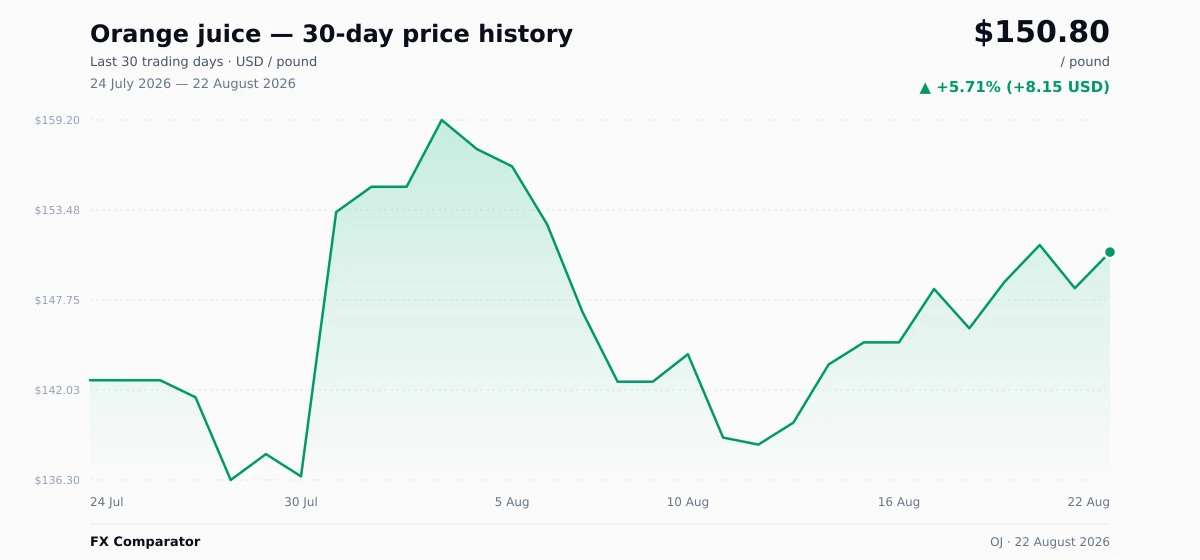
Download chart: WebP
Daily close
26 trading days
| Date | Price (USD) | Price (EUR) | Price (GBP) | Daily change |
|---|---|---|---|---|
| 8 Oct 2026 | US$147.86 | €132.18 | £111.96 | ▲ +0.41% |
| 7 Oct 2026 | US$147.25 | €131.64 | £111.49 | ▼ −2.29% |
| 6 Oct 2026 | US$150.70 | €134.72 | £114.11 | ▲ +3.97% |
| 5 Oct 2026 | US$144.95 | €129.58 | £109.75 | ▲ +7.21% |
| 3 Oct 2026 | US$135.20 | €120.86 | £102.37 | ▼ −1.49% |
| 2 Oct 2026 | US$137.25 | €122.70 | £103.92 | ▼ −3.14% |
| 1 Oct 2026 | US$141.70 | €126.68 | £107.29 | ▼ −6.44% |
| 30 Sept 2026 | US$151.45 | €135.39 | £114.67 | ▼ −1.37% |
| 29 Sept 2026 | US$153.55 | €137.27 | £116.26 | ▲ +2.37% |
| 28 Sept 2026 | US$150.00 | €134.10 | £113.58 | ▼ −0.73% |
| 26 Sept 2026 | US$151.10 | €135.08 | £114.41 | ▼ −0.20% |
| 25 Sept 2026 | US$151.40 | €135.35 | £114.64 | ▲ +0.23% |
| 24 Sept 2026 | US$151.05 | €135.03 | £114.37 | ▲ +1.48% |
| 23 Sept 2026 | US$148.85 | €133.07 | £112.71 | ▼ −1.42% |
| 22 Sept 2026 | US$151.00 | €134.99 | £114.33 | ▲ +2.10% |
| 21 Sept 2026 | US$147.90 | €132.22 | £111.99 | ▲ +4.97% |
| 19 Sept 2026 | US$140.90 | €125.96 | £106.69 | ▼ −1.57% |
| 18 Sept 2026 | US$143.15 | €127.97 | £108.39 | ▲ +2.03% |
| 17 Sept 2026 | US$140.30 | €125.42 | £106.23 | ▼ −3.74% |
| 16 Sept 2026 | US$145.75 | €130.30 | £110.36 | ▼ −4.39% |
| 15 Sept 2026 | US$152.45 | €136.29 | £115.43 | ▼ −0.72% |
| 14 Sept 2026 | US$153.55 | €137.27 | £116.26 | ▲ +5.71% |
| 12 Sept 2026 | US$145.25 | €129.85 | £109.98 | ▲ +0.31% |
| 11 Sept 2026 | US$144.80 | €129.45 | £109.64 | ▼ −0.96% |
| 10 Sept 2026 | US$146.20 | €130.70 | £110.70 | ▼ −1.05% |
| 9 Sept 2026 | US$147.75 | €132.08 | £111.87 | — |