Urea price
Urea currently trades at US$435.00 per tonne (≈ €388.88 · £329.37) — 38.17% below the 12-month high. Over the past 12 months the price has gained 13.65%, with the annual range running from US$350.00 to US$703.50. 24-hour movement is minimal (±0.00%).

Invest in commodity ETFs from just $50
Gold, oil and even whole commodity sectors through ETFs, all in one account, kept simple.
eToro is a multi-asset investment platform. The value of your investments may go up or down. Your capital is at risk.
Urea chart
Interactive chart and 30-day overview
The Urea chart shows how the urea price has moved over time. The interactive view lets you switch the timeframe (from 7 days up to MAX), the currency (USD / EUR / GBP) and overlay moving averages. Click any two points to measure the percentage change between those dates.
How is urea priced?
Urea is priced per metric tonne (1 t = 1,000 kg) — the standard unit for industrial and bulk commodities on the London Metal Exchange (LME), CME and major European exchanges. Wholesale shipments move in containers or bulk vessels, typically in 25-tonne or 100-tonne lots.
At US$435.00 per tonne, one kilogram is worth US$0.4350. End-user pricing for processed goods includes refining margins, transport and tariffs on top of the wholesale benchmark.
What drives the price of urea?
The main driver of the urea price is the natural gas price. Gas is both the feedstock and the energy source for ammonia synthesis under the Haber–Bosch process, and accounts for about 80% of total urea production costs. Middle Eastern producers, including Saudi Arabia’s SABIC, Qatar’s Qafco and UAE-based Fertiglobe, have a durable cost advantage because of cheap domestic gas fixed for industrial use. US plants, including the CF Industries Donaldsonville complex, Nutrien and OCI Global Wever, produce against gas linked to Henry Hub pricing. European plants, including BASF, Yara and OCI Global capacity at Geleen, must deal with higher TTF gas prices. That places them in the upper segment of the global cost curve; a persistently wide Henry Hub–TTF spread can lead to temporary shutdowns in Europe.
The second structural factor is Chinese export policy. China produces about 60 Mt of the global annual urea output of roughly 180 million tonnes, and treats domestic agricultural security as a priority. During spring and summer planting peaks, typically for rice and maize, the customs authority and the commerce ministry may impose a urea export quota or informal export restriction. Such measures can move CFR India and FOB Middle East prices higher by as much as USD 50–100 per tonne. The opening and closing of the “Chinese tap” is one of the largest sources of volatility in the global urea market. Argus Nitrogen weekly FOB China assessments react sharply to customs announcements.
The third key factor is import demand, dominated by three markets. India is the world’s largest urea importer, with annual volumes of about 5–10 million tonnes. Periodic international tenders by state-backed IPL (Indian Potash Limited), RCF and NFL, often via FCI and STC, directly affect FOB Middle East and FOB Russia pricing. Brazil imports about 7 Mt a year, mainly to supply soyabean and maize regions in Mato Grosso and Paraná; port buying helps shape CFR Brazil assessments. In Europe, sanctions and tariff measures affecting Russian imports, combined with elevated TTF gas prices, have raised the cost of EU supply. The EU agricultural sector relies more heavily on Middle Eastern and North African shipments, including Egyptian and Algerian product.
investingTitle
How to invest in the urea industry
A European retail investor does not have access to a direct pure-play urea CFD. Neither XTB nor eToro offers a urea futures contract, as the CME UFV contract has limited retail liquidity and the physical market is priced through weekly Argus and ICIS FOB assessments. Urea exposure can be built through nitrogen fertiliser producer shares: CF Industries (CF) is one of the world’s largest urea and UAN producers and is listed on the NYSE; Nutrien (NTR) is an integrated nitrogen and potash fertiliser group; Norway’s Yara International (YAR.OL) is a major player in global nitrogen; Dutch-Egyptian OCI Global (OCI.AS) has significant urea and methanol plants; and Mosaic (MOS) offers broader phosphate and potash exposure. Outside single stocks, the VanEck Agribusiness ETF (MOO) provides diversified exposure to the fertiliser sector. International shares may be held in tax-efficient accounts, such as a UK ISA or similar EU wrappers, where available.
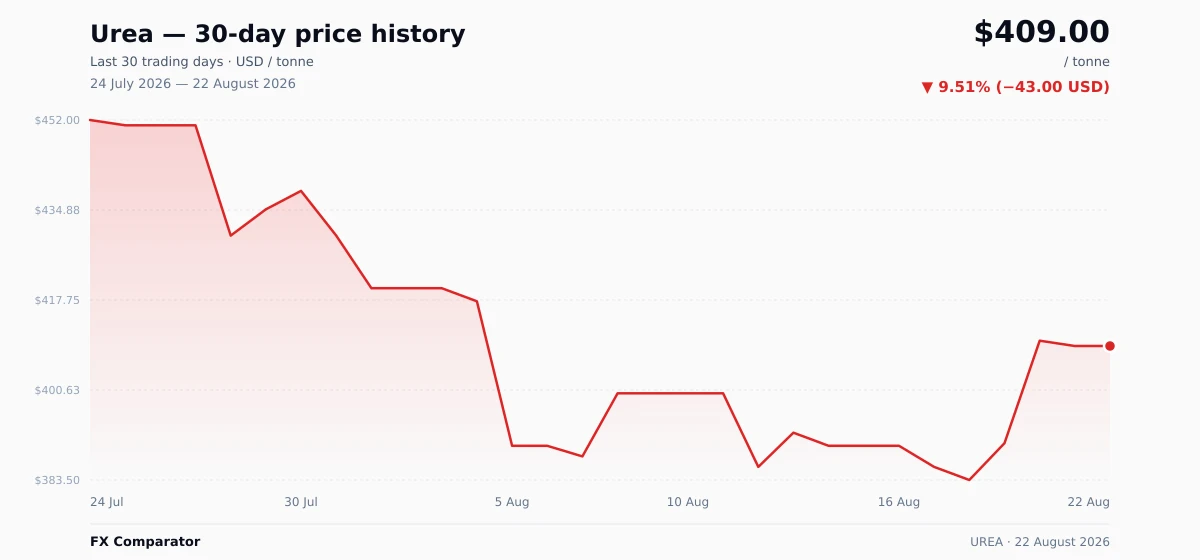
30-day price history
Chart and daily closing prices
Download chart: WebP
Daily close
21 trading days
| Date | Price (USD) | Price (EUR) | Price (GBP) | Daily change |
|---|---|---|---|---|
| 7 Oct 2026 | US$435.00 | €388.88 | £329.37 | ▼ −1.14% |
| 6 Oct 2026 | US$440.00 | €393.35 | £333.16 | ▼ −1.46% |
| 3 Oct 2026 | US$446.50 | €399.16 | £338.08 | ▲ +3.24% |
| 2 Oct 2026 | US$432.50 | €386.64 | £327.48 | ▼ −0.57% |
| 1 Oct 2026 | US$435.00 | €388.88 | £329.37 | ▼ −4.61% |
| 30 Sept 2026 | US$456.00 | €407.65 | £345.27 | ▼ −0.22% |
| 29 Sept 2026 | US$457.00 | €408.54 | £346.03 | ▼ −0.05% |
| 26 Sept 2026 | US$457.25 | €408.77 | £346.22 | ▼ −0.11% |
| 25 Sept 2026 | US$457.75 | €409.21 | £346.60 | ▼ −0.05% |
| 24 Sept 2026 | US$458.00 | €409.44 | £346.79 | ▼ −0.22% |
| 23 Sept 2026 | US$459.00 | €410.33 | £347.55 | ▼ −0.22% |
| 22 Sept 2026 | US$460.00 | €411.23 | £348.30 | ▲ +0.11% |
| 19 Sept 2026 | US$459.50 | €410.78 | £347.92 | ▼ −0.16% |
| 18 Sept 2026 | US$460.25 | €411.45 | £348.49 | ▲ +0.05% |
| 17 Sept 2026 | US$460.00 | €411.23 | £348.30 | ▲ +0.11% |
| 16 Sept 2026 | US$459.50 | €410.78 | £347.92 | ▲ +1.43% |
| 15 Sept 2026 | US$453.00 | €404.97 | £343.00 | ▲ +0.50% |
| 12 Sept 2026 | US$450.75 | €402.96 | £341.30 | ▲ +0.11% |
| 11 Sept 2026 | US$450.25 | €402.51 | £340.92 | ▲ +0.45% |
| 10 Sept 2026 | US$448.25 | €400.72 | £339.41 | ▲ +0.45% |
| 9 Sept 2026 | US$446.25 | €398.93 | £337.89 | — |