Indium price
Indium currently trades at US$5,250 per kg (≈ €4,685 · £3,971) — close to the 12-month high. Over the past 12 months the price has gained 107.92%, with the annual range running from US$2,480 to US$5,750. 24-hour movement is minimal (±0.00%).

Invest in commodity ETFs from just $50
Gold, oil and even whole commodity sectors through ETFs, all in one account, kept simple.
eToro is a multi-asset investment platform. The value of your investments may go up or down. Your capital is at risk.
Indium chart
Interactive chart and 30-day overview
The Indium chart shows how the indium price has moved over time. The interactive view lets you switch the timeframe (from 7 days up to MAX), the currency (USD / EUR / GBP) and overlay moving averages. Click any two points to measure the percentage change between those dates.
How is indium priced?
What drives the price of indium?
The display industry accounts for almost 60% of indium demand. LCD panels, OLED displays, touchscreen devices and thin-film photovoltaic solar panels all use indium tin oxide (ITO) coatings as conductive, transparent layers. The rest is split between low-melting-point solders, semiconductors such as indium phosphide and indium gallium arsenide, and specialist alloys and bearing metals. Cycles in laptops, smartphones and televisions feed directly into the indium spot price.
Supply is highly concentrated by geography. According to the USGS Mineral Commodity Summaries, global primary indium production is around 800 tonnes/year. About 50% comes from China (around 400 tonnes), 15% from South Korea (around 120 tonnes), 10% from Japan (around 85 tonnes), and a further 5% from Canada (around 60 tonnes). Indium is recovered almost exclusively as a by-product from zinc ores, mainly sphalerite. Primary supply is therefore tied to zinc smelter utilisation and does not respond flexibly to higher indium prices.
The third structural feature is recycling. Around 80% of the material loss from sputtering targets used to apply ITO coatings returns to the refining chain. In other words, a large share of indium in the internal material flow of display manufacturing moves in a closed loop. Price references from Fastmarkets MB and Argus Minor Metals usually refer to 99.99% indium ingot.
How to get exposure to indium
Indium has no central futures market, so direct indium CFDs, ETFs or futures are not available through retail brokers. XTB and eToro do not offer standalone indium products. Exposure is indirect and usually comes through three routes: shares in large zinc producers such as Glencore, Teck Resources and Korea Zinc, where indium appears as a by-product; display-sector companies such as LG Display and Samsung SDI, which are linked to ITO demand; and critical raw-materials mining portfolios, including Neo Performance Materials and similar specialist companies. Indium Corporation of America is privately held and not exchange-listed. Two regulated brokers where these shares and ETF baskets can be accessed are:
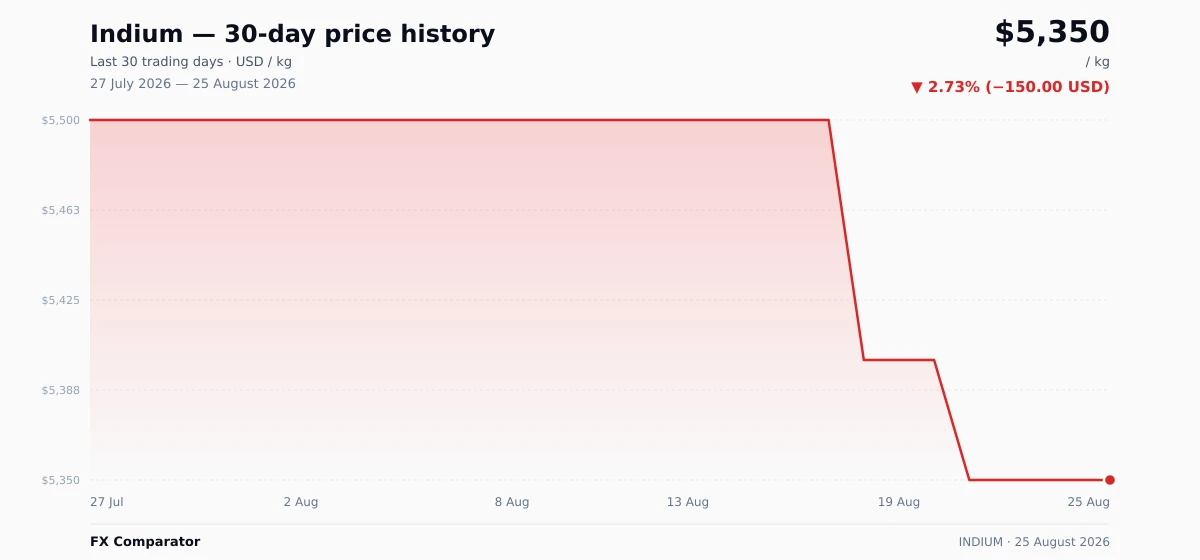
30-day price history
Chart and daily closing prices
Download chart: WebP
Daily close
3 trading days
| Date | Price (USD) | Price (EUR) | Price (GBP) | Daily change |
|---|---|---|---|---|
| 23 Sept 2026 | US$5,250 | €4,685 | £3,971 | ▼ −0.47% |
| 18 Sept 2026 | US$5,275 | €4,707 | £3,990 | ▼ −0.47% |
| 11 Sept 2026 | US$5,300 | €4,730 | £4,009 | — |