Propane price
Propane currently trades at US$0.9400 per gallon (≈ €0.8403 · £0.7117) — effectively at the 12-month high. Over the past 12 months the price has gained 40.30%, with the annual range running from US$0.6100 to US$0.9400. In the past 24 hours the price has sharply, risen by 2.17%.


Invest in commodity ETFs from just $50
Gold, oil and even whole commodity sectors through ETFs, all in one account, kept simple.
eToro is a multi-asset investment platform. The value of your investments may go up or down. Your capital is at risk.
Propane chart
Interactive chart and 30-day overview
The Propane chart shows how the propane price has moved over time. The interactive view lets you switch the timeframe (from 7 days up to MAX), the currency (USD / EUR / GBP) and overlay moving averages. Click any two points to measure the percentage change between those dates.
How is propane priced?
What drives the price of propane?
The strongest seasonal driver of propane prices is US winter heating demand. In the north-eastern states and in rural areas not served by natural gas grids, propane is a major household fuel. A cold winter front can move the Mont Belvieu price sharply in a short period. The EIA (U.S. Energy Information Administration) weekly propane inventories report is one of the market’s most closely watched data releases. During the heating season, the pace of stock draws can shape prices for the following weeks.
Supply is shaped by propane’s nature as a by-product. Propane reaches the market from the NGL (natural gas liquids) stream during natural gas processing and from crude oil refining. Its output is therefore driven mainly by the level of natural gas and oil production, rather than by a stand-alone propane supply-demand balance. As US shale gas production expanded, NGL infrastructure around the Mont Belvieu hub — fractionation plants, storage sites, pipelines — and marine export-terminal capacity grew substantially.
The third driver is US LPG exports. The United States is the world’s largest exporter of propane and butane, with Asia (Japan, South Korea, India) and Europe among the main destination markets. The fourth factor is petrochemical demand. PDH (propane dehydrogenation) plants convert propane into propylene, a feedstock for polypropylene plastics. The expansion of Chinese PDH capacity supports Asian propane imports and, through that channel, the Mont Belvieu benchmark.
How to invest in propane
Retail investors rarely get direct access to the propane market. The NYMEX Mont Belvieu Propane futures contract is a large, institutional product. European retail investors usually obtain exposure through listed companies in the propane supply chain: midstream and NGL-processing companies such as Enterprise Products Partners — EPD and Targa Resources — TRGP, or household LPG distributors such as Suburban Propane — SPH and UGI Corp / AmeriGas — UGI. Some brokers also offer a limited range of energy-market CFDs. Two regulated brokers where EPD, TRGP, SPH and UGI shares are available are:
30-day price history
Chart and daily closing prices
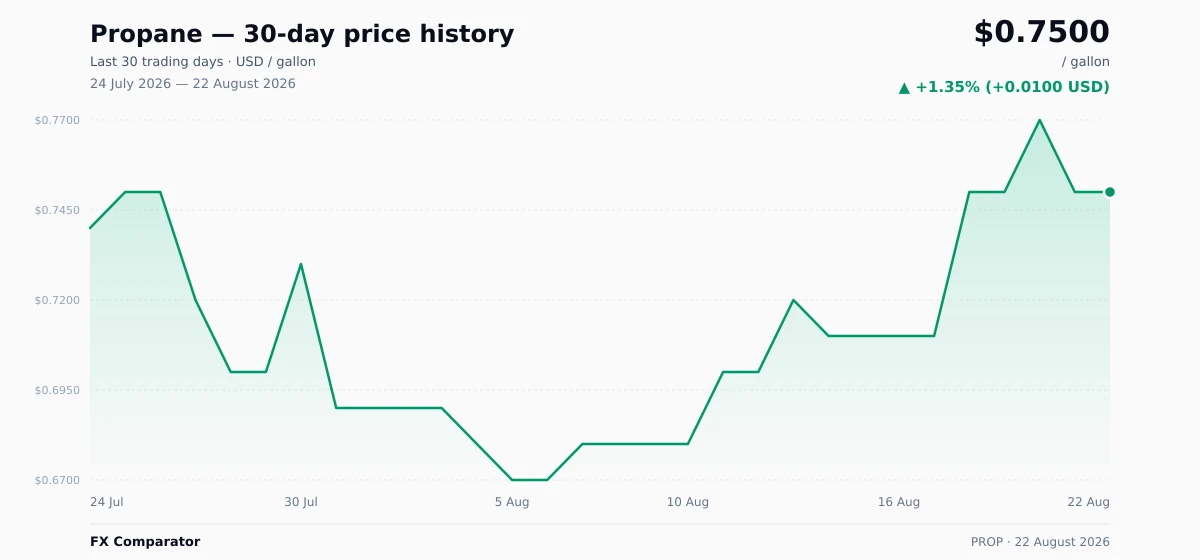
Download chart: WebP
Daily close
22 trading days
| Date | Price (USD) | Price (EUR) | Price (GBP) | Daily change |
|---|---|---|---|---|
| 8 Oct 2026 | US$0.9400 | €0.8403 | £0.7117 | ▲ +2.17% |
| 7 Oct 2026 | US$0.9200 | €0.8225 | £0.6966 | ▲ +1.10% |
| 6 Oct 2026 | US$0.9100 | €0.8135 | £0.6890 | ▼ −2.15% |
| 5 Oct 2026 | US$0.9300 | €0.8314 | £0.7042 | ▲ +2.20% |
| 3 Oct 2026 | US$0.9100 | €0.8135 | £0.6890 | ▲ +1.11% |
| 2 Oct 2026 | US$0.9000 | €0.8046 | £0.6815 | ▲ +1.12% |
| 1 Oct 2026 | US$0.8900 | €0.7956 | £0.6739 | ▼ −2.20% |
| 30 Sept 2026 | US$0.9100 | €0.8135 | £0.6890 | ▲ +2.25% |
| 29 Sept 2026 | US$0.8900 | €0.7956 | £0.6739 | ▲ +2.30% |
| 26 Sept 2026 | US$0.8700 | €0.7778 | £0.6587 | ▼ −2.25% |
| 24 Sept 2026 | US$0.8900 | €0.7956 | £0.6739 | ▲ +1.14% |
| 23 Sept 2026 | US$0.8800 | €0.7867 | £0.6663 | ▲ +4.76% |
| 22 Sept 2026 | US$0.8400 | €0.7509 | £0.6360 | ▲ +1.20% |
| 21 Sept 2026 | US$0.8300 | €0.7420 | £0.6285 | ▼ −1.19% |
| 18 Sept 2026 | US$0.8400 | €0.7509 | £0.6360 | ▼ −1.18% |
| 17 Sept 2026 | US$0.8500 | €0.7599 | £0.6436 | ▼ −2.30% |
| 16 Sept 2026 | US$0.8700 | €0.7778 | £0.6587 | ▲ +2.35% |
| 14 Sept 2026 | US$0.8500 | €0.7599 | £0.6436 | ▲ +1.19% |
| 12 Sept 2026 | US$0.8400 | €0.7509 | £0.6360 | ▼ −2.33% |
| 11 Sept 2026 | US$0.8600 | €0.7688 | £0.6512 | ▲ +1.18% |
| 10 Sept 2026 | US$0.8500 | €0.7599 | £0.6436 | ▲ +2.41% |
| 9 Sept 2026 | US$0.8300 | €0.7420 | £0.6285 | — |