Industrial metals · SODASH

Soda ash price

Soda ash currently trades at US$1,196 per tonne (≈ €1,017 · £891.38) — 14.20% below the 12-month high. Over the past 12 months it has lost 14.20%, with the annual range running from US$1,158 to US$1,394. 24-hour movement is minimal (±0.00%).
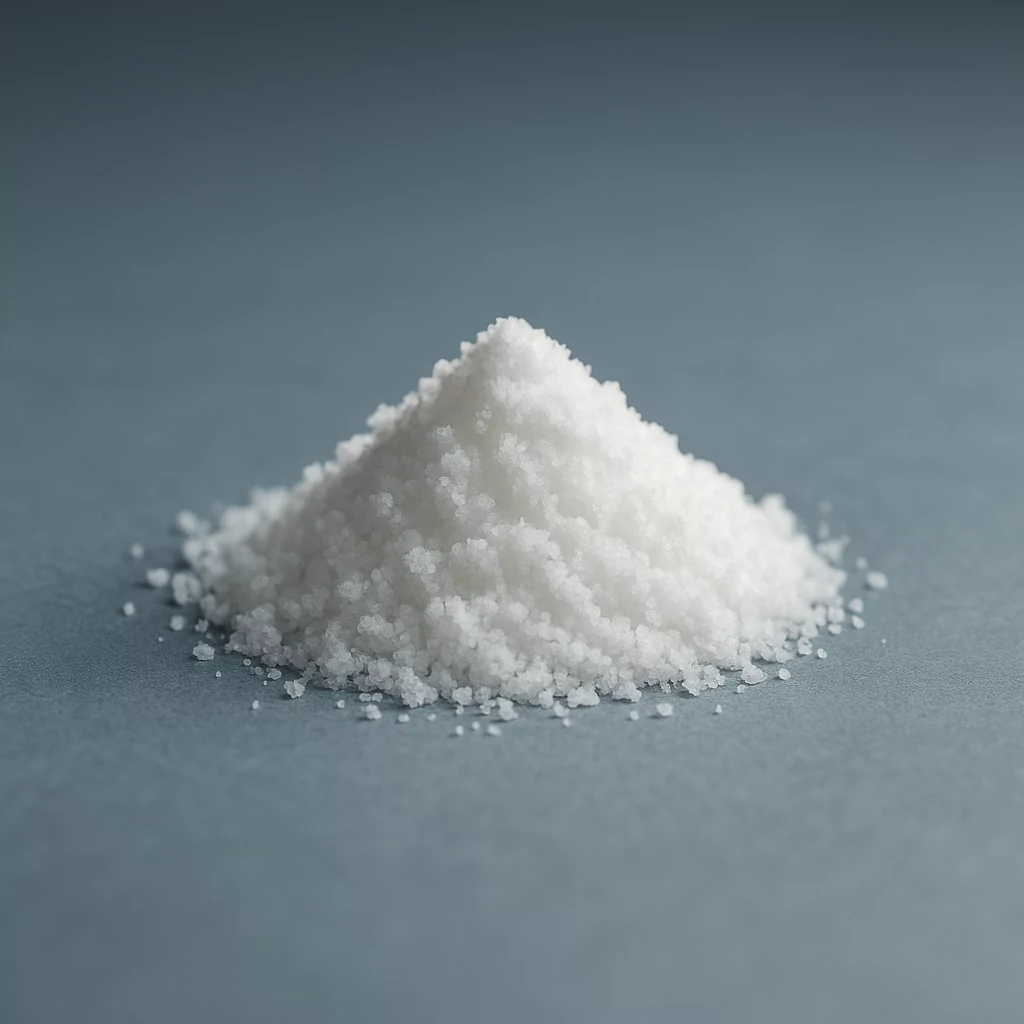
US$1,196 / tonne
≈ €1,017 ≈ £891.38 Unchanged 24h 16% within the 52-week range
FX Editorial Team · Data updated: · Editorially verified
Soda ash (SODASH) price today US$1,196 / tonne, ↑ +0.00% (24h)

Soda ash chart

Interactive chart and 30-day overview

7 days
Unchanged
30 days
▼ −2.13%
−US$26.00
1 year
▼ −14.20%
−US$198.00
52-week range
US$1,158 16% US$1,394
Soda ash (SODASH) 30-day price chart — USD, EUR, GBP

The Soda ash chart shows how the soda ash price has moved over time. The interactive view lets you switch the timeframe (from 7 days up to MAX), the currency (USD / EUR / GBP) and overlay moving averages. Click any two points to measure the percentage change between those dates.

How is soda ash priced?

Soda ash is priced per metric tonne (1 t = 1,000 kg) — the standard unit for industrial and bulk commodities on the London Metal Exchange (LME), CME and major European exchanges. Wholesale shipments move in containers or bulk vessels, typically in 25-tonne or 100-tonne lots.

At US$1,196 per tonne, one kilogram is worth US$1.20. End-user pricing for processed goods includes refining margins, transport and tariffs on top of the wholesale benchmark.

What drives the price of soda ash?

The main driver of the soda ash market is the combined flat-glass demand cycle in construction and solar power. Almost half of global soda ash consumption goes into glassmaking. Within that, flat glass, or float glass, is the dominant end use: producing one tonne of flat glass requires about 0.2 tonnes of soda ash. Flat-glass demand is driven by two large markets — window and façade glazing in construction, including housing starts and commercial property refurbishment, and cover glass for photovoltaic solar panels. An average 400 W solar panel contains about 6 kg of flat glass. Global solar installations, at several hundred GW a year, add structural demand for flat glass and, through that, for soda ash. Capacity utilisation at Chinese flat-glass producers such as Xinyi Glass, Flat Glass Group and CSG Holding feeds directly into ICIS and IHS Markit FOB soda ash assessments.

The second major factor is Chinese synthetic Solvay capacity and environmental regulation. China accounts for about 32 million tonnes of global soda ash output of roughly 70 million tonnes, or close to half. Most of that volume is produced through the synthetic Solvay process, which uses brine, limestone and ammonia and requires significant energy and water. Solvay plants such as Shandong Haihua, Tangshan Sanyou and Hubei Shuanghuan are sensitive to Chinese coal and electricity prices, as well as to the ammonia market, a feedstock also used in urea synthesis. Tighter Chinese environmental rules, especially during the winter pollution season in northern China, can lead to periodic production curbs, which may be reflected in FOB assessments.

The third structural factor is the split in the cost curve between natural and synthetic production routes. The Green River basin in Wyoming has an unusually large trona resource, with about 90% of the world’s known trona reserves located there. Mining, calcining and refining trona is materially cheaper than the Solvay process. Genesis Energy (GEL), the Wyoming subsidiary of Tata Chemicals (TATACHEM.NS), Sisecam’s Wyoming business and Solvay’s (SOLB.BR) natural trona operations sit at the low end of the global cost curve, with production costs of about USD 120–150 per tonne. By contrast, Chinese and European synthetic Solvay plants produce at around USD 200–250 per tonne because of higher energy and ammonia costs. This gives US trona producers a sustained export cost advantage into South America, south-east Asia and Europe.

How to invest in soda ash

European retail investors generally do not have access to a direct soda ash CFD. Neither XTB nor eToro offers a soda ash futures contract, as there is no liquid global futures benchmark. Physical trade is priced mainly against IHS Markit, ICIS and Argus assessments. Soda ash exposure is usually built through integrated soda ash and chemicals shares. Genesis Energy (GEL — a Wyoming trona MLP), Tata Chemicals (TATACHEM.NS — an Indian chemicals group with a Wyoming trona operation) and Solvay (SOLB.BR — a Belgian chemicals group with a Green River trona mine) provide more direct market exposure. International listed shares can often be held in a standard brokerage account or, where available, in tax-efficient accounts such as a UK ISA or similar EU wrappers. Some also pay dividends.

30-day price history

Chart and daily closing prices
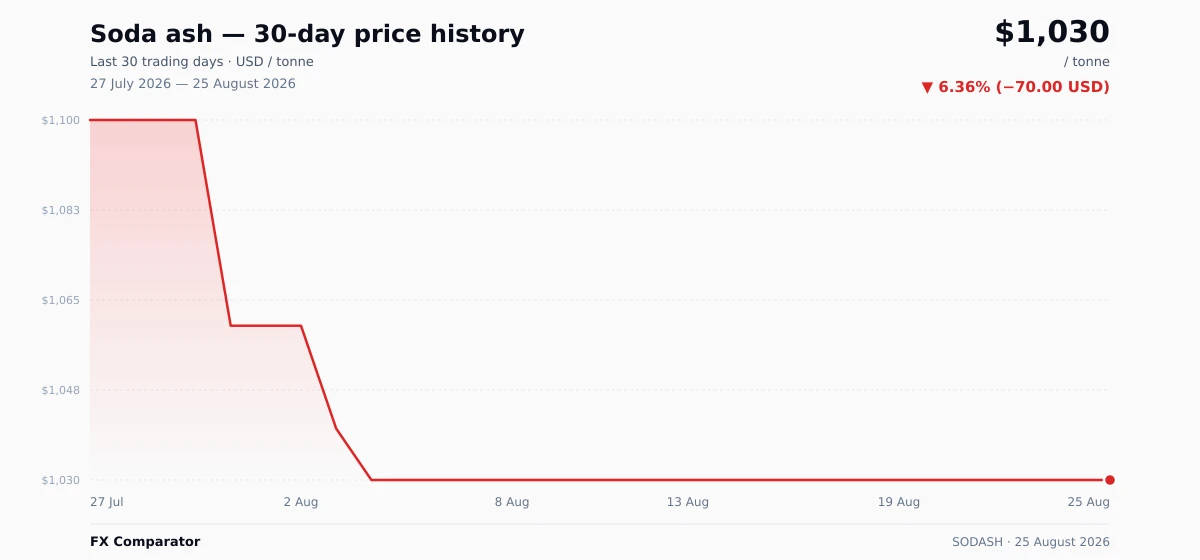
Soda ash (SODASH) 30-day price chart — USD, EUR, GBP

Daily close

30 trading days

Date Price (USD) Price (EUR) Price (GBP) Daily change
13 May 2026 US$1,196 €1,017 £891.38 ▼ −1.32%
10 May 2026 US$1,212 €1,031 £903.30 ▼ −0.82%
20 Apr 2026 US$1,222 €1,039 £910.76

Soda ash: frequently asked questions

What is soda ash and how is it used in industry? +
Soda ash (Na₂CO₃, sodium carbonate) is a white, crystalline, basic industrial chemical. It is produced through two main routes: the synthetic Solvay process, using brine, limestone and ammonia, or by mining and calcining the natural mineral trona. The largest users of global annual production of about 70 million tonnes are glassmaking, at roughly 50% across flat glass, container glass and fibreglass; detergents and cleaning products, at about 15%; chemical derivatives such as sodium silicate, sodium bicarbonate and sodium phosphates, at about 15%; and the growing lithium battery industry, where soda ash is used in lithium carbonate (Li₂CO₃) conversion.
Why is there no liquid global soda ash futures contract? +
The physical soda ash market is dominated by a concentrated producer base and long-term bilateral contracts. It therefore lacks the fragmented, standardised market structure that typically supports exchange-traded futures. A large share of global production is sold to major glass and detergent producers such as Saint-Gobain, Owens-Illinois and Procter & Gamble through three- to 12-month OEM contracts. Pricing is based on weekly or monthly FOB assessments per tonne from IHS Markit Soda Ash, ICIS Soda Ash and Argus Soda Ash, usually in US dollars. Spot transactions for prompt delivery exist, but they are not futures contracts. Derivatives such as CFDs and options are, in practice, not widely available through retail brokers.
How much do 1 kg and 100 kg of soda ash cost based on an FOB assessment? +
Using a 280 USD/tonne example, 1 kg of industrial soda ash is about 0.28 USD (280 ÷ 1000), while 100 kg is about 28 USD. This is a wholesale FOB industrial reference price. Packaged household washing soda sold in retail stores is usually much more expensive because of packaging, transport, local taxes and retail margins. Large industrial shipments used in lithium carbonate production or glassmaking are more closely linked to IHS Markit, ICIS and Argus assessments, usually with a small premium.
What is the difference between the Solvay process and natural trona mining? +
The Solvay process is a synthetic chemical production route. It makes soda ash from brine (NaCl), limestone (CaCO₃) and ammonia (NH₃), with the ammonia recovered and recirculated. It is energy- and water-intensive, produces significant CO₂ and chloride by-products, and has production costs of about USD 200–250 per tonne. Natural trona mining, by contrast, uses the trona mineral (Na₃H(CO₃)₂·2H₂O) found in the Green River basin in Wyoming. The ore is mined, solution-mined and calcined. Production costs are only about USD 120–150 per tonne, with much lower energy use and CO₂ intensity. About 90% of global trona reserves are concentrated in Wyoming, with smaller deposits in Turkey, China and Botswana.
Which countries are the largest soda ash producers? +
Global soda ash production is tracked in the USGS Mineral Commodity Summaries (MCS Soda Ash). The three largest producers are China, at about 32 Mt a year, dominated by synthetic Solvay plants such as Shandong Haihua, Tangshan Sanyou and Hubei Shuanghuan; the United States, at about 12 Mt, mostly natural trona from Wyoming producers including Genesis Energy, Tata Chemicals, Ciner Resources and Solvay; and Turkey, at about 4 Mt, led by the Eti Soda and Kazan Soda natural trona operations. They are followed by Russia, at about 3 Mt, and India, at about 3 Mt, including Tata Chemicals’ Mithapur operation. In Europe, Solvay (SOLB.BR), Ciech in Poland and CIECH-Soda Polska are among the main producers. A large share of US production is export-oriented, with significant volumes shipped to South America and south-east Asia.
How is the rise of lithium batteries linked to the soda ash market? +
A core precursor for lithium battery cathode active materials is lithium carbonate (Li₂CO₃), produced either from Australian spodumene concentrate or from South American brines in Chile and Argentina. Both conversion routes require soda ash. In spodumene conversion, lithium sulphate (Li₂SO₄) from acid leaching is converted into carbonate form using soda ash. In the brine route, soda ash is added during concentrate purification and precipitation. Industry consensus is that producing 1 tonne of Li₂CO₃ requires about 1.5–1.7 tonnes of soda ash. Electric vehicle adoption and stationary battery deployment have made this a fast-growing demand pillar for the soda ash market.
Are there pure-play soda ash stocks available to retail investors? +
There are few listed pure-play soda ash companies available to retail investors. Genesis Energy (GEL) is a diversified MLP with a significant Wyoming trona operation. Broader chemicals exposure is available through Tata Chemicals (TATACHEM.NS) on India’s NSE, which has a large global soda ash presence across India, the US, the UK and Kenya, and Solvay (SOLB.BR) on the Brussels exchange, a Belgian chemicals group with a Wyoming trona operation. There is no pure soda ash ETF, but indirect exposure can be built through broader materials or chemicals ETFs, such as iShares MSCI Global Materials.
How are soda ash-linked shares taxed? +
Tax treatment varies by jurisdiction; consult a local tax adviser. This is particularly relevant for dividends, foreign withholding tax and securities with special structures such as the Genesis Energy (GEL) MLP.