Industrial metals · TEL

Tellurium price

Tellurium currently trades at US$802.50 per tonne (≈ €682.50 · £598.10) — effectively at the 12-month high. Over the past 12 months it has gained 8.45%, with the annual range running from US$580.00 to US$802.50. 24-hour movement is minimal (±0.00%).
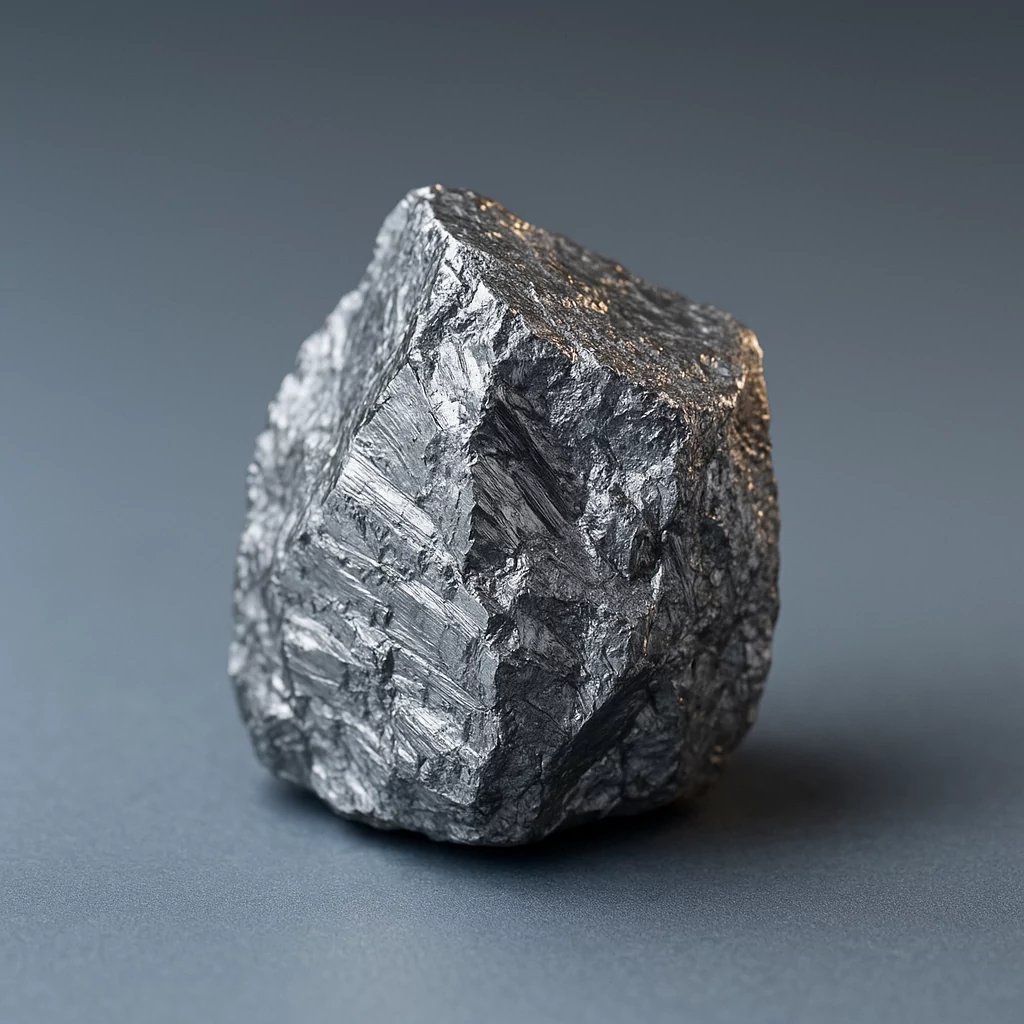
US$802.50 / tonne
≈ €682.50 ≈ £598.10 Unchanged 24h 100% within the 52-week range
FX Editorial Team · Data updated: · Editorially verified
Tellurium (TEL) price today US$802.50 / tonne, ↑ +0.00% (24h)

Tellurium chart

Interactive chart and 30-day overview

7 days
▲ +0.31%
+US$2.50
30 days
▲ +2.88%
+US$22.50
1 year
▲ +8.45%
+US$62.50
52-week range
US$580.00 100% US$802.50
Tellurium (TEL) 30-day price chart — USD, EUR, GBP

The Tellurium chart shows how the tellurium price has moved over time. The interactive view lets you switch the timeframe (from 7 days up to MAX), the currency (USD / EUR / GBP) and overlay moving averages. Click any two points to measure the percentage change between those dates.

How is tellurium priced?

Tellurium is priced per metric tonne (1 t = 1,000 kg) — the standard unit for industrial and bulk commodities on the London Metal Exchange (LME), CME and major European exchanges. Wholesale shipments move in containers or bulk vessels, typically in 25-tonne or 100-tonne lots.

At US$802.50 per tonne, one kilogram is worth US$0.8025. End-user pricing for processed goods includes refining margins, transport and tariffs on top of the wholesale benchmark.

What drives the price of tellurium?

The main source of demand is the cadmium telluride (CdTe) thin-film solar panel. CdTe modules have the second-largest market share in photovoltaics after crystalline silicon. At industrial scale, production is dominated by one company: First Solar, based in the US state of Arizona. Each square metre of module contains a few grams of tellurium, so First Solar’s annual capacity expansion and module shipment pace directly shape the path of global tellurium demand. The rest of demand is split between thermoelectric modules (Bi₂Te₃-based coolers, Peltier elements and waste-heat recovery), lead and steel alloys (to improve the mechanical properties of free-machining steels), and vulcanising additives for the rubber industry.

Supply is tied to copper smelting. Tellurium is extracted almost exclusively from the selenium and tellurium content of anode slimes produced during the electrolytic refining of copper anodes, at the end of the refining chain. According to the USGS Mineral Commodity Summaries, global refined tellurium production is about 600 tonnes/year. Roughly 60% is refined by China (~360 tonnes), 8% by Japan (~50 tonnes), 8% by the United States (~50 tonnes), with further output from Russia, Sweden and Canada. Because tellurium is recovered as a by-product of copper production, primary supply is tied to copper smelter utilisation and does not respond flexibly to a rise in tellurium’s own price.

The third structural factor is strategic supply risk. Tellurium appears in the US Department of Energy’s Critical Materials Strategy and on the USGS critical minerals list, because the CdTe solar industry and the thermoelectric sector depend on Chinese refining capacity. In the United States, the Defense Logistics Agency uses strategic stockpiling, while EU critical raw materials policy uses broader diversification and stockpiling tools to reduce supply shocks linked to concentration. The market’s other defining feature is its size: total annual refined output is roughly equivalent to a medium-sized precious-metals dealer’s weekly turnover, so even modest demand shifts can move spot prices.

How can investors get exposure to tellurium?

Tellurium has no exchange-traded futures market, so direct tellurium CFDs, ETFs or futures are not available through retail brokers. XTB and eToro do not offer a standalone tellurium product. Exposure can be built indirectly through three channels: the sole large-scale player in the CdTe solar industry, First Solar (FSLR); shares in large copper-smelting and mining companies such as Freeport-McMoRan and Southern Copper, where tellurium appears as a by-product; and critical raw materials and rare-earth ETFs, such as VanEck Rare Earth & Strategic Metals — REMX. Two regulated brokers with English-language platforms where these shares and ETF packages can be bought are:

30-day price history

Chart and daily closing prices
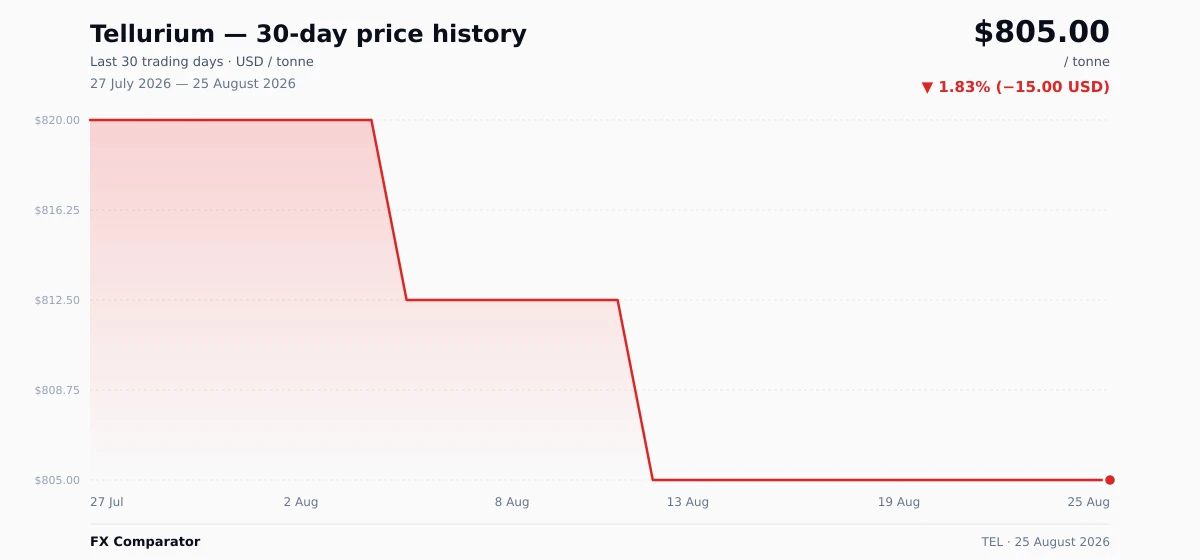
Tellurium (TEL) 30-day price chart — USD, EUR, GBP

Daily close

30 trading days

Date Price (USD) Price (EUR) Price (GBP) Daily change
20 May 2026 US$802.50 €682.50 £598.10 ▲ +0.31%
12 May 2026 US$800.00 €680.38 £596.24 ▲ +2.24%
29 Apr 2026 US$782.50 €665.49 £583.20 ▲ +0.32%
20 Apr 2026 US$780.00 €663.37 £581.33

Tellurium FAQ

Why is there no exchange-traded futures market for tellurium? +
Annual global refined tellurium output is only about ~600 tonnes. That is orders of magnitude smaller than trading volumes in copper, zinc or even tin. The volume and user base, typically large industrial buyers, solar module and thermoelectric module manufacturers, and copper smelters, do not justify a standalone exchange contract. Pricing therefore takes place through daily indices from specialist agencies such as Asian Metal, Fastmarkets MB and Argus Minor Metals, quoted in US dollars per kilogram or per tonne.
Why is tellurium a by-product of copper mining? +
In nature, tellurium is almost always found in copper sulphide ores at very low concentrations, typically a few grams per tonne. There is no standalone tellurium ore available in commercial quantities. During the electrolytic refining of copper anodes, pure copper is deposited on the cathode, while sludge that settles at the bottom of the anode, known as anode slime, contains selenium and tellurium. The metal is extracted from this material at the end of the refining chain. As a result, the base level of primary tellurium supply is set by global copper production volumes and smelter utilisation, not by tellurium’s own price.
What is cadmium telluride (CdTe), and why does it matter? +
CdTe is a compound of cadmium and tellurium used as the active layer in thin-film photovoltaic solar modules. CdTe modules typically have lower manufacturing costs and better temperature characteristics than crystalline silicon-based modules, which makes them common in utility-scale solar projects. CdTe has the second-largest market share in solar technology after crystalline silicon. At industrial scale, it is effectively produced by a single company, First Solar. That means the path of tellurium demand closely follows First Solar’s capacity expansion schedule.
How large is global tellurium production, and who are the biggest producers? +
According to the USGS Mineral Commodity Summaries, annual global refined tellurium production is about ~600 tonnes. The largest refiner is China, at about ~360 tonnes, or roughly 60% of global output, followed by Japan at ~50 tonnes, or ~8%, and the United States at ~50 tonnes, or ~8%. The remainder is produced by Russia, Sweden and Canada. Because of China’s weight in refining, Chinese export controls and the utilisation rates of domestic copper smelters feed directly into spot prices.
Why is tellurium on critical raw materials lists? +
The USGS critical minerals list, the US Department of Energy Critical Materials Strategy and the EU Critical Raw Materials Act cover raw materials that are important for strategic industries such as clean energy, semiconductors and defence, while supply is geographically concentrated and substitution is technologically limited. Tellurium appears on the US lists because of its use in CdTe solar modules and thermoelectrics, and because of China’s dominant role in refining.
Can investors buy tellurium directly on XTB or eToro? +
No. Neither XTB nor eToro offers a standalone tellurium CFD, ETF or futures product, because tellurium has no exchange-traded market. Exposure can be built indirectly through the only large-scale player in the CdTe solar industry, First Solar (FSLR), through large copper producers such as Freeport-McMoRan and Southern Copper, where tellurium appears as a by-product of electrolytic copper refining, or through broader critical raw materials and rare-earth ETFs, such as VanEck Rare Earth & Strategic Metals — REMX.
What does “99.95%” tellurium mean? +
The standard industrial grade of tellurium is 99.95%, or three-and-a-half nines purity, known in English industry jargon as “3N5”. For CdTe solar and thermoelectric end-use, this purity level is the basic market standard. The daily indices published by Asian Metal, Fastmarkets MB and Argus Minor Metals typically refer to this grade. Higher-purity “4N” (99.99%), “5N” (99.999%) and “6N” (99.9999%) grades are used in specialised semiconductor and optoelectronic applications and trade at a meaningful premium to the 3N5 spot price.
Why is tellurium becoming more strategically significant? +
Growth in solar capacity and the wider use of thin-film photovoltaic technology directly raise demand for tellurium. Each installed megawatt of CdTe modules requires a specific amount of metallurgically produced tellurium. Because supply is tied to copper smelting and cannot be scaled independently, waves of investment in the solar industry can tighten the market. In response, the US Defense Logistics Agency uses strategic stockpiling, while EU critical raw materials policy aims more broadly to reduce supply risks caused by geographic concentration.