Gold price
Gold currently trades at US$4,120 per troy ounce (≈ €3,683 · £3,120) — 26.54% below the 12-month high. Over the past 12 months the price has gained 2.70%, with the annual range running from US$3,887 to US$5,608. In the past 24 hours the price has risen by 0.22%.


Invest in commodity ETFs from just $50
Gold, oil and even whole commodity sectors through ETFs, all in one account, kept simple.
eToro is a multi-asset investment platform. The value of your investments may go up or down. Your capital is at risk.
Gold chart
Interactive chart and 30-day overview
The Gold chart shows how the gold price has moved over time. The interactive view lets you switch the timeframe (from 7 days up to MAX), the currency (USD / EUR / GBP) and overlay moving averages. Click any two points to measure the percentage change between those dates.
How is gold priced?
Gold is quoted in troy ounces on the global market (1 T.oz = 31.1035 g). The unit traces back to medieval Champagne fairs in Troyes, France, and is the standard for precious-metals trading at the London Bullion Market Association (LBMA), COMEX and the Shanghai Gold Exchange.
At the current US$4,120 per troy ounce, one gram costs about US$132.46 and a one-kilogram bar is worth around US$132,463. Retail bars and coins typically trade at a premium to spot — small denominations carry higher fabrication and certification costs as a percentage, while kilo-bars sit closest to the wholesale price.
What drives the price of gold?
Gold is one of the oldest monetary assets. Its market price is shaped by several independent forces. The most important is central bank demand: central banks buy gold to diversify reserves, and that demand has become a material long-term factor. Another is geopolitical uncertainty. During wars, trade tensions or periods of weakening confidence in the global system, investors often treat gold as a haven asset, which can lift prices.
The second group of drivers is monetary policy and inflation expectations. Gold pays no interest, so its appeal relative to bonds and bank deposits depends on real interest rates — nominal yields minus inflation. When real rates are low or negative, gold tends to look more attractive. The strength of the US dollar also has an inverse relationship with the gold price: a weaker dollar usually means a higher USD gold price, and vice versa.
The third factor is physical supply and demand. Annual gold mining produces about 3,500 tonnes. Demand comes mainly from jewellery, especially in India and China, investment products such as ETFs, coins and bars, and industrial uses including electronics and dentistry. Mine supply responds slowly to price changes. Developing a new gold deposit can take 8–15 years, while output from existing mines also tends to decline over time.
How to invest in gold
A European retail investor can gain exposure to gold in several ways. Physical gold — investment bars and coins — is the traditional route. It offers direct ownership and no counterparty risk, but involves storage costs and often wide retail spreads. Gold ETCs, European products such as iShares Physical Gold ETC — SGLN or Invesco Physical Gold — SGLD, provide paper exposure to physical gold through a brokerage account, typically with low ongoing fees of about 0.2–0.4% a year. Gold-mining shares and ETFs, such as Newmont, Barrick and VanEck GDX, offer leveraged exposure to the gold price, with higher potential returns and higher volatility. Traders can also speculate directly on GOLD through CFDs. These are leveraged products and carry high risk.
30-day price history
Chart and daily closing prices
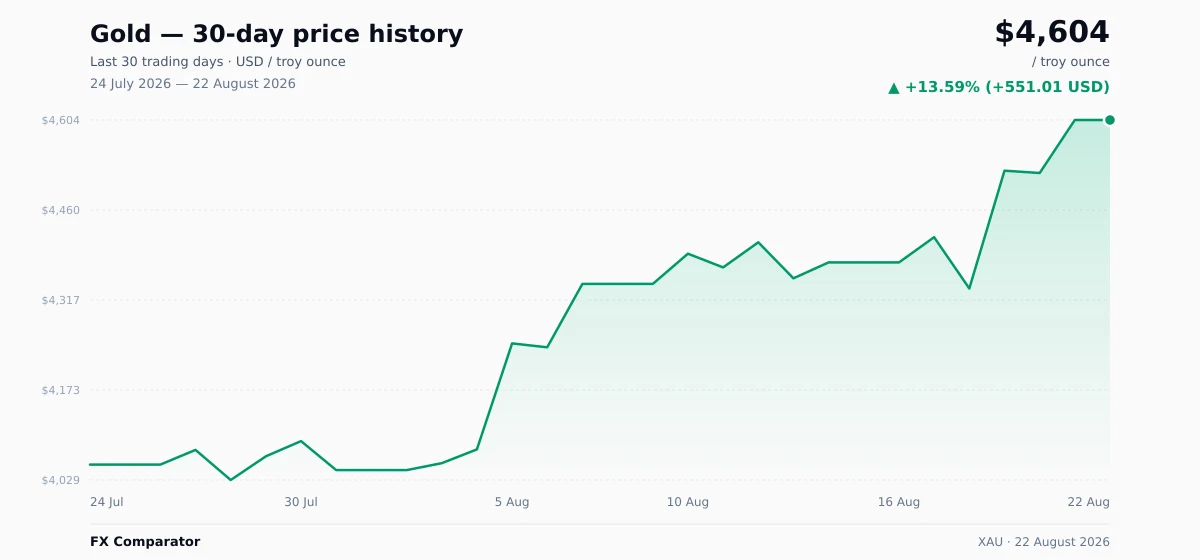
Download chart: WebP
Daily close
21 trading days
| Date | Price (USD) | Price (EUR) | Price (GBP) | Daily change |
|---|---|---|---|---|
| 8 Oct 2026 | US$4,120 | €3,683 | £3,120 | ▲ +0.22% |
| 7 Oct 2026 | US$4,111 | €3,675 | £3,113 | ▼ −1.28% |
| 6 Oct 2026 | US$4,164 | €3,723 | £3,153 | ▲ +0.57% |
| 2 Oct 2026 | US$4,141 | €3,702 | £3,135 | ▼ −0.88% |
| 1 Oct 2026 | US$4,178 | €3,735 | £3,163 | ▲ +0.49% |
| 30 Sept 2026 | US$4,157 | €3,717 | £3,148 | ▼ −0.59% |
| 29 Sept 2026 | US$4,182 | €3,739 | £3,167 | ▲ +1.63% |
| 28 Sept 2026 | US$4,115 | €3,679 | £3,116 | ▼ −3.98% |
| 25 Sept 2026 | US$4,286 | €3,832 | £3,245 | ▲ +0.29% |
| 24 Sept 2026 | US$4,274 | €3,821 | £3,236 | ▼ −0.32% |
| 23 Sept 2026 | US$4,288 | €3,833 | £3,247 | ▼ −1.63% |
| 22 Sept 2026 | US$4,359 | €3,897 | £3,300 | ▲ +0.34% |
| 21 Sept 2026 | US$4,344 | €3,883 | £3,289 | ▼ −0.78% |
| 18 Sept 2026 | US$4,378 | €3,914 | £3,315 | ▲ +0.84% |
| 17 Sept 2026 | US$4,342 | €3,882 | £3,288 | ▲ +1.82% |
| 16 Sept 2026 | US$4,265 | €3,812 | £3,229 | ▼ −0.69% |
| 15 Sept 2026 | US$4,294 | €3,839 | £3,252 | ▼ −0.11% |
| 14 Sept 2026 | US$4,299 | €3,843 | £3,255 | ▼ −1.16% |
| 11 Sept 2026 | US$4,349 | €3,888 | £3,293 | ▲ +0.75% |
| 10 Sept 2026 | US$4,317 | €3,859 | £3,269 | ▼ −1.93% |
| 9 Sept 2026 | US$4,402 | €3,935 | £3,333 | — |