Palladium price
Palladium currently trades at US$1,127 per troy ounce (≈ €1,007 · £853.19) — 47.92% below the 12-month high. Over the past 12 months the price has lost 20.92%, with the annual range running from US$1,124 to US$2,164. In the past 24 hours the price has risen by 0.28%.

Invest in commodity ETFs from just $50
Gold, oil and even whole commodity sectors through ETFs, all in one account, kept simple.
eToro is a multi-asset investment platform. The value of your investments may go up or down. Your capital is at risk.
Palladium chart
Interactive chart and 30-day overview
The Palladium chart shows how the palladium price has moved over time. The interactive view lets you switch the timeframe (from 7 days up to MAX), the currency (USD / EUR / GBP) and overlay moving averages. Click any two points to measure the percentage change between those dates.
How is palladium priced?
Palladium is quoted in troy ounces on the global market (1 T.oz = 31.1035 g). The unit traces back to medieval Champagne fairs in Troyes, France, and is the standard for precious-metals trading at the London Bullion Market Association (LBMA), COMEX and the Shanghai Gold Exchange.
At the current US$1,127 per troy ounce, one gram costs about US$36.23 and a one-kilogram bar is worth around US$36,227. Retail bars and coins typically trade at a premium to spot — small denominations carry higher fabrication and certification costs as a percentage, while kilo-bars sit closest to the wholesale price.
What drives the price of palladium?
Palladium is unusual among precious metals: it is an industrial metal that also trades as an investment product. About 80% of demand comes from automotive catalytic converters. In three-way catalysts for petrol internal combustion engines, palladium helps neutralise carbon monoxide, hydrocarbons and nitrogen oxides. The price therefore tracks global car-production cycles, including sales in China, Europe and North America, and tighter emissions rules such as Euro 7 and China 7.
Supply is highly concentrated by geography, which is another defining feature of the market. Russia accounts for almost 40% of global mine output, which is about 210 tonnes a year, mainly from Norilsk Nickel’s deposits on the Taimyr Peninsula, at about 85 tonnes. South Africa supplies a further roughly 35%, through producers such as Sibanye-Stillwater, Anglo American Platinum and Impala Platinum, at about 75 tonnes. Russian export restrictions, South African mining strikes and power shortages linked to Eskom load-shedding can feed directly into prices. Canada, the US and Zimbabwe produce most of the rest.
The third factor is substitution and recycling. The price ratio between palladium and platinum influences which metal catalyst makers prefer. In an earlier market cycle, a sustained premium for palladium encouraged a shift back towards platinum in petrol-engine catalysts. Recycled palladium, mainly from spent catalytic converters and known as secondary supply, adds 70–90 tonnes a year to mine production and can act as a stabilising force after price spikes.
How can investors get exposure to palladium?
European retail investors have three main routes: physical palladium, such as bars and coins from refiners including Argor-Heraeus, Heraeus, Valcambi and PAMP Suisse; palladium-backed exchange-traded products, mainly ETCs; and shares in major mining companies. Exchange-traded exposure is available through a brokerage account. Below are two regulated online brokers active in Europe.
30-day price history
Chart and daily closing prices
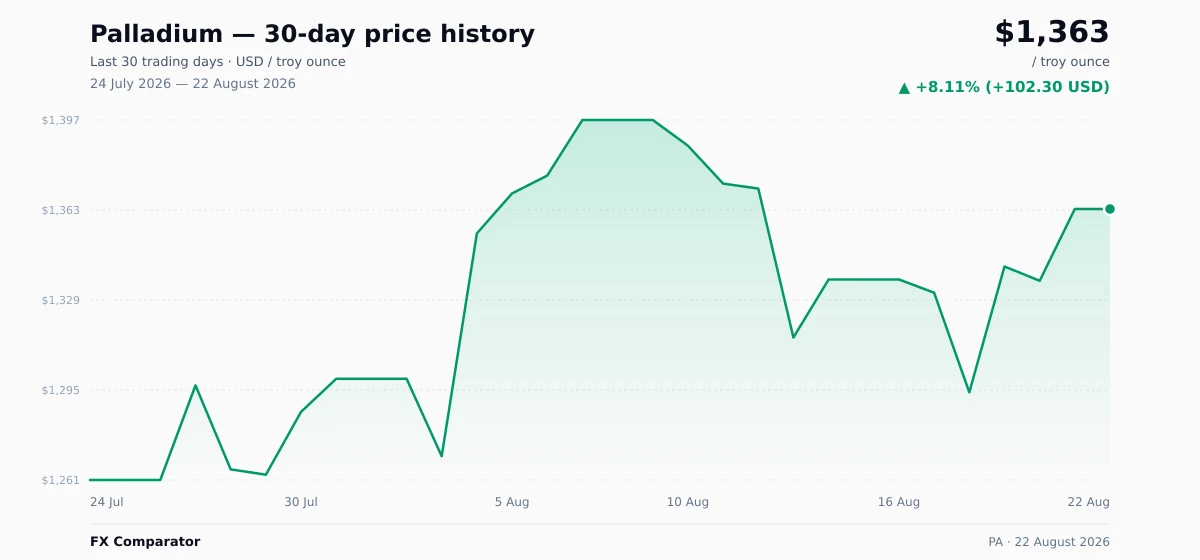
Download chart: WebP
Daily close
22 trading days
| Date | Price (USD) | Price (EUR) | Price (GBP) | Daily change |
|---|---|---|---|---|
| 8 Oct 2026 | US$1,127 | €1,007 | £853.19 | ▲ +0.28% |
| 7 Oct 2026 | US$1,124 | €1,005 | £850.84 | ▼ −4.45% |
| 6 Oct 2026 | US$1,176 | €1,051 | £890.44 | ▼ −0.54% |
| 5 Oct 2026 | US$1,182 | €1,057 | £895.29 | ▼ −0.66% |
| 2 Oct 2026 | US$1,190 | €1,064 | £901.27 | ▲ +0.18% |
| 1 Oct 2026 | US$1,188 | €1,062 | £899.68 | ▼ −1.87% |
| 30 Sept 2026 | US$1,211 | €1,082 | £916.79 | ▼ −1.52% |
| 29 Sept 2026 | US$1,230 | €1,099 | £930.95 | ▲ +1.26% |
| 28 Sept 2026 | US$1,214 | €1,085 | £919.37 | ▼ −5.10% |
| 25 Sept 2026 | US$1,279 | €1,144 | £968.74 | ▲ +1.26% |
| 24 Sept 2026 | US$1,264 | €1,130 | £956.70 | ▼ −0.73% |
| 23 Sept 2026 | US$1,273 | €1,138 | £963.74 | ▼ −3.19% |
| 22 Sept 2026 | US$1,315 | €1,175 | £995.54 | ▲ +0.06% |
| 21 Sept 2026 | US$1,314 | €1,175 | £994.93 | ▲ +0.36% |
| 18 Sept 2026 | US$1,309 | €1,170 | £991.38 | ▲ +1.88% |
| 17 Sept 2026 | US$1,285 | €1,149 | £973.13 | ▲ +0.19% |
| 16 Sept 2026 | US$1,283 | €1,147 | £971.31 | ▼ −1.98% |
| 15 Sept 2026 | US$1,309 | €1,170 | £990.92 | ▲ +1.43% |
| 14 Sept 2026 | US$1,290 | €1,153 | £976.91 | ▼ −1.48% |
| 11 Sept 2026 | US$1,310 | €1,171 | £991.60 | ▲ +1.79% |
| 10 Sept 2026 | US$1,287 | €1,150 | £974.19 | ▼ −5.28% |
| 9 Sept 2026 | US$1,358 | €1,214 | £1,028 | — |