Silver price
Silver currently trades at US$58.91 per troy ounce (≈ €52.66 · £44.61) — 50.37% below the 12-month high. Over the past 12 months the price has gained 20.82%, with the annual range running from US$45.53 to US$118.70. In the past 24 hours the price has fallen by 1.54%.

Invest in commodity ETFs from just $50
Gold, oil and even whole commodity sectors through ETFs, all in one account, kept simple.
eToro is a multi-asset investment platform. The value of your investments may go up or down. Your capital is at risk.
Silver chart
Interactive chart and 30-day overview
The Silver chart shows how the silver price has moved over time. The interactive view lets you switch the timeframe (from 7 days up to MAX), the currency (USD / EUR / GBP) and overlay moving averages. Click any two points to measure the percentage change between those dates.
How is silver priced?
Silver is quoted in troy ounces on the global market (1 T.oz = 31.1035 g). The unit traces back to medieval Champagne fairs in Troyes, France, and is the standard for precious-metals trading at the London Bullion Market Association (LBMA), COMEX and the Shanghai Gold Exchange.
At the current US$58.91 per troy ounce, one gram costs about US$1.89 and a one-kilogram bar is worth around US$1,894. Retail bars and coins typically trade at a premium to spot — small denominations carry higher fabrication and certification costs as a percentage, while kilo-bars sit closest to the wholesale price.
What drives the price of silver?
Silver is a dual-purpose asset: both a precious metal and an industrial raw material. Almost half of annual global use — about 50%, according to the Silver Institute — goes to industrial applications: solar panels (photovoltaic cells), electronics, automotive electrical systems, brazing alloys, medical devices and 5G network components. The rest is split between jewellery, silverware and investment demand, including coins, bars and exchange-traded products. This structure helps explain why silver is more sensitive to the global industrial cycle than gold.
Supply is driven by mine production and recycling. Annual global mine output is around 25,000 tonnes. Mexico is the largest producer, followed by China and Peru. A structural feature of the market is that 70-80% of mined silver comes to the surface as a by-product of copper, lead and zinc mines. Silver supply is therefore tied to base-metals markets and does not respond flexibly to a rise in the silver price. The Silver Institute has recorded a structural deficit in the market for several years, with demand exceeding primary supply.
On the monetary side, silver is influenced by real interest rates, the strength of the dollar and inflation expectations — similar to gold, but usually with larger price swings. Market participants often refer to the gold-silver ratio: the number of ounces of silver needed to buy one ounce of gold. The long-run average is around 60-70, but the ratio can move from 30 to above 100 in extreme market conditions. It is a common reference point for the relative valuation of the two metals.
How to invest in silver
European retail investors can access the silver market through several routes: physical coins and bars from regulated bullion dealers, such as The Royal Mint in the UK, BullionVault or GoldMoney; exchange-traded products, including European silver ETCs; shares in silver miners and streamers, such as Pan American Silver, First Majestic Silver and Wheaton Precious Metals; and futures or CFD positions. Paper-based exposure avoids physical storage costs and dealer premiums, but investors do not own physical metal. Two regulated brokers where European silver ETCs, silver-mining shares and XAG/USD CFDs are available:
30-day price history
Chart and daily closing prices
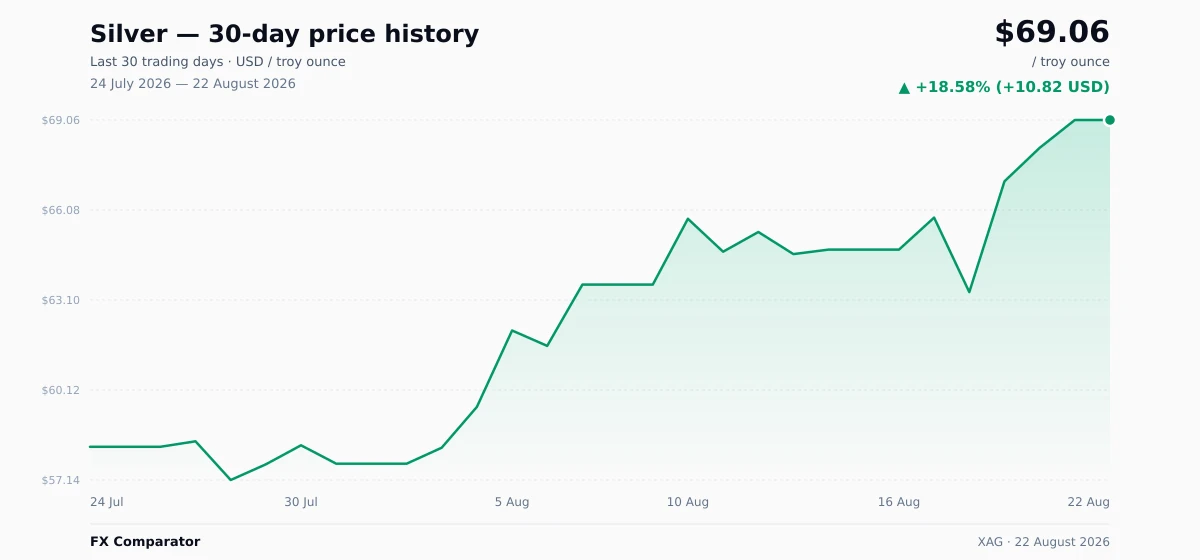
Download chart: WebP
Daily close
22 trading days
| Date | Price (USD) | Price (EUR) | Price (GBP) | Daily change |
|---|---|---|---|---|
| 8 Oct 2026 | US$58.91 | €52.66 | £44.61 | ▼ −1.54% |
| 7 Oct 2026 | US$59.83 | €53.49 | £45.30 | ▼ −2.56% |
| 6 Oct 2026 | US$61.40 | €54.89 | £46.49 | ▲ +0.49% |
| 5 Oct 2026 | US$61.10 | €54.62 | £46.26 | ▲ +1.14% |
| 2 Oct 2026 | US$60.41 | €54.00 | £45.74 | ▼ −1.02% |
| 1 Oct 2026 | US$61.03 | €54.56 | £46.21 | ▲ +0.96% |
| 30 Sept 2026 | US$60.45 | €54.04 | £45.77 | ▼ −1.72% |
| 29 Sept 2026 | US$61.51 | €54.99 | £46.57 | ▲ +1.35% |
| 28 Sept 2026 | US$60.69 | €54.26 | £45.95 | ▼ −5.67% |
| 25 Sept 2026 | US$64.34 | €57.52 | £48.72 | ▲ +0.70% |
| 24 Sept 2026 | US$63.89 | €57.12 | £48.38 | ▼ −0.93% |
| 23 Sept 2026 | US$64.49 | €57.65 | £48.83 | ▼ −3.89% |
| 22 Sept 2026 | US$67.10 | €59.99 | £50.81 | ▲ +1.56% |
| 21 Sept 2026 | US$66.07 | €59.06 | £50.03 | ▼ −0.32% |
| 18 Sept 2026 | US$66.28 | €59.25 | £50.19 | ▲ +1.56% |
| 17 Sept 2026 | US$65.26 | €58.34 | £49.41 | ▲ +3.55% |
| 16 Sept 2026 | US$63.02 | €56.34 | £47.72 | ▼ −1.10% |
| 15 Sept 2026 | US$63.72 | €56.96 | £48.25 | ▲ +0.70% |
| 14 Sept 2026 | US$63.28 | €56.57 | £47.91 | ▼ −1.94% |
| 11 Sept 2026 | US$64.53 | €57.69 | £48.86 | ▲ +1.45% |
| 10 Sept 2026 | US$63.61 | €56.87 | £48.16 | ▼ −5.53% |
| 9 Sept 2026 | US$67.33 | €60.19 | £50.98 | — |