Rhodium price
Rhodium currently trades at US$9,000 per troy ounce (≈ €8,046 · £6,815) — 26.53% below the 12-month high. Over the past 12 months the price has gained 25.87%, with the annual range running from US$7,150 to US$12,250. 24-hour movement is minimal (±0.00%).

Invest in commodity ETFs from just $50
Gold, oil and even whole commodity sectors through ETFs, all in one account, kept simple.
eToro is a multi-asset investment platform. The value of your investments may go up or down. Your capital is at risk.
Rhodium chart
Interactive chart and 30-day overview
The Rhodium chart shows how the rhodium price has moved over time. The interactive view lets you switch the timeframe (from 7 days up to MAX), the currency (USD / EUR / GBP) and overlay moving averages. Click any two points to measure the percentage change between those dates.
How is rhodium priced?
Rhodium is quoted in troy ounces on the global market (1 T.oz = 31.1035 g). The unit traces back to medieval Champagne fairs in Troyes, France, and is the standard for precious-metals trading at the London Bullion Market Association (LBMA), COMEX and the Shanghai Gold Exchange.
At the current US$9,000 per troy ounce, one gram costs about US$289.36 and a one-kilogram bar is worth around US$289,357. Retail bars and coins typically trade at a premium to spot — small denominations carry higher fabrication and certification costs as a percentage, while kilo-bars sit closest to the wholesale price.
What drives the price of rhodium?
About 80–85% of rhodium demand comes from catalytic converters for petrol cars. In three-way catalytic converters, rhodium breaks down nitrogen oxides (NOx). No other metal performs this task with comparable efficiency. Tighter emissions standards, including Euro 6 in the EU, Bharat 6 in India and China 6 in China, directly increase rhodium loadings per vehicle. The price therefore tracks global car-production cycles and the rollout of emissions rules. The rest of demand comes from glassmaking, including crucibles for LCD and specialty glass, platinum coatings for jewellery, and chemical catalysis such as nitric acid production.
Supply is highly concentrated. South Africa accounts for ~80% of annual global mine production of ~30 tonnes, or about ~24 tonnes, mainly from platinum mines in the Bushveld Complex, where rhodium is produced as a by-product of platinum and palladium. Three large producers — Anglo American Platinum, Impala Platinum and Sibanye-Stillwater — dominate supply. Russia supplies a further ~10%, or ~2.5 tonnes. Zimbabwe and Canada account for most of the remainder. Because of this concentration, power cuts linked to South Africa’s Eskom, mining strikes and safety incidents can have an immediate price impact. Short-term replacement supply is limited.
The third factor is the lack of a liquid market and the volatility that follows. Rhodium has no exchange-traded futures market like platinum or palladium. Trading is mostly OTC, using industrial prices from refiners such as Johnson Matthey, BASF and Heraeus. Physical investment products exist, including Heraeus and Argor-Heraeus bars, but bid-offer spreads are typically 20–30%, and the resale market is thin. Limited market depth means rhodium has historically traded between 500 and 29,000 USD/ounce within a single decade. That volatility is unusual even among precious metals.
How can investors get exposure to rhodium?
Direct rhodium investment is largely unavailable to European retail investors. There is no liquid rhodium ETF, no widely available retail CFD, and physical bars often trade with 20–30% bid-ask spreads. In practice, rhodium exposure is usually approximated through broader PGM positions — platinum and palladium ETCs, and shares in the three major Bushveld producers. Below are two regulated brokers active in Europe and the UK.
30-day price history
Chart and daily closing prices
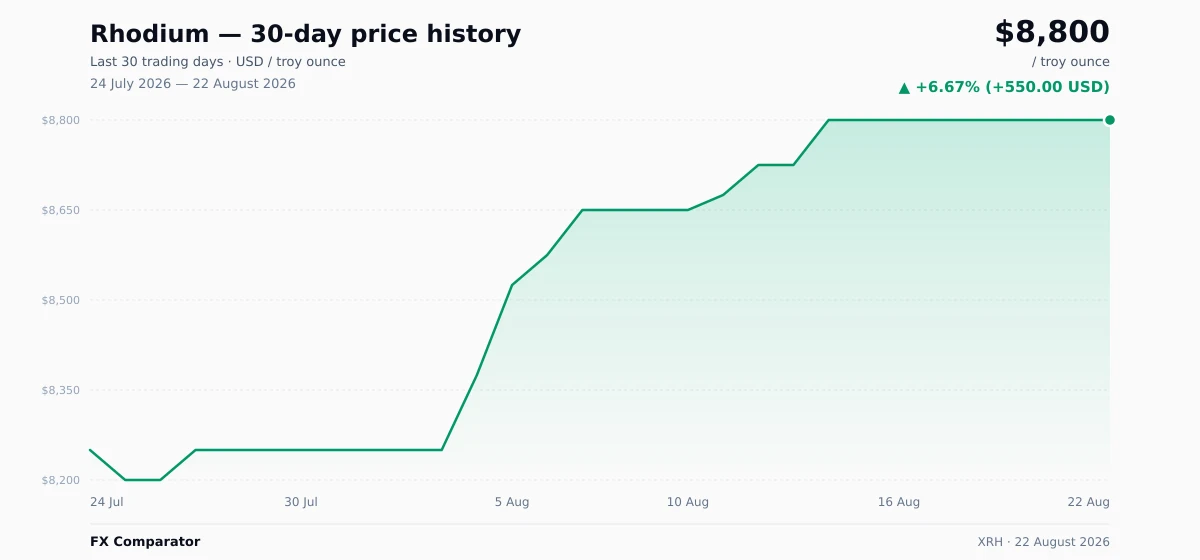
Download chart: WebP
Daily close
17 trading days
| Date | Price (USD) | Price (EUR) | Price (GBP) | Daily change |
|---|---|---|---|---|
| 2 Oct 2026 | US$9,000 | €8,046 | £6,815 | ▼ −1.10% |
| 1 Oct 2026 | US$9,100 | €8,135 | £6,890 | ▼ −0.55% |
| 30 Sept 2026 | US$9,150 | €8,180 | £6,928 | ▼ −1.08% |
| 29 Sept 2026 | US$9,250 | €8,269 | £7,004 | ▼ −1.07% |
| 28 Sept 2026 | US$9,350 | €8,359 | £7,080 | ▼ −1.06% |
| 26 Sept 2026 | US$9,450 | €8,448 | £7,155 | ▲ +1.07% |
| 25 Sept 2026 | US$9,350 | €8,359 | £7,080 | ▼ −1.06% |
| 24 Sept 2026 | US$9,450 | €8,448 | £7,155 | ▲ +1.61% |
| 23 Sept 2026 | US$9,300 | €8,314 | £7,042 | ▲ +3.33% |
| 21 Sept 2026 | US$9,000 | €8,046 | £6,815 | ▼ −1.64% |
| 18 Sept 2026 | US$9,150 | €8,180 | £6,928 | ▼ −0.81% |
| 17 Sept 2026 | US$9,225 | €8,247 | £6,985 | ▼ −3.40% |
| 14 Sept 2026 | US$9,550 | €8,537 | £7,231 | ▼ −2.80% |
| 13 Sept 2026 | US$9,825 | €8,783 | £7,439 | ▲ +1.03% |
| 12 Sept 2026 | US$9,725 | €8,694 | £7,364 | ▼ −1.02% |
| 10 Sept 2026 | US$9,825 | €8,783 | £7,439 | ▲ +2.61% |
| 9 Sept 2026 | US$9,575 | €8,560 | £7,250 | — |