Platinum price
Platinum currently trades at US$1,638 per troy ounce (≈ €1,464 · £1,240) — 43.88% below the 12-month high. In the past 24 hours the price has risen by 0.13%.

Invest in commodity ETFs from just $50
Gold, oil and even whole commodity sectors through ETFs, all in one account, kept simple.
eToro is a multi-asset investment platform. The value of your investments may go up or down. Your capital is at risk.
Platinum chart
Interactive chart and 30-day overview
The Platinum chart shows how the platinum price has moved over time. The interactive view lets you switch the timeframe (from 7 days up to MAX), the currency (USD / EUR / GBP) and overlay moving averages. Click any two points to measure the percentage change between those dates.
How is platinum priced?
Platinum is quoted in troy ounces on the global market (1 T.oz = 31.1035 g). The unit traces back to medieval Champagne fairs in Troyes, France, and is the standard for precious-metals trading at the London Bullion Market Association (LBMA), COMEX and the Shanghai Gold Exchange.
At the current US$1,638 per troy ounce, one gram costs about US$52.66 and a one-kilogram bar is worth around US$52,662. Retail bars and coins typically trade at a premium to spot — small denominations carry higher fabrication and certification costs as a percentage, while kilo-bars sit closest to the wholesale price.
What drives the price of platinum?
Platinum is driven much more by industrial demand than gold or silver. Annual global platinum output is only around 190 tonnes. About 40% of that is absorbed by the car industry as a catalyst coating, mainly for diesel engines. The decline of diesel and the rise of electric drivetrains therefore weigh directly on demand. At the same time, fuel-cell technology — hydrogen vehicles and stationary equipment — remains an industrial use case, as PEM-cell catalysts also require platinum.
Supply is highly concentrated. About 70% of mined platinum comes from South Africa, roughly 140 tonnes a year, mainly from the Bushveld complex and sites operated by Anglo American Platinum, Impala Platinum and Sibanye-Stillwater. Russia is the second-largest producer at about 20 tonnes a year, mostly as a palladium by-product from Norilsk Nickel. Zimbabwe and North America add further supply. Because of this concentration, South African power shortages, Eskom failures, strikes and moves in the rand can be felt directly in London pricing.
The third group of drivers is investment demand and relative value. Platinum once traded above gold. The spread between the two metals, often expressed as the Pt/Au ratio, is a recognised gauge of the industrial cycle. When platinum trades at a sustained discount, physical investment products such as coins and bars, ETCs such as PPLT and PHPT, and industrial end-users may all increase buying. Jewellery demand, mainly from China and Japan, is also significant, although it has been on a slowing trend for years.
How to invest in platinum
A European retail investor has four main routes to platinum exposure. Physical platinum, such as Vienna Philharmonic coins, Argor-Heraeus bars or Heraeus minted bars bought from a regulated bullion dealer, is the traditional route. Unlike investment gold, it may be subject to VAT or sales tax, depending on the jurisdiction, which can widen the entry price. Platinum ETCs, such as Aberdeen Standard Physical Platinum — PPLT and WisdomTree Physical Platinum — PHPT, provide physically backed exposure through a brokerage account, usually with low fund fees. Platinum mining shares, including Anglo American Platinum — AMS.JO, Impala Platinum — IMP.JO and Sibanye-Stillwater — SBSW, offer leveraged sensitivity to the metal price, with larger potential gains and losses. Traders can also speculate directly on a PLATINUM quote through CFDs. These are high-risk, leveraged products.
30-day price history
Chart and daily closing prices
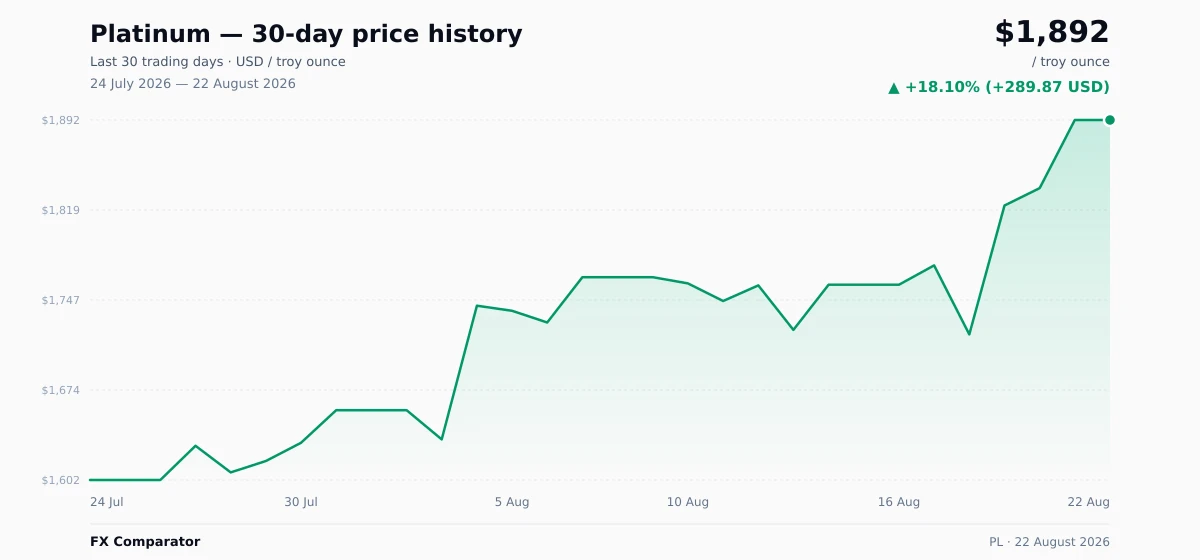
Download chart: WebP
Daily close
22 trading days
| Date | Price (USD) | Price (EUR) | Price (GBP) | Daily change |
|---|---|---|---|---|
| 8 Oct 2026 | US$1,638 | €1,464 | £1,240 | ▲ +0.13% |
| 7 Oct 2026 | US$1,636 | €1,462 | £1,239 | ▼ −4.59% |
| 6 Oct 2026 | US$1,715 | €1,533 | £1,298 | ▼ −0.87% |
| 5 Oct 2026 | US$1,729 | €1,546 | £1,310 | ▲ +1.32% |
| 2 Oct 2026 | US$1,707 | €1,526 | £1,292 | ▼ −1.35% |
| 1 Oct 2026 | US$1,730 | €1,547 | £1,310 | ▲ +0.78% |
| 30 Sept 2026 | US$1,717 | €1,535 | £1,300 | ▼ −0.02% |
| 29 Sept 2026 | US$1,717 | €1,535 | £1,300 | ▼ −0.14% |
| 28 Sept 2026 | US$1,720 | €1,537 | £1,302 | ▼ −3.91% |
| 25 Sept 2026 | US$1,790 | €1,600 | £1,355 | ▲ +1.73% |
| 24 Sept 2026 | US$1,759 | €1,573 | £1,332 | ▼ −0.04% |
| 23 Sept 2026 | US$1,760 | €1,573 | £1,333 | ▼ −4.30% |
| 22 Sept 2026 | US$1,839 | €1,644 | £1,392 | ▲ +1.68% |
| 21 Sept 2026 | US$1,809 | €1,617 | £1,370 | ▲ +0.15% |
| 18 Sept 2026 | US$1,806 | €1,615 | £1,367 | ▲ +1.60% |
| 17 Sept 2026 | US$1,778 | €1,589 | £1,346 | ▲ +1.06% |
| 16 Sept 2026 | US$1,759 | €1,572 | £1,332 | ▼ −1.36% |
| 15 Sept 2026 | US$1,783 | €1,594 | £1,350 | ▲ +0.82% |
| 14 Sept 2026 | US$1,769 | €1,581 | £1,339 | ▼ −2.06% |
| 11 Sept 2026 | US$1,806 | €1,614 | £1,367 | ▲ +1.20% |
| 10 Sept 2026 | US$1,785 | €1,595 | £1,351 | ▼ −6.23% |
| 9 Sept 2026 | US$1,903 | €1,701 | £1,441 | — |