Grains · RR-FUT

Rice price

Rice currently trades at US$12.98 per Cwt (≈ €11.04 · £9.67) — close to the 12-month high. Over the past 12 months it has lost 1.22%, with the annual range running from US$9.24 to US$13.80. 24-hour movement is minimal (±0.00%).

US$12.98 / Cwt
≈ €11.04 ≈ £9.67 Unchanged 24h 82% within the 52-week range
FX Editorial Team · Data updated: · Editorially verified
Rice (RR-FUT) price today US$12.98 / Cwt, ↑ +0.00% (24h)

Rice chart

Interactive chart and 30-day overview

7 days
▲ +3.26%
+US$0.4100
30 days
▲ +18.11%
+US$1.99
1 year
▼ −1.22%
−US$0.1600
52-week range
US$9.24 82% US$13.80
Rice (RR-FUT) 30-day price chart — USD, EUR, GBP

The Rice chart shows how the rice price has moved over time. The interactive view lets you switch the timeframe (from 7 days up to MAX), the currency (USD / EUR / GBP) and overlay moving averages. Click any two points to measure the percentage change between those dates.

How is rice priced?

Rice is priced per hundredweight (Cwt = 100 lb ≈ 45.4 kg) on the CME. The Cwt is the legacy US unit for livestock, dairy and rice futures.

At US$12.98 per Cwt, one kilogram costs about US$0.2862 and one tonne around US$286.16. International trade typically uses metric units, but US futures prices remain in Cwt.

What moves the price of rice?

The single largest influence on global rice prices is India’s export policy. India is the world’s biggest rice exporter — with annual shipments of about 22 million tonnes, it accounts for roughly 40% of global rice trade — so any government measure that restricts exports has an immediate effect on world prices. Earlier Indian export curbs, including the ban on non-basmati white rice, pushed Thai and Vietnamese FOB quotes up by 15–25% within weeks, as Asian importers — mainly the Philippines, Indonesia and countries in West Africa — had to turn to South-East Asia. The market closely follows statements from India’s Ministry of Agriculture & Farmers Welfare and the Directorate General of Foreign Trade (DGFT).

The Asian monsoon season, from June to September, determines the outcome of the main kharif crop cycle. About 80% of India’s rice output comes from the kharif sowing, which relies heavily on rainfall from the south-west monsoon. A weak monsoon quickly lowers estimates for India’s crop and the global supply outlook, while a strong, wet monsoon tends to produce a large harvest and put pressure on prices. The same logic applies to other major Asian producers — Bangladesh, Thailand, Vietnam, Indonesia and the Philippines — across both the south-west and north-east monsoon cycles. The market treats seasonal forecasts from the India Meteorological Department (IMD) and NOAA ENSO reports on El Niño and La Niña as leading indicators.

The third structural factor is the strategic rice reserve policy of Asian governments. China holds the world’s largest rice stocks — about 60% of global ending stocks — managed by the China Grain Reserves Corporation, or Sinograin. India builds and releases stocks through the Food Corporation of India (FCI) to supply public food programmes, while Indonesia regulates the market through the state logistics agency Bulog. The cycle of stockpiling and releases, as well as government-guaranteed procurement prices, such as India’s minimum support price (MSP), directly affects regional supply and can at times pull market prices away from the underlying balance of supply and demand. The FAO Rice Market Monitor and the USDA Foreign Agricultural Service publication Grain: World Markets and Trade provide monthly global rice balances.

How to invest in rice

Retail investors can access the rice market without taking physical delivery, but the range of products is much narrower than for corn or wheat. There is no major exchange-traded fund focused specifically on rice. The most liquid paper exposure is the CBOT rough rice futures contract (ZR), while some brokers offer rice CFDs, often under the “RICE” ticker, with limited liquidity. Indirect exposure is available through shares in global agricultural trading houses such as Archer Daniels Midland (ADM) and Bunge, and agribusiness companies such as Brazil’s Cosan, which is active in sugar and ethanol. Two regulated brokers where rice CFDs and agribusiness shares are available:

30-day price history

Chart and daily closing prices
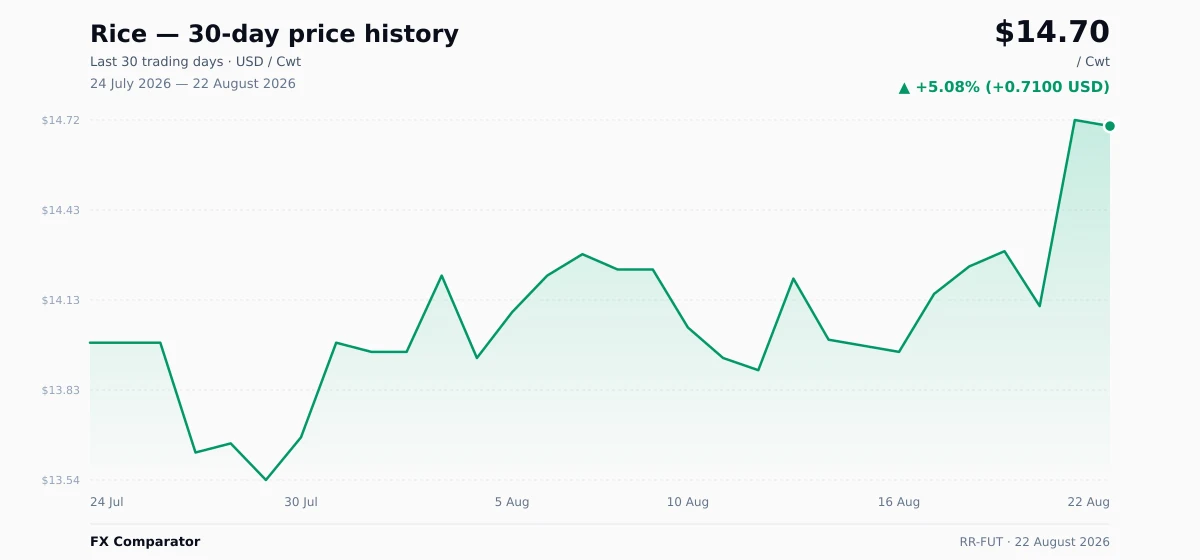
Rice (RR-FUT) 30-day price chart — USD, EUR, GBP

Daily close

30 trading days

Date Price (USD) Price (EUR) Price (GBP) Daily change
23 May 2026 US$12.98 €11.04 £9.67 ▼ −0.15%
22 May 2026 US$13.00 €11.06 £9.69 ▲ +0.23%
21 May 2026 US$12.97 €11.03 £9.67 ▲ +0.78%
20 May 2026 US$12.87 €10.95 £9.59 ▲ +0.47%
19 May 2026 US$12.81 €10.89 £9.55 ▲ +2.15%
18 May 2026 US$12.54 €10.66 £9.35 ▼ −0.24%
16 May 2026 US$12.57 €10.69 £9.37 ▲ +0.40%
15 May 2026 US$12.52 €10.65 £9.33 ▼ −1.42%
14 May 2026 US$12.70 €10.80 £9.47 ▲ +2.75%
13 May 2026 US$12.36 €10.51 £9.21 ▲ +3.69%
12 May 2026 US$11.92 €10.14 £8.88 ▲ +0.59%
11 May 2026 US$11.85 €10.08 £8.83 ▲ +0.25%
10 May 2026 US$11.82 €10.05 £8.81 ▲ +0.17%
6 May 2026 US$11.80 €10.04 £8.79 ▲ +1.11%
5 May 2026 US$11.67 €9.92 £8.70 ▲ +3.37%
4 May 2026 US$11.29 €9.60 £8.41 ▲ +3.77%
2 May 2026 US$10.88 €9.25 £8.11 ▲ +0.18%
1 May 2026 US$10.86 €9.24 £8.09 ▲ +0.84%
30 Apr 2026 US$10.77 €9.16 £8.03 ▲ +1.99%
29 Apr 2026 US$10.56 €8.98 £7.87 ▼ −1.40%
28 Apr 2026 US$10.71 €9.11 £7.98 ▼ −0.28%
27 Apr 2026 US$10.74 €9.13 £8.00 ▼ −0.56%
25 Apr 2026 US$10.80 €9.19 £8.05 ▼ −1.73%
22 Apr 2026 US$10.99 €9.35 £8.19 ▼ −0.45%
21 Apr 2026 US$11.04 €9.39 £8.23 ▼ −0.54%
20 Apr 2026 US$11.10 €9.44 £8.27

Rice: frequently asked questions

Why is rice quoted in Cwt on the Chicago exchange? +
Cwt, or hundredweight, is a traditional unit in US grain and commodity trading: 1 Cwt = 100 US pounds = 45.359 kg. The CBOT, now part of CME Group, quotes the ZR rough rice futures contract in this unit, in dollars. Other major CBOT grains, such as corn, wheat, soybeans and oats, trade in bushels. Rice is the exception because the bushel was originally defined by volume, and volume-based pricing would be impractical for rough rice because of its porous, husk-covered structure. To convert to tonnes, use a multiplier of 22.046; to convert to kilograms, divide by 45.359.
What is the difference between rough rice and milled rice? +
Rough rice, also called paddy rice, is rice after harvest, with the rice husk and rice bran still on the grain. The CBOT ZR futures contract is based on this form. Dehulling removes the husk, producing brown rice. Milling then removes the bran layer, producing white milled rice, the form usually sold in Western supermarkets. The milling yield is about 70% — in other words, 100 kg of rough rice produces about 70 kg of white rice, with the remaining 30% made up of husk, bran and broken grains.
Who is the world’s largest rice producer and exporter? +
China is the largest producer, with about 150 Mt of milled rice, followed by India at about 140 Mt, Bangladesh at about 38 Mt, Indonesia at about 35 Mt, and then Vietnam and Thailand. Total global annual production is roughly 520 million tonnes of milled rice. In exports, India is clearly the leader, with about 22 Mt a year, or roughly 40% of global rice trade, followed by Thailand at about 8–9 Mt, Vietnam at about 7–8 Mt and Pakistan. China and Bangladesh are huge producers, but their output is used almost entirely for domestic consumption, and they sometimes appear in the market as net importers. The two largest importers are the Philippines and Indonesia.
Why does the Thai 5% broken rice benchmark matter? +
The main reference price in the international physical rice trade is Thai 5% broken white rice, quoted FOB Bangkok. It is published weekly by the Thai Rice Exporters Association (TREA) and is used as the basis for contracts by Asian importers, including the Philippines, Indonesia and countries in West Africa. “5% broken” refers to the quality grade: no more than 5% of the shipment may consist of broken grains. The US southern long-grain rough rice contract listed on CBOT (ZR) is a different quality and a different market. CBOT is the futures benchmark for paper speculation and hedging, while the Thai FOB price is the reference for the physical global trade.
How does India’s export policy affect the global rice price? +
India is the world’s largest rice exporter — with annual shipments of about 22 Mt, it accounts for roughly 40% of global rice trade. If the Indian government introduces export restrictions because of food-price inflation or domestic supply concerns, as happened with earlier non-basmati export restrictions and the ban on non-basmati white rice, Asian importers have to turn to Thailand and Vietnam. That pushed Thai FOB quotes up by 15–25% within weeks. The market closely watches statements from the Ministry of Agriculture & Farmers Welfare, the Food Corporation of India (FCI) and the Directorate General of Foreign Trade (DGFT), as well as the annual review of India’s minimum support price (MSP).
Why is the Asian monsoon so important for the rice market? +
Rice is a water-intensive crop. In Asia it is usually grown in flooded paddy fields, and the water supply for the kharif, or summer, sowing is provided by rainfall from the south-west monsoon between June and September. About 80% of India’s total rice output comes from the kharif crop, so a weak monsoon quickly lowers estimates for India’s harvest and the global supply outlook. A strong, wet monsoon tends to produce a large crop and put pressure on prices. Seasonal forecasts from the India Meteorological Department (IMD) and NOAA reports on El Niño and La Niña are leading indicators for the market. An El Niño year is often associated with a weaker monsoon and higher rice prices.
Why is CBOT rice futures trading smaller than corn or wheat? +
Most of the world’s rice is grown and consumed in Asia. Of roughly 520 million tonnes of global production, only about 52 million tonnes enter international trade, because domestic consumption absorbs the rest in producer countries. Western institutional investors therefore use rice less for hedging or speculation than corn or wheat, where the US, the EU and South America are major exporters. Daily open interest in the CBOT ZR contract is a fraction of that in corn, and the benchmark for physical trade is not the Chicago price but Thai 5% broken rice FOB Bangkok. This produces a thinner market, wider spreads and higher volatility per unit of liquidity.
Is there a pure rice ETF like the Teucrium CORN fund for corn? +
There is currently no major exchange-traded fund focused purely on rice comparable with the Teucrium Corn Fund (CORN) for corn or the Teucrium Wheat Fund (WEAT) for wheat. The most direct paper exposure to rice is therefore the CBOT futures contract (ZR) or rice CFDs offered by brokers, often under the “RICE” ticker and with limited liquidity. Broader exposure is available through diversified agricultural ETFs such as Invesco DB Agriculture (DBA), which hold weighted baskets of several grains, and through agribusiness shares such as Archer Daniels Midland (ADM), Bunge and Brazil’s Cosan, which is active in the sugar and ethanol market.