Oats price
Oats currently trade at US$415.29 per bushel (≈ €371.42 · £313.77) — close to the 12-month high. Over the past 12 months the price has gained 34.74%, with the annual range running from US$278.91 to US$435.99. In the past 24 hours the price has fallen by 1.91%.


Invest in commodity ETFs from just $50
Gold, oil and even whole commodity sectors through ETFs, all in one account, kept simple.
eToro is a multi-asset investment platform. The value of your investments may go up or down. Your capital is at risk.
Oats chart
Interactive chart and 30-day overview
The Oats chart shows how the oats price has moved over time. The interactive view lets you switch the timeframe (from 7 days up to MAX), the currency (USD / EUR / GBP) and overlay moving averages. Click any two points to measure the percentage change between those dates.
How are oats priced?
Oats are priced per bushel — the historical US grain measure (1 bushel ≈ 27.2 kg of wheat or soybean, ≈ 25.4 kg of corn). The bushel remains the standard on the Chicago Board of Trade (CBOT) grain futures.
At US$415.29 per bushel, one tonne is worth around US$15,241. Global grain trade increasingly references the tonne, but the bushel persists as the price-discovery unit on the CBOT — where USDA WASDE supply-and-demand reports drive most short-term moves.
What drives the price of oats?
Oats are the least traded of the four main grain futures markets. Daily open interest in CBOT oats (ZO) is a fraction of that in wheat or corn. This thin market structure means a mid-sized supply shock or a large speculative position can move prices sharply. Bid-ask spreads are also wider than in more liquid grains. Global annual oat production is only about 25 million tonnes, compared with about 780 Mt for wheat and about 1,200 Mt for corn. This structure makes oats a higher-volatility grain for investors on a per-unit basis.
The demand side is distinguished by the growth of the oat milk and plant-based milk alternatives segment. The listing of Sweden’s Oatly (OTLY) and the expansion of the category, including Califia Farms, Chobani Oat and private-label oat drinks from retailers, have structurally lifted demand for oats used in human food. This sits alongside steady demand for porridge oats and muesli in the breakfast market, and for functional foods linked to the beta-glucan content of oats, including products marketed for cholesterol management. In formal labelling, plant-based drinks are often sold as “oat drink” rather than “oat milk”, but “oat milk” remains the common consumer term in many markets.
Supply is dominated by three regions: Canada at about 3.5 Mt, roughly 14% of global output and by far the largest exporter, mainly to the US and Latin America; the European Union at about 7 Mt, led by Poland, Spain, Finland, Germany and Sweden; and Russia at about 4 Mt, mostly for domestic use. US oat production has fallen sharply over recent decades to about 0.6 Mt, making the country a net importer, mainly from Canada. Oat inventories are traditionally lower than wheat or corn stocks. The smaller market has less commercial storage capacity, so a Canadian drought or early frost can have a disproportionate price impact. Market participants closely follow Statistics Canada crop reports, the USDA’s monthly WASDE data and CBOT oat futures prices.
How to invest in oats
The oat market can be accessed without physical ownership through several routes: CBOT oat futures (ZO), oat CFDs linked to the Chicago price, and shares in agribusiness and food companies with oat exposure, including Archer Daniels Midland (ADM), active in grain processing and trading; Oatly Group (OTLY), an oat milk producer; and General Mills (GIS), a breakfast cereal producer and competitor to Quaker Oats. There is no large ETF focused solely on oats, reflecting the small size of the oat market and the limited product range offered by asset managers. Two regulated brokers where oat CFDs and related shares are available are:
30-day price history
Chart and daily closing prices
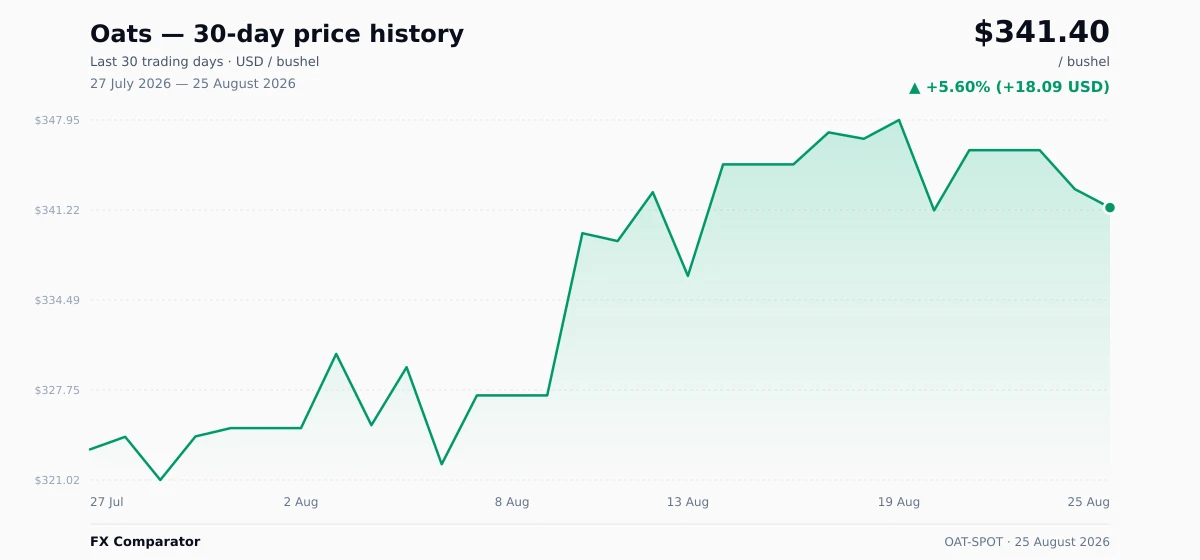
Download chart: WebP
Daily close
22 trading days
| Date | Price (USD) | Price (EUR) | Price (GBP) | Daily change |
|---|---|---|---|---|
| 12 Oct 2026 | US$415.29 | €371.42 | £313.77 | ▼ −1.91% |
| 9 Oct 2026 | US$423.36 | €378.64 | £319.87 | ▼ −2.90% |
| 8 Oct 2026 | US$435.99 | €389.94 | £329.41 | ▲ +1.41% |
| 7 Oct 2026 | US$429.93 | €384.52 | £324.83 | ▼ −1.10% |
| 6 Oct 2026 | US$434.69 | €388.77 | £328.43 | ▲ +3.27% |
| 5 Oct 2026 | US$420.91 | €376.45 | £318.02 | ▲ +1.82% |
| 2 Oct 2026 | US$413.37 | €369.71 | £312.32 | ▼ −0.53% |
| 1 Oct 2026 | US$415.57 | €371.67 | £313.98 | ▼ −1.88% |
| 30 Sept 2026 | US$423.52 | €378.78 | £319.99 | ▼ −0.55% |
| 29 Sept 2026 | US$425.86 | €380.88 | £321.76 | ▲ +0.08% |
| 28 Sept 2026 | US$425.53 | €380.58 | £321.51 | ▲ +0.91% |
| 25 Sept 2026 | US$421.71 | €377.16 | £318.62 | ▼ −1.39% |
| 24 Sept 2026 | US$427.65 | €382.48 | £323.11 | ▲ +1.75% |
| 23 Sept 2026 | US$420.30 | €375.90 | £317.56 | ▲ +0.28% |
| 22 Sept 2026 | US$419.14 | €374.87 | £316.68 | ▲ +0.11% |
| 21 Sept 2026 | US$418.69 | €374.46 | £316.34 | ▲ +1.53% |
| 18 Sept 2026 | US$412.38 | €368.82 | £311.57 | ▼ −2.24% |
| 17 Sept 2026 | US$421.85 | €377.29 | £318.73 | ▲ +3.59% |
| 16 Sept 2026 | US$407.22 | €364.21 | £307.68 | ▲ +2.48% |
| 15 Sept 2026 | US$397.35 | €355.38 | £300.22 | ▲ +0.18% |
| 14 Sept 2026 | US$396.63 | €354.73 | £299.67 | ▲ +3.39% |
| 13 Sept 2026 | US$383.61 | €343.09 | £289.84 | — |