Wheat price
Wheat currently trades at US$695.46 per bushel (≈ €617.14 · £523.83) — 11.36% below the 12-month high. Over the past 12 months the price has gained 35.33%, with the annual range running from US$500.80 to US$784.58. In the past 24 hours the price has sharply, fallen by 2.09%.


Invest in commodity ETFs from just $50
Gold, oil and even whole commodity sectors through ETFs, all in one account, kept simple.
eToro is a multi-asset investment platform. The value of your investments may go up or down. Your capital is at risk.
Wheat chart
Interactive chart and 30-day overview
The Wheat chart shows how the wheat price has moved over time. The interactive view lets you switch the timeframe (from 7 days up to MAX), the currency (USD / EUR / GBP) and overlay moving averages. Click any two points to measure the percentage change between those dates.
How is wheat priced?
Wheat is priced per bushel — the historical US grain measure (1 bushel ≈ 27.2 kg of wheat or soybean, ≈ 25.4 kg of corn). The bushel remains the standard on the Chicago Board of Trade (CBOT) grain futures.
At US$695.46 per bushel, one tonne is worth around US$25,523. Global grain trade increasingly references the tonne, but the bushel persists as the price-discovery unit on the CBOT — where USDA WASDE supply-and-demand reports drive most short-term moves.
What drives the price of wheat?
Wheat prices are driven first by global harvests and stock levels. FAO and USDA data put annual world production in the ~780 million tonnes range. China is the largest producer at about 140 Mt, followed by the European Union as a bloc at about 130 Mt, India, Russia at about 85 Mt and the United States. The export market is led by a different group. Russia has been the largest wheat exporter for years, followed by Australia, Canada, the United States, Argentina and Ukraine. One of the market’s most closely watched indicators is the stock-to-use ratio, or ending stocks relative to consumption. When it falls below 25%, supply is considered tight and prices tend to come under upward pressure.
Weather is the main source of short-term price volatility. Winter wheat development depends on autumn rainfall and winter snow cover. Spring wheat is sensitive to heatwaves in July and August. The market watches Russia’s Volga region, Kansas and Oklahoma in the US, New South Wales and Western Australia, and the main growing areas in France and Germany. A severe drought in the Black Sea region — as seen around the period of Russia’s export ban — can lift prices by more than 50% within a few months.
Geopolitics and trade policy can quickly redraw the supply map. Conflicts in the Black Sea region, export quotas, import tenders and policy decisions by large buyers — especially Egypt (GASC tenders), Indonesia, China, Algeria and Turkey — can move Chicago and Paris (Euronext MATIF) prices within weeks. Flows into the WEAT (Teucrium Wheat Fund) ETF and speculative positioning in the CFTC Commitments of Traders report can add further short-term moves.
How can investors get exposure to wheat?
Investors can access the wheat market without holding the physical grain in several ways: exposure linked to WEAT (Teucrium Wheat Fund, ticker: WEAT; availability for EU retail clients is limited), CFDs on Chicago wheat (often listed as WHEAT by brokers), futures contracts (CBOT ZW), and shares in major grain-processing and trading companies such as Archer Daniels Midland — ADM, Bunge and Corteva. WEAT and wheat CFDs provide the cleaner agricultural exposure. Agribusiness shares are more indirect and carry company-specific business risk. Two regulated brokers offering wheat CFDs, agribusiness shares and, depending on the platform and client classification, WEAT exposure are:
30-day price history
Chart and daily closing prices
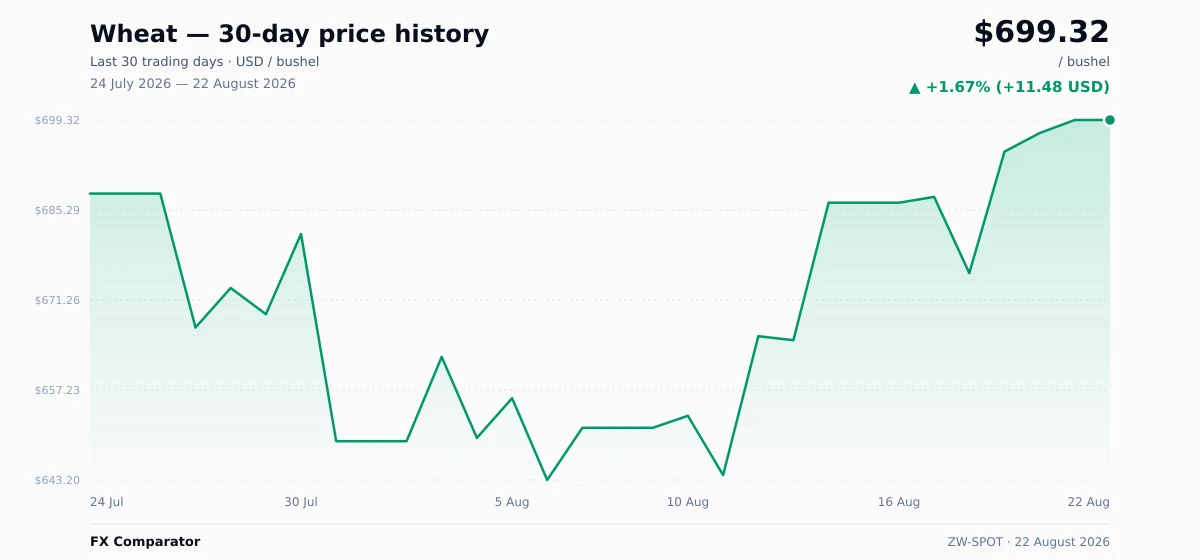
Download chart: WebP
Daily close
22 trading days
| Date | Price (USD) | Price (EUR) | Price (GBP) | Daily change |
|---|---|---|---|---|
| 7 Oct 2026 | US$695.46 | €617.14 | £523.83 | ▼ −2.09% |
| 6 Oct 2026 | US$710.33 | €630.34 | £535.03 | ▲ +1.75% |
| 5 Oct 2026 | US$698.13 | €619.51 | £525.85 | ▲ +1.36% |
| 2 Oct 2026 | US$688.75 | €611.19 | £518.78 | ▲ +0.24% |
| 1 Oct 2026 | US$687.07 | €609.70 | £517.51 | ▲ +0.94% |
| 30 Sept 2026 | US$680.69 | €604.04 | £512.71 | ▼ −2.54% |
| 29 Sept 2026 | US$698.42 | €619.77 | £526.06 | ▲ +0.85% |
| 28 Sept 2026 | US$692.52 | €614.54 | £521.62 | ▼ −2.36% |
| 25 Sept 2026 | US$709.23 | €629.36 | £534.21 | ▼ −0.12% |
| 24 Sept 2026 | US$710.05 | €630.09 | £534.82 | ▼ −0.28% |
| 23 Sept 2026 | US$712.03 | €631.85 | £536.32 | ▼ −1.23% |
| 22 Sept 2026 | US$720.90 | €639.72 | £543.00 | ▼ −1.28% |
| 21 Sept 2026 | US$730.22 | €647.99 | £550.02 | ▲ +1.70% |
| 18 Sept 2026 | US$718.01 | €637.15 | £540.82 | ▼ −1.60% |
| 17 Sept 2026 | US$729.67 | €647.50 | £549.60 | ▼ −0.87% |
| 16 Sept 2026 | US$736.09 | €653.20 | £554.44 | ▲ +0.67% |
| 15 Sept 2026 | US$731.16 | €648.82 | £550.72 | ▲ +0.73% |
| 14 Sept 2026 | US$725.88 | €644.14 | £546.75 | ▼ −0.47% |
| 11 Sept 2026 | US$729.34 | €647.21 | £549.35 | ▼ −2.01% |
| 10 Sept 2026 | US$744.30 | €660.48 | £560.62 | ▲ +1.77% |
| 9 Sept 2026 | US$731.32 | €648.97 | £550.84 | ▼ −2.39% |
| 8 Sept 2026 | US$749.25 | €664.88 | £564.35 | — |