Soybean price
Soybean currently trades at US$13.06 per bushel (≈ €11.59 · £9.84) — effectively at the 12-month high. Over the past 12 months the price has gained 27.90%, with the annual range running from US$10.01 to US$13.27. In the past 24 hours the price has risen by 0.13%.


Invest in commodity ETFs from just $50
Gold, oil and even whole commodity sectors through ETFs, all in one account, kept simple.
eToro is a multi-asset investment platform. The value of your investments may go up or down. Your capital is at risk.
Soybean chart
Interactive chart and 30-day overview
The Soybean chart shows how the soybean price has moved over time. The interactive view lets you switch the timeframe (from 7 days up to MAX), the currency (USD / EUR / GBP) and overlay moving averages. Click any two points to measure the percentage change between those dates.
How is soybean priced?
Soybean is priced per bushel — the historical US grain measure (1 bushel ≈ 27.2 kg of wheat or soybean, ≈ 25.4 kg of corn). The bushel remains the standard on the Chicago Board of Trade (CBOT) grain futures.
At US$13.06 per bushel, one tonne is worth around US$479.46. Global grain trade increasingly references the tonne, but the bushel persists as the price-discovery unit on the CBOT — where USDA WASDE supply-and-demand reports drive most short-term moves.
What drives soybean prices?
Chinese feed demand is the single most important driver of the soybean market. China imports about 100 million tonnes of soybeans a year — mainly to produce soybean meal for animal feed — equal to roughly 60% of global soybean imports. The size of China's pig herd, African swine fever cycles and Chinese tariff and trade-policy decisions therefore feed directly into Chicago prices. Monthly import data from China's General Administration of Customs and the USDA Foreign Agricultural Service report Oilseeds: World Markets and Trade are two of the market's most closely watched sources.
Brazilian and US production take place in opposite hemispheres, so global soybean supply is refreshed somewhere almost every month. In the US, planting takes place in April-May and harvesting in September-November. In Brazil and Argentina the cycle is reversed: planting in October-November and harvesting in March-May. Global output is in the ~400 million tonnes range. Brazil is the largest producer at ~155 Mt, followed by the US at ~115 Mt, Argentina at ~50 Mt and China, some way behind, at ~20 Mt. La Niña-related drought in the southern hemisphere — especially in Argentina's Pampas — can cut supply by 20-30 Mt in a season, which is quickly reflected in Chicago prices.
Crush economics links the soybean to its two main processed products. A soybean typically breaks down into about 80% soybean meal (ZM) and about 20% soybean oil (ZL) during processing. The combined value of meal and oil, minus the price of the bean, gives processors such as Archer Daniels Midland, Bunge and Cargill their crush margin. When crush margins are high, processors buy beans more aggressively, supporting CBOT prices. When margins are low, processing slows. Soybean oil is also a major biodiesel feedstock in the US, so renewable-energy policy and energy prices can feed indirectly into soybean prices.
How to invest in soybeans
Investors can access the soybean market without physical ownership through several routes: an exchange-traded fund, the Teucrium Soybean Fund (ticker: SOYB); CFDs on Chicago soybeans, often listed as SOYBEAN or SOYBEAN-FUT by brokers; futures contracts (CBOT ZS); and shares in large soybean processors and agricultural trading companies such as Archer Daniels Midland (ADM), Bunge and Corteva. SOYB and soybean CFDs provide more direct agricultural exposure. Agribusiness equities are more indirect and carry company-specific business risks. Two regulated brokers with English-language platforms where soybean CFDs, SOYB and agribusiness shares are available:
30-day price history
Chart and daily closing prices
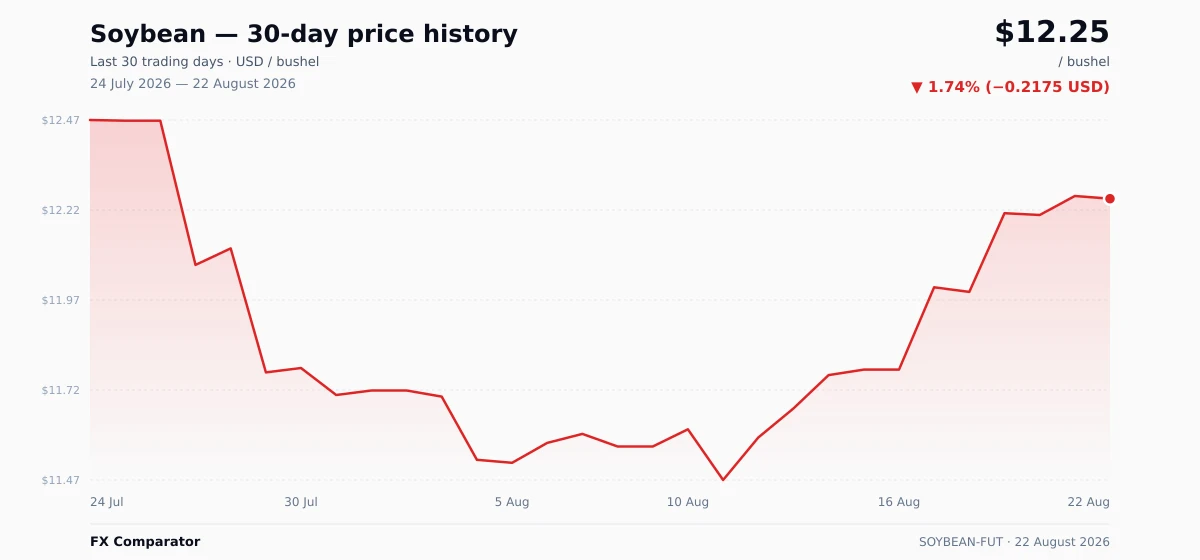
Download chart: WebP
Daily close
26 trading days
| Date | Price (USD) | Price (EUR) | Price (GBP) | Daily change |
|---|---|---|---|---|
| 7 Oct 2026 | US$13.06 | €11.59 | £9.84 | ▲ +0.13% |
| 6 Oct 2026 | US$13.05 | €11.58 | £9.83 | ▲ +1.85% |
| 5 Oct 2026 | US$12.81 | €11.37 | £9.65 | ▲ +0.22% |
| 3 Oct 2026 | US$12.78 | €11.34 | £9.63 | ▲ +0.08% |
| 2 Oct 2026 | US$12.77 | €11.33 | £9.62 | ▼ −0.47% |
| 1 Oct 2026 | US$12.83 | €11.39 | £9.67 | ▼ −0.83% |
| 30 Sept 2026 | US$12.94 | €11.48 | £9.75 | ▼ −0.29% |
| 29 Sept 2026 | US$12.98 | €11.52 | £9.77 | ▲ +0.78% |
| 28 Sept 2026 | US$12.88 | €11.43 | £9.70 | ▼ −2.37% |
| 26 Sept 2026 | US$13.19 | €11.70 | £9.93 | ▼ −0.08% |
| 25 Sept 2026 | US$13.20 | €11.71 | £9.94 | ▲ +0.27% |
| 24 Sept 2026 | US$13.17 | €11.68 | £9.92 | ▼ −0.08% |
| 23 Sept 2026 | US$13.18 | €11.69 | £9.92 | ▼ −0.57% |
| 22 Sept 2026 | US$13.25 | €11.76 | £9.98 | ▼ −0.15% |
| 21 Sept 2026 | US$13.27 | €11.78 | £10.00 | ▲ +1.80% |
| 19 Sept 2026 | US$13.04 | €11.57 | £9.82 | ▲ +0.04% |
| 18 Sept 2026 | US$13.03 | €11.56 | £9.81 | ▼ −1.25% |
| 17 Sept 2026 | US$13.20 | €11.71 | £9.94 | ▼ −0.15% |
| 16 Sept 2026 | US$13.22 | €11.73 | £9.95 | ▲ +0.17% |
| 15 Sept 2026 | US$13.19 | €11.71 | £9.94 | ▲ +1.09% |
| 14 Sept 2026 | US$13.05 | €11.58 | £9.83 | ▲ +1.93% |
| 12 Sept 2026 | US$12.80 | €11.36 | £9.64 | ▼ −1.22% |
| 11 Sept 2026 | US$12.96 | €11.50 | £9.76 | ▼ −1.69% |
| 10 Sept 2026 | US$13.18 | €11.70 | £9.93 | ▲ +1.56% |
| 9 Sept 2026 | US$12.98 | €11.52 | £9.78 | ▲ +0.02% |
| 8 Sept 2026 | US$12.98 | €11.52 | £9.77 | — |