Corn price
Corn currently trades at US$5.10 per bushel (≈ €4.52 · £3.84) — close to the 12-month high. Over the past 12 months the price has gained 19.44%, with the annual range running from US$4.08 to US$5.47. In the past 24 hours the price has fallen by 1.02%.

Invest in commodity ETFs from just $50
Gold, oil and even whole commodity sectors through ETFs, all in one account, kept simple.
eToro is a multi-asset investment platform. The value of your investments may go up or down. Your capital is at risk.
Corn chart
Interactive chart and 30-day overview
The Corn chart shows how the corn price has moved over time. The interactive view lets you switch the timeframe (from 7 days up to MAX), the currency (USD / EUR / GBP) and overlay moving averages. Click any two points to measure the percentage change between those dates.
How is corn priced?
Corn is priced per bushel — the historical US grain measure (1 bushel ≈ 27.2 kg of wheat or soybean, ≈ 25.4 kg of corn). The bushel remains the standard on the Chicago Board of Trade (CBOT) grain futures.
At US$5.10 per bushel, one tonne is worth around US$187.02. Global grain trade increasingly references the tonne, but the bushel persists as the price-discovery unit on the CBOT — where USDA WASDE supply-and-demand reports drive most short-term moves.
What drives the price of corn?
The largest source of short-term volatility in corn prices is weather in the US Corn Belt. Iowa, Illinois, Nebraska, Indiana and Minnesota account for most US output, while the United States produces about 30% of global corn supply, or roughly 380 million tonnes. The most critical period for the market is pollination in July, when the crop’s water demand is highest. A heatwave or drought at that point can move Chicago prices by 10–20% within days. Traders follow NOAA forecasts, weekly USDA Crop Progress reports and the Pro Farmer Crop Tour.
A distinctive feature of corn demand is the US bioethanol mandate. Under the Renewable Fuel Standard (RFS), about 15 billion gallons of corn ethanol must be blended into the US fuel pool each year, absorbing roughly 30–40% of the US corn crop. This structural demand links the corn market to oil prices and US environmental regulation, including EPA waivers and small-refinery exemptions. When oil prices rise or petrol becomes more expensive, ethanol margins can improve, adding support to corn demand.
International trade is shaped by Chinese import demand and competition from South America. China is the world’s largest corn consumer, with annual domestic use of about 290 million tonnes, supplied partly by local production and partly by imports. Brazil, at about 130 Mt, and Argentina, at about 50 Mt, bring southern-hemisphere crops to market from spring through late summer, often offsetting US supply. La Niña and El Niño cycles directly affect the outlook for Brazil’s safrinha, or second-crop, corn. Ukraine, at about 25 Mt, and the EU, at about 70 Mt, are also significant players. The FAO Cereal Supply and Demand Brief and the USDA Foreign Agricultural Service report Grain: World Markets and Trade publish monthly global balances.
How to invest in corn
Investors can gain exposure to corn without holding the physical crop through several instruments: exchange-traded funds such as the Teucrium Corn Fund, ticker CORN; CFDs on Chicago corn; futures contracts such as CBOT ZC; and shares in large processors, traders and equipment makers, including Archer Daniels Midland — ADM, Bunge and Deere & Co. The CORN ETF and corn CFDs offer the more direct agricultural exposure. Agribusiness shares are more indirect and carry company-specific business risk. Two regulated brokers where corn CFDs and agribusiness shares are available, while access to the CORN ETF may depend on client type and jurisdiction, are:
30-day price history
Chart and daily closing prices
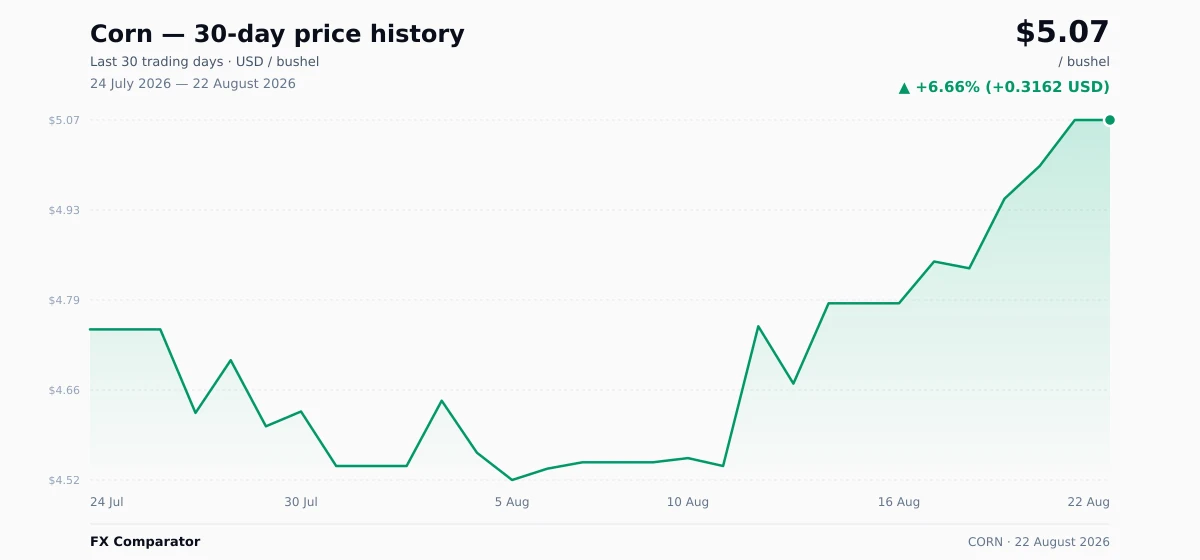
Download chart: WebP
Daily close
22 trading days
| Date | Price (USD) | Price (EUR) | Price (GBP) | Daily change |
|---|---|---|---|---|
| 7 Oct 2026 | US$5.10 | €4.52 | £3.84 | ▼ −1.02% |
| 6 Oct 2026 | US$5.15 | €4.57 | £3.88 | ▲ +2.27% |
| 5 Oct 2026 | US$5.03 | €4.47 | £3.79 | ▲ +0.12% |
| 2 Oct 2026 | US$5.03 | €4.46 | £3.79 | ▼ −0.90% |
| 1 Oct 2026 | US$5.07 | €4.50 | £3.82 | ▲ +0.16% |
| 30 Sept 2026 | US$5.07 | €4.50 | £3.82 | ▼ −3.90% |
| 29 Sept 2026 | US$5.27 | €4.68 | £3.97 | ▲ +0.01% |
| 28 Sept 2026 | US$5.27 | €4.68 | £3.97 | ▼ −1.25% |
| 25 Sept 2026 | US$5.34 | €4.74 | £4.02 | ▲ +0.50% |
| 24 Sept 2026 | US$5.31 | €4.71 | £4.00 | ▼ −0.38% |
| 23 Sept 2026 | US$5.33 | €4.73 | £4.02 | ▼ −1.35% |
| 22 Sept 2026 | US$5.40 | €4.80 | £4.07 | ▼ −1.14% |
| 21 Sept 2026 | US$5.47 | €4.85 | £4.12 | ▲ +2.94% |
| 18 Sept 2026 | US$5.31 | €4.71 | £4.00 | ▼ −0.57% |
| 17 Sept 2026 | US$5.34 | €4.74 | £4.02 | ▼ −0.64% |
| 16 Sept 2026 | US$5.38 | €4.77 | £4.05 | ▼ −0.25% |
| 15 Sept 2026 | US$5.39 | €4.78 | £4.06 | ▲ +0.44% |
| 14 Sept 2026 | US$5.37 | €4.76 | £4.04 | ▲ +0.34% |
| 11 Sept 2026 | US$5.35 | €4.74 | £4.03 | ▼ −0.19% |
| 10 Sept 2026 | US$5.36 | €4.75 | £4.04 | ▲ +0.95% |
| 9 Sept 2026 | US$5.31 | €4.71 | £4.00 | ▼ −0.79% |
| 8 Sept 2026 | US$5.35 | €4.75 | £4.03 | — |