Tea price
Tea currently trades at US$2.08 per kg (≈ €1.86 · £1.57) — 15.86% below the 12-month high. Over the past 12 months the price has gained 66.36%, with the annual range running from US$1.25 to US$2.47. In the past 24 hours the price has fallen by 0.17%.


Invest in commodity ETFs from just $50
Gold, oil and even whole commodity sectors through ETFs, all in one account, kept simple.
eToro is a multi-asset investment platform. The value of your investments may go up or down. Your capital is at risk.
Tea chart
Interactive chart and 30-day overview
The Tea chart shows how the tea price has moved over time. The interactive view lets you switch the timeframe (from 7 days up to MAX), the currency (USD / EUR / GBP) and overlay moving averages. Click any two points to measure the percentage change between those dates.
How is tea priced?
What moves the price of tea?
The main structural feature of the tea market is supply concentration in East Africa and South Asia. Global tea output is about 6.5 million tonnes a year, according to the FAO Tea Market Outlook. The largest producer is China, with about 3 million tonnes a year (~46%), but most of its crop is consumed domestically. India produces about 1.35 million tonnes a year and consumes roughly 1.1 million tonnes itself. The export market is therefore shaped mainly by Kenya (about 570 kt a year, the world’s largest tea exporter) and Sri Lanka (~250 kt). In that sense, the Mombasa Tea Auction sets the global reference price for CTC black tea. Turkey (~210 kt, mainly for domestic black-tea consumption) and Vietnam form the next tier. Many plantations are centuries-old monocultures. Much of the Kenyan and Sri Lankan tea industry rests on estates planted during the British colonial period. Ageing bushes and the migration of younger workers are structural supply risks.
Short-term price volatility is driven mainly by weather in the main growing regions. In Kenya, tea estates in the Rift Valley and around Mount Kenya are sensitive to the distribution of the two annual rainy seasons — the long rains from March to May and the short rains from October to December. Drought quickly cuts the weekly harvest of two leaves and a bud. Excessive rain can also overwhelm factories handling fresh leaf. In Sri Lanka, high-grown estates in Nuwara Eliya, Dimbula and Uva are shaped by the opposing cycles of the south-west and north-east monsoons. The country’s economic crisis, fertiliser import ban and shortage of foreign currency left a lasting shock on Ceylon-tea supply. In India, the main risks are monsoon distribution and climate warming in Assam and Darjeeling, where Darjeeling’s cool highland microclimate is narrowing. In China, the main risk is spring frost in producing areas such as Yunnan and Fujian.
Demand is shaped by the procurement cycles of large importing countries and international tea-bag brands. The largest importers include Pakistan (about 200 kt a year, almost entirely Kenyan CTC), Russia, Egypt, the United Kingdom and Iran. Iranian imports are persistently affected by US sanctions and currency moves, which also influence the grey channels of global tea trade. The branded processing side is concentrated. Lipton Teas and Infusions (Lipton, PG Tips, Brooke Bond — formerly ekaterra, owned by CVC Capital Partners) and Tata Consumer Products (Tetley, Tata Tea) are the two largest players in the global tea-bag market. Large importer tenders and the renewal of long-term processor contracts can move weekly auction prices materially.
How to invest in tea
Tea has no listed futures contract. There is no direct tea CFD at XTB or eToro either, because physical trade is auction-based (Mombasa, Colombo, Kolkata), not based on a standardised exchange listing. For a European retail investor, tea exposure is therefore built through individual shares in the consumer-goods value chain. The most direct exposure is Tata Consumer Products (ticker: TATACONSUM.NS, NSE Mumbai), the parent company of the Tetley tea-bag brand and the second-largest integrated player in the global tea market. Unilever (ticker: UL NYSE / ULVR.L London) historically owned Lipton and Brooke Bond. It sold the tea business under the “ekaterra” name and is now mainly exposed through indirect links to beverages. Nestlé (NESN.SW) offers tea exposure through the Nestea brand. Two regulated brokers offering access to related global shares:
30-day price history
Chart and daily closing prices
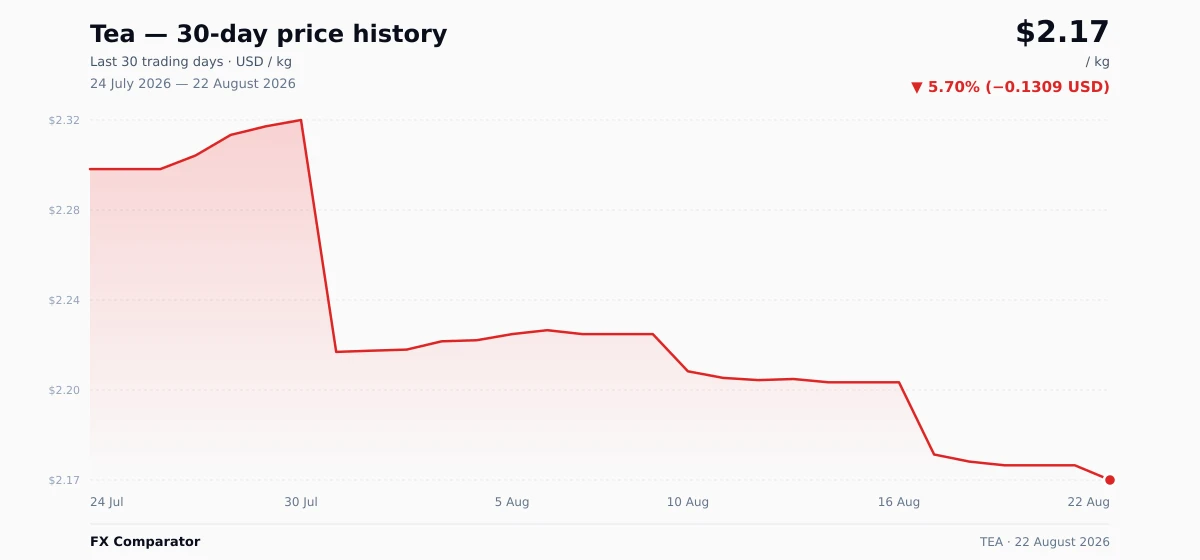
Download chart: WebP
Daily close
28 trading days
| Date | Price (USD) | Price (EUR) | Price (GBP) | Daily change |
|---|---|---|---|---|
| 8 Oct 2026 | US$2.08 | €1.86 | £1.57 | ▼ −0.17% |
| 7 Oct 2026 | US$2.08 | €1.86 | £1.57 | ▼ −0.18% |
| 6 Oct 2026 | US$2.08 | €1.86 | £1.58 | ▼ −0.08% |
| 5 Oct 2026 | US$2.09 | €1.86 | £1.58 | ▼ −0.03% |
| 4 Oct 2026 | US$2.09 | €1.86 | £1.58 | ▼ −0.02% |
| 3 Oct 2026 | US$2.09 | €1.87 | £1.58 | ▼ −0.01% |
| 2 Oct 2026 | US$2.09 | €1.87 | £1.58 | ▼ −0.19% |
| 1 Oct 2026 | US$2.09 | €1.87 | £1.58 | ▼ −0.09% |
| 30 Sept 2026 | US$2.09 | €1.87 | £1.58 | ▲ +0.05% |
| 29 Sept 2026 | US$2.09 | €1.87 | £1.58 | ▼ −0.11% |
| 28 Sept 2026 | US$2.09 | €1.87 | £1.59 | ▼ −0.02% |
| 27 Sept 2026 | US$2.09 | €1.87 | £1.59 | ▲ +0.06% |
| 26 Sept 2026 | US$2.09 | €1.87 | £1.58 | ▲ +0.02% |
| 25 Sept 2026 | US$2.09 | €1.87 | £1.58 | ▼ −1.01% |
| 24 Sept 2026 | US$2.11 | €1.89 | £1.60 | ▼ −0.15% |
| 23 Sept 2026 | US$2.12 | €1.89 | £1.60 | ▲ +0.08% |
| 22 Sept 2026 | US$2.12 | €1.89 | £1.60 | ▲ +0.08% |
| 21 Sept 2026 | US$2.11 | €1.89 | £1.60 | ▲ +0.03% |
| 18 Sept 2026 | US$2.11 | €1.89 | £1.60 | ▼ −0.48% |
| 17 Sept 2026 | US$2.12 | €1.90 | £1.61 | ▼ −0.01% |
| 16 Sept 2026 | US$2.12 | €1.90 | £1.61 | ▼ −0.19% |
| 15 Sept 2026 | US$2.13 | €1.90 | £1.61 | ▼ −0.21% |
| 14 Sept 2026 | US$2.13 | €1.91 | £1.61 | ▼ −0.01% |
| 13 Sept 2026 | US$2.13 | €1.91 | £1.61 | ▼ −0.02% |
| 12 Sept 2026 | US$2.13 | €1.91 | £1.61 | ▼ −0.03% |
| 11 Sept 2026 | US$2.13 | €1.91 | £1.62 | ▼ −1.35% |
| 10 Sept 2026 | US$2.16 | €1.93 | £1.64 | ▼ −0.28% |
| 9 Sept 2026 | US$2.17 | €1.94 | £1.64 | — |