Coal price
Coal currently trades at US$150.25 per tonne (≈ €134.32 · £113.77) — effectively at the 12-month high. Over the past 12 months the price has gained 43.44%, with the annual range running from US$103.45 to US$152.20. In the past 24 hours the price has fallen by 1.28%.


Invest in commodity ETFs from just $50
Gold, oil and even whole commodity sectors through ETFs, all in one account, kept simple.
eToro is a multi-asset investment platform. The value of your investments may go up or down. Your capital is at risk.
Coal chart
Interactive chart and 30-day overview
The Coal chart shows how the coal price has moved over time. The interactive view lets you switch the timeframe (from 7 days up to MAX), the currency (USD / EUR / GBP) and overlay moving averages. Click any two points to measure the percentage change between those dates.
How is coal priced?
Coal is priced per metric tonne (1 t = 1,000 kg) — the standard unit for industrial and bulk commodities on the London Metal Exchange (LME), CME and major European exchanges. Wholesale shipments move in containers or bulk vessels, typically in 25-tonne or 100-tonne lots.
At US$150.25 per tonne, one kilogram is worth US$0.1503. End-user pricing for processed goods includes refining margins, transport and tariffs on top of the wholesale benchmark.
What drives the price of Newcastle thermal coal?
The main driver of the global coal market is Chinese power-generation demand. China accounts for about 55% of global coal consumption and, although its domestic production is around 4.5 billion tonnes a year, power plants in coastal provinces such as Guangdong, Zhejiang and Fujian typically use imported coal because of logistics. Chinese coal imports rose to a record 548 Mt, mainly from Indonesia, which exports about 550 Mt globally, and Australia. A cold winter or a dry summer that cuts hydropower output can move the Newcastle benchmark quickly.
The second major buyer is India, the world’s second-largest coal-consumption market. State miner Coal India produces about 800 Mt domestically, but that is below the needs of the country’s power sector. India therefore imports about 237 Mt of coal a year. Much of this is low-calorific-value Indonesian thermal coal at 3,800–4,200 kcal/kg, but higher-calorific-value Newcastle-type coal also has a significant share in coastal power plants. Coal-demand swings during India’s monsoon season from June to September, rail capacity for domestic coal transport and the rupee exchange rate are direct pressure points for import prices.
Over the longer term, the energy transition and carbon pricing are the market’s main sources of uncertainty. The EU ETS carbon price, currently around EUR 70–90 per tonne of CO₂, adds EUR 150–200 per tonne to the operating cost of European coal-fired power plants. European coal imports, reflected in the ARA benchmark, have therefore fallen structurally. The ban on Russian coal imports has reshaped trade flows: Europe has switched to Colombian, South African and US coal. At the same time, emerging markets such as Vietnam, Indonesia and Bangladesh are building new coal-fired capacity, while global seaborne coal trade has risen to more than 1,545 Mt.
How can investors get exposure to thermal coal?
A European retail investor typically builds coal exposure through coal-mining shares. Direct CFDs on Newcastle thermal coal are offered by only a small number of brokers, and liquidity is usually lower than in oil or natural gas CFDs. There is effectively no pure-play coal ETF available now. The VanEck KOL ETF has been liquidated, and no comparable product has replaced it. The sector is accessible through diversified mining groups such as Glencore, with coal, copper and zinc exposure; more coal-focused companies such as Peabody Energy, Whitehaven Coal and Yancoal; and integrated European utilities such as RWE and ČEZ. International listed shares may be held in tax-efficient accounts, such as a UK ISA or similar EU wrappers, where eligible, and can generate dividends as well as capital gains or losses.
30-day price history
Chart and daily closing prices
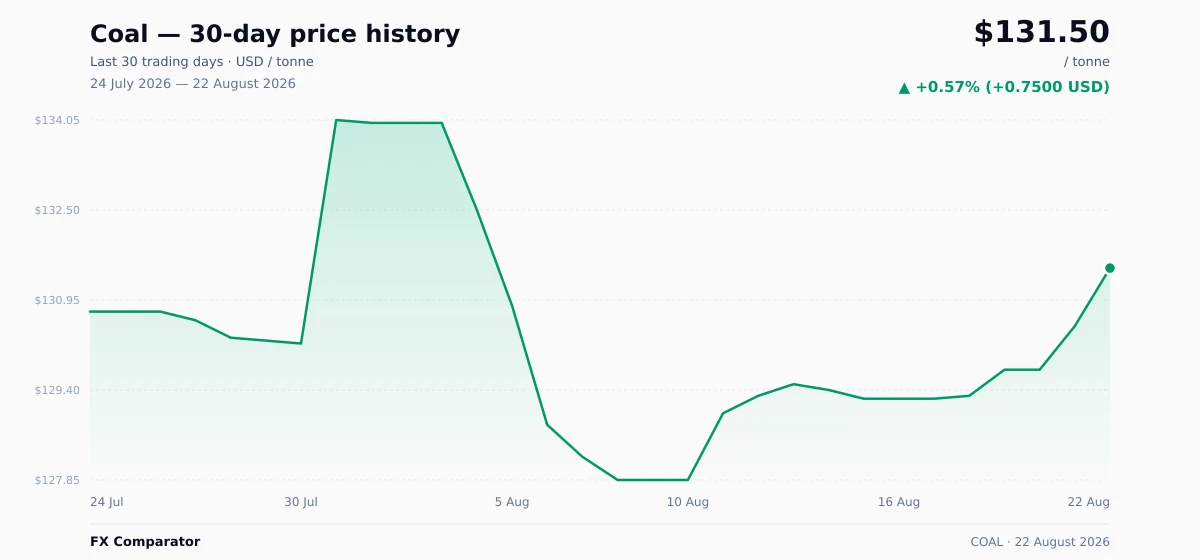
Download chart: WebP
Daily close
22 trading days
| Date | Price (USD) | Price (EUR) | Price (GBP) | Daily change |
|---|---|---|---|---|
| 8 Oct 2026 | US$150.25 | €134.32 | £113.77 | ▼ −1.28% |
| 7 Oct 2026 | US$152.20 | €136.06 | £115.24 | ▲ +1.47% |
| 6 Oct 2026 | US$150.00 | €134.10 | £113.58 | ▲ +0.70% |
| 3 Oct 2026 | US$148.95 | €133.16 | £112.78 | ▼ −0.23% |
| 2 Oct 2026 | US$149.30 | €133.47 | £113.05 | ▲ +1.91% |
| 1 Oct 2026 | US$146.50 | €130.97 | £110.93 | ▲ +0.90% |
| 30 Sept 2026 | US$145.20 | €129.80 | £109.94 | ▼ −0.55% |
| 29 Sept 2026 | US$146.00 | €130.52 | £110.55 | ▲ +1.57% |
| 26 Sept 2026 | US$143.75 | €128.51 | £108.84 | ▲ +0.17% |
| 25 Sept 2026 | US$143.50 | €128.28 | £108.66 | ▼ −0.83% |
| 24 Sept 2026 | US$144.70 | €129.36 | £109.56 | ▼ −0.48% |
| 23 Sept 2026 | US$145.40 | €129.98 | £110.09 | ▲ +0.94% |
| 22 Sept 2026 | US$144.05 | €128.78 | £109.07 | ▲ +0.03% |
| 19 Sept 2026 | US$144.00 | €128.73 | £109.03 | ▼ −0.45% |
| 18 Sept 2026 | US$144.65 | €129.31 | £109.53 | ▼ −0.07% |
| 17 Sept 2026 | US$144.75 | €129.40 | £109.60 | ▲ +0.10% |
| 16 Sept 2026 | US$144.60 | €129.27 | £109.49 | ▼ −1.53% |
| 15 Sept 2026 | US$146.85 | €131.28 | £111.19 | ▲ +0.07% |
| 12 Sept 2026 | US$146.75 | €131.19 | £111.12 | ▼ −0.84% |
| 11 Sept 2026 | US$148.00 | €132.31 | £112.06 | ▲ +0.44% |
| 10 Sept 2026 | US$147.35 | €131.73 | £111.57 | ▼ −0.17% |
| 9 Sept 2026 | US$147.60 | €131.95 | £111.76 | — |