Energy · HO-SPOT

Heating oil price

Heating oil currently trades at US$3.82 per gallon (≈ €3.25 · £2.85) — 16.59% below the 12-month high. Over the past 12 months it has gained 83.65%, with the annual range running from US$1.99 to US$4.58. 24-hour movement is minimal (±0.00%).

US$3.82 / gallon
≈ €3.25 ≈ £2.85 Unchanged 24h 71% within the 52-week range
FX Editorial Team · Data updated: · Editorially verified
Heating oil (HO-SPOT) price today US$3.82 / gallon, ↑ +0.00% (24h)

Heating oil chart

Interactive chart and 30-day overview

7 days
▼ −3.54%
−US$0.1400
30 days
▲ +0.79%
+US$0.0300
1 year
▲ +83.65%
+US$1.74
52-week range
US$1.99 71% US$4.58
Heating oil (HO-SPOT) 30-day price chart — USD, EUR, GBP

The Heating oil chart shows how the heating oil price has moved over time. The interactive view lets you switch the timeframe (from 7 days up to MAX), the currency (USD / EUR / GBP) and overlay moving averages. Click any two points to measure the percentage change between those dates.

How is heating oil priced?

Heating oil is priced per US gallon (1 gal = 3.785 litres / 0.0238 barrel) on the NYMEX and ICE. The gallon is the standard for US refined petroleum products including gasoline, heating oil and propane.

At US$3.82 per gallon, one litre wholesales for about US$1.01 and one barrel is equivalent to US$160.44. End-user prices at the pump include refining margin, distribution, excise duty and VAT.

What drives the price of heating oil?

Pricing centres on the US north-east heating cycle. Almost 60% of US heating-oil consumption is linked to households in New England and the Mid-Atlantic states, including New York, Massachusetts, Connecticut and Maine, where older oil-fired boilers remain common. A cold winter front can lift weekly demand quickly, and the HO futures curve reacts at once. During the heating season, from October to March, the EIA Heating Oil and Propane Update publishes a weekly product-market report tracking regional retail prices and heating degree days.

The distillate inventory level is the market’s main short-term signal. The EIA Weekly Petroleum Status Report, published on Wednesdays, shows the state of US distillate fuel oil stocks. If inventories stay below the five-year average in the weeks before winter, the market prices a seasonal premium into the HO futures contract. US daily distillate consumption is about 4 million barrels. Roughly a quarter is used for heating, with the rest used in road diesel, agriculture and marine fuels.

The global diesel market sets the longer-term framework. European gasoil consumption is about 6 million barrels a day, while China uses around 3.5 million barrels a day. As a result, global road, farm and marine diesel demand also feeds into US heating-oil prices through the Brent crack spread. The market is also sensitive to Russian diesel exports. Russia used to ship large volumes of diesel, mainly to Europe. Sanctions and periodic export bans tighten Atlantic Basin supply, moving HO and ICE Low Sulphur Gasoil (LGO) prices together.

How to invest in heating oil

Physical heating oil is a commercial product and is usually traded in industrial volumes, so retail investors typically gain exposure through CFDs, refiners and integrated oil companies. Standalone exchange-traded products focused only on heating oil are limited. Distillate exposure is usually indirect, through refining stocks such as Valero and Marathon Petroleum, or through broader energy-sector ETFs. Two regulated brokers that offer heating-oil CFDs and related equities are:

30-day price history

Chart and daily closing prices
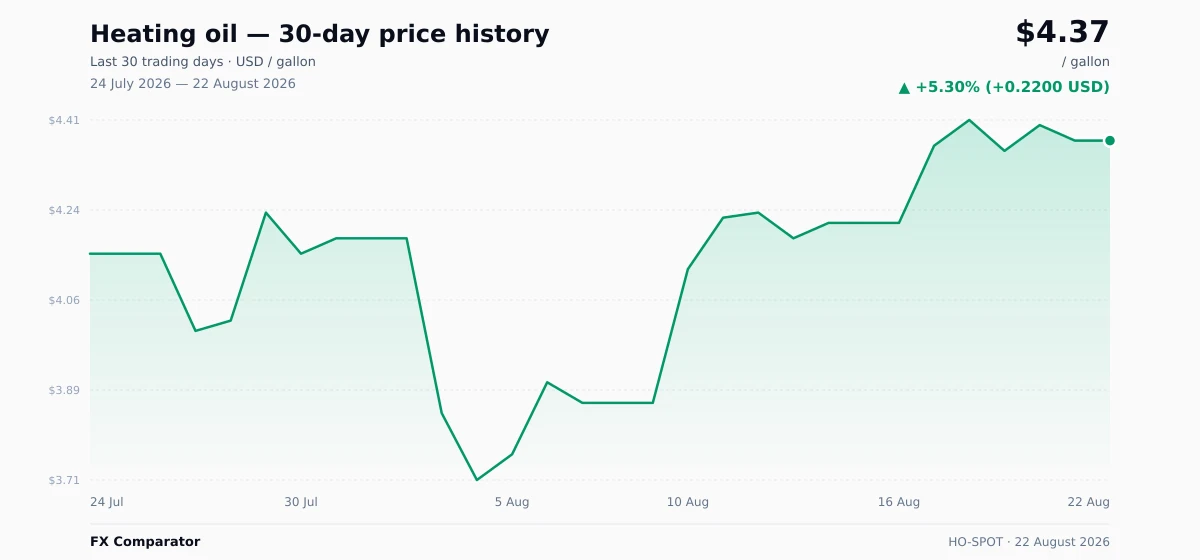
Heating oil (HO-SPOT) 30-day price chart — USD, EUR, GBP

Daily close

30 trading days

Date Price (USD) Price (EUR) Price (GBP) Daily change
22 May 2026 US$3.82 €3.25 £2.85 ▼ −1.29%
21 May 2026 US$3.87 €3.29 £2.88 ▼ −0.77%
20 May 2026 US$3.90 €3.32 £2.91 ▼ −3.47%
18 May 2026 US$4.04 €3.44 £3.01 ▲ +2.02%
16 May 2026 US$3.96 €3.37 £2.95 ▼ −0.75%
15 May 2026 US$3.99 €3.39 £2.97 ▲ +4.45%
14 May 2026 US$3.82 €3.25 £2.85 ▼ −2.55%
13 May 2026 US$3.92 €3.33 £2.92 ▼ −2.24%
12 May 2026 US$4.01 €3.41 £2.99 ▲ +3.08%
11 May 2026 US$3.89 €3.31 £2.90 ▲ +2.10%
10 May 2026 US$3.81 €3.24 £2.84 ▲ +0.53%
6 May 2026 US$3.79 €3.22 £2.82 ▼ −4.29%
5 May 2026 US$3.96 €3.37 £2.95 ▼ −1.98%
4 May 2026 US$4.04 €3.44 £3.01 ▲ +2.28%
2 May 2026 US$3.95 €3.36 £2.94 ▼ −0.25%
1 May 2026 US$3.96 €3.37 £2.95 ▼ −3.18%
30 Apr 2026 US$4.09 €3.48 £3.05 ▲ +5.68%
29 Apr 2026 US$3.87 €3.29 £2.88 ▼ −0.26%
28 Apr 2026 US$3.88 €3.30 £2.89 ▼ −1.02%
27 Apr 2026 US$3.92 €3.33 £2.92 ▲ +1.29%
25 Apr 2026 US$3.87 €3.29 £2.88 ▲ +2.11%
22 Apr 2026 US$3.79 €3.22 £2.82 ▲ +8.60%
21 Apr 2026 US$3.49 €2.97 £2.60 ▼ −0.29%
20 Apr 2026 US$3.50 €2.98 £2.61

Heating oil: frequently asked questions

Why is heating oil quoted in gallons? +
The NYMEX heating oil (HO) contract is based on the US market, where refined products are traditionally measured in gallons. One US gallon equals 3.78541 litres. The quoted unit is dollars per gallon, and the contract size is 42,000 gallons, exactly equal to 1,000 barrels (Bbl). The European equivalent, ICE Low Sulphur Gasoil, is quoted by the tonne. The two markets are arbitraged through the HOGO spread after conversion.
What is the difference between heating oil and road diesel? +
At the molecular level, almost none. Since the contract specification was changed, the NYMEX HO contract has been physically deliverable into ultra-low-sulphur diesel (ULSD, maximum 15 ppm sulphur), the same distillate product used in road diesel engines. In the US market, the distinction is mainly tax status and red dye. Heating fuel receives a tax benefit and is not allowed for road use. Similar rules apply in many jurisdictions: dyed or rebated heating fuel is intended for boilers, and using it in road vehicles is illegal.
What is the global-market price of one litre of heating oil if the US quote is $2.30 per gallon? +
The conversion is: 2.30 USD / 3.78541 ≈ 0.61 USD per litre at the raw wholesale level. One barrel, or 42 gallons, is therefore about 96.6 USD. One litre of heating oil weighs about 0.85 kg, based on distillate density. One tonne is roughly 1,176 litres, so the indicative world-market price converted to tonnes is about 720 USD. Retail delivered prices also depend on refining margins, logistics and local taxes; tax treatment varies by jurisdiction; consult a local tax adviser.
Why does the EIA weekly distillate inventory report matter? +
The EIA, or U.S. Energy Information Administration, publishes the Weekly Petroleum Status Report on Wednesdays. It includes the current level of US distillate fuel oil stocks. The market is especially sensitive to data in the weeks before the heating season. If inventories remain below the five-year average in October and November, the HO futures contract prices in a seasonal premium because supply can tighten during a cold winter front. The data also affect pricing across the wider US diesel market.
What is ICE Low Sulphur Gasoil and how is it linked to HO? +
ICE Low Sulphur Gasoil (LGO) is the European diesel and gasoil contract listed on London’s ICE exchange. It is quoted in dollars per tonne and is the reference price for the European road-diesel market. It prices the same type of distillate as NYMEX HO, but in a different unit and with a different physical delivery point. The HOGO spread, or Heating Oil – Gasoil spread, measures the difference between the two markets. Traders use it to balance US and European supply through transatlantic diesel arbitrage.
How much distillate does the US consume each day? +
According to the EIA, US daily distillate fuel oil consumption is about 4 million barrels. Around a quarter is heating use, mainly in north-eastern states, while about three-quarters is road diesel, agricultural and marine, or bunker, use. For comparison, European gasoil consumption is about 6 million barrels a day, while China uses around 3.5 million barrels a day. The size of the global diesel market and any supply tension can directly affect the US HO price.
Why are standalone heating-oil ETFs rare? +
The heating-oil market is smaller than the crude oil or natural gas markets. Its futures curve has also historically shown high contango, which can erode returns for funds that track futures. Demand is strongly seasonal, with winter peaks and summer weakness, making it harder to build a sustainable ETF structure. Broader energy funds, such as USO for crude oil and XLE for the energy sector, exist alongside some heating-oil-linked ETCs that offer indirect exposure. Pure HO exposure is usually accessed through CFDs, futures contracts or heating-oil-linked exchange-traded products.
How does the heating-oil price affect refining stocks such as Valero and Marathon Petroleum? +
Valero (VLO) and Marathon Petroleum (MPC) are among the large US independent refiners. Their profitability is shaped by the gasoline-diesel crack spread, such as the 3-2-1 or 5-3-2 crack, which measures the price difference between refined products and crude-oil inputs. When distillate demand, including heating oil and diesel, is strong, the crack spread widens and refinery margins rise. A cold winter cycle or a tight European diesel market can therefore support refining equities. The effect is smaller for integrated oil companies such as ExxonMobil and Chevron because upstream production also drives their earnings.