Tin price
Tin currently trades at US$54,184 per tonne (≈ €48,478 · £41,034) — close to the 12-month high. Over the past 12 months the price has gained 48.29%, with the annual range running from US$34,450 to US$59,040. 24-hour movement is minimal (±0.00%).

Invest in commodity ETFs from just $50
Gold, oil and even whole commodity sectors through ETFs, all in one account, kept simple.
eToro is a multi-asset investment platform. The value of your investments may go up or down. Your capital is at risk.
Tin chart
Interactive chart and 30-day overview
The Tin chart shows how the tin price has moved over time. The interactive view lets you switch the timeframe (from 7 days up to MAX), the currency (USD / EUR / GBP) and overlay moving averages. Click any two points to measure the percentage change between those dates.
How is tin priced?
Tin is priced per metric tonne (1 t = 1,000 kg) — the standard unit for industrial and bulk commodities on the London Metal Exchange (LME), CME and major European exchanges. Wholesale shipments move in containers or bulk vessels, typically in 25-tonne or 100-tonne lots.
At US$54,184 per tonne, one kilogram is worth US$54.18. End-user pricing for processed goods includes refining margins, transport and tariffs on top of the wholesale benchmark.
What drives the price of tin?
Electronics solder accounts for about 50% of global tin consumption, so tin prices track the semiconductor cycle unusually closely. The EU RoHS Directive made lead-free solder mandatory: the former Sn63/Pb37 tin-lead alloy was replaced by the Sn-Ag-Cu (SAC) family — the most common SAC305 formulation contains 96.5% tin, 3% silver and 0.5% copper. Because lead-free alternatives use a higher tin content, the regulatory shift structurally increased the industry’s tin intensity. A smartphone PCB assembly uses about 1–2 g of tin, a PC motherboard 5–10 g, and server boards considerably more.
Supply is highly concentrated. Global mine production is around 290,000 tonnes, with a large share coming from three countries. China produces about 70 kt, mainly in Yunnan and Guangxi; Indonesia about 75 kt, led by state-owned PT Timah on Bangka and Belitung; Myanmar about 30 kt, almost entirely from artisanal mines in Wa State; and Peru about 25 kt, led by Minsur’s San Rafael mine. Brazil, Bolivia and the Democratic Republic of Congo follow. The three largest producers together account for about 60% of global output and include countries where export rules, concession changes or security conditions regularly affect supply.
The third pillar is tinplate, tin-coated steel sheet used for food and paint cans. This segment is structurally stable — canned food demand is relatively insulated from the economic cycle — and offsets some of the volatility in electronics. Other drivers include chemical uses such as PVC stabilisers, catalysts and fungicides; brass and bronze alloys, including the classic 88% copper — 12% tin bronze used in industrial fittings; and LME warehouse stock levels. Prices are also affected by fluctuations in output from Myanmar’s Man Maw mine and Indonesia’s periodic export restrictions aimed at curbing black- and grey-market trade.
How to invest in tin
A European retail investor can gain tin exposure in several ways. A tin CFD is the most direct route — a leveraged product linked to the LME Tin price that allows positions in either direction, but carries high risk. Pure tin ETFs are rare; limited-access tin ETC/ETN products are more common, and exposure can also be taken through CFDs or individual shares. The main listed companies include Alphamin Resources (AFM, Canadian listing, Bisie mine in the Democratic Republic of Congo), Peru’s Minsur (San Rafael, one of the world’s largest tin mines) and Malaysia Smelting Corporation (MSC, Kuala Lumpur listing). Indonesia’s PT Timah is a state producer listed in Jakarta and is typically harder to access through retail brokers.
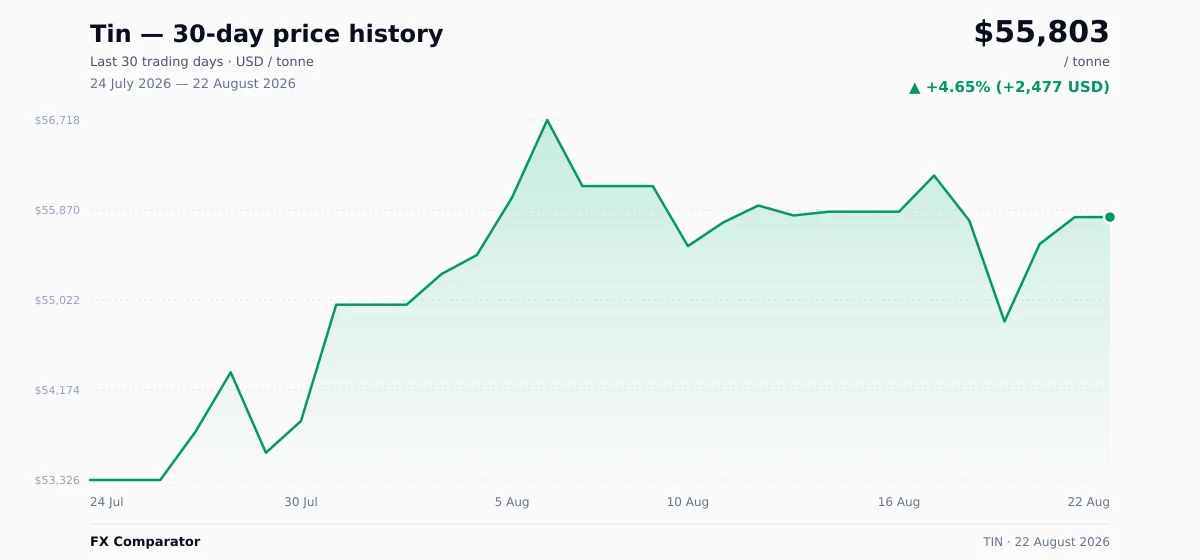
30-day price history
Chart and daily closing prices
Download chart: WebP
Daily close
21 trading days
| Date | Price (USD) | Price (EUR) | Price (GBP) | Daily change |
|---|---|---|---|---|
| 7 Oct 2026 | US$54,184 | €48,478 | £41,034 | ▼ −0.24% |
| 6 Oct 2026 | US$54,314 | €48,594 | £41,133 | ▲ +0.56% |
| 5 Oct 2026 | US$54,013 | €48,325 | £40,905 | ▼ −0.59% |
| 2 Oct 2026 | US$54,332 | €48,610 | £41,146 | ▲ +0.75% |
| 1 Oct 2026 | US$53,927 | €48,248 | £40,839 | ▼ −0.50% |
| 30 Sept 2026 | US$54,198 | €48,490 | £41,045 | ▲ +0.77% |
| 29 Sept 2026 | US$53,786 | €48,122 | £40,733 | ▼ −1.03% |
| 28 Sept 2026 | US$54,348 | €48,625 | £41,158 | ▲ +0.63% |
| 25 Sept 2026 | US$54,010 | €48,322 | £40,902 | ▲ +0.21% |
| 24 Sept 2026 | US$53,898 | €48,222 | £40,817 | ▼ −0.58% |
| 23 Sept 2026 | US$54,214 | €48,505 | £41,057 | ▲ +0.50% |
| 22 Sept 2026 | US$53,944 | €48,263 | £40,852 | ▲ +0.45% |
| 21 Sept 2026 | US$53,705 | €48,049 | £40,671 | ▲ +0.98% |
| 18 Sept 2026 | US$53,186 | €47,585 | £40,278 | ▲ +1.45% |
| 17 Sept 2026 | US$52,424 | €46,903 | £39,701 | ▲ +0.88% |
| 16 Sept 2026 | US$51,966 | €46,493 | £39,354 | ▲ +0.17% |
| 15 Sept 2026 | US$51,879 | €46,416 | £39,288 | ▼ −2.78% |
| 14 Sept 2026 | US$53,364 | €47,744 | £40,413 | ▼ −1.80% |
| 11 Sept 2026 | US$54,344 | €48,621 | £41,155 | ▼ −1.58% |
| 10 Sept 2026 | US$55,218 | €49,403 | £41,817 | ▲ +0.65% |
| 9 Sept 2026 | US$54,862 | €49,084 | £41,548 | — |