Rapeseed oil price
Rapeseed oil currently trades at US$557.30 per tonne (≈ €498.21 · £421.98) — effectively at the 12-month high. Over the past 12 months the price has gained 19.53%, with the annual range running from US$446.25 to US$565.75. In the past 24 hours the price has risen by 0.96%.


Invest in commodity ETFs from just $50
Gold, oil and even whole commodity sectors through ETFs, all in one account, kept simple.
eToro is a multi-asset investment platform. The value of your investments may go up or down. Your capital is at risk.
Rapeseed oil chart
Interactive chart and 30-day overview
The Rapeseed oil chart shows how the rapeseed oil price has moved over time. The interactive view lets you switch the timeframe (from 7 days up to MAX), the currency (USD / EUR / GBP) and overlay moving averages. Click any two points to measure the percentage change between those dates.
How is rapeseed oil priced?
Rapeseed oil is priced per metric tonne (1 t = 1,000 kg) — the standard unit for industrial and bulk commodities on the London Metal Exchange (LME), CME and major European exchanges. Wholesale shipments move in containers or bulk vessels, typically in 25-tonne or 100-tonne lots.
At US$557.30 per tonne, one kilogram is worth US$0.5573. End-user pricing for processed goods includes refining margins, transport and tariffs on top of the wholesale benchmark.
What drives the price of rapeseed oil?
The EU biodiesel mandate is the single most important driver of the rapeseed oil market. Through the transport and fuel obligations in the Renewable Energy Directive (RED III), about 40% of rapeseed oil produced in the bloc ends up as FAME biodiesel. Rapeseed oil is the largest single feedstock in EU biodiesel production, ahead of imported palm oil and recycled used cooking oil (UCO). Changes in demand from the biodiesel industry therefore feed directly into the Euronext Paris RPSD rapeseed contract and related oil prices. Global rapeseed oil production is in the ~30 Mt range (FAO Oilcrops Market Monitor), of which the EU alone produces ~10 Mt, mainly from crops in Germany, France, Poland and Czechia.
The Ukrainian rapeseed crop and Black Sea logistics are the second major factor. Ukraine is the EU’s largest external supplier of rapeseed. EU oilseed crushers process the seed, and the resulting oil feeds German and French biodiesel refineries. Since the start of the war, Ukrainian crop planting decisions, the functioning of the sea corridor through Odesa, Chornomorsk and Yuzhne, Danube river shipments and the capacity of Romanian and Bulgarian ports such as Constanta and Varna have all affected prices. Rival vegetable oils — palm oil from Indonesia and Malaysia, tracked by MPOB data; soybean oil, traded through the CBOT ZL contract; and sunflower oil, quoted Black Sea FOB — create substitution pressure in cooking-oil and biodiesel markets. When rapeseed oil becomes more expensive, buyers shift towards the three alternatives and the spread between the four oils widens.
The third group of drivers is Canadian canola export supply and US RFS demand. Canada is the world’s largest canola exporter. The Canola (RS) futures contract on ICE Canada is the benchmark, and Canadian Canola Council data show that the country exports a significant share of its ~4 Mt of canola oil output. US renewable fuel rules (RFS biomass-based diesel) and California’s LCFS programme are drawing more Canadian canola oil into the United States as a feedstock for renewable diesel (HVO/RD). China, with ~8 Mt of rapeseed oil production, is the second-largest producer globally, while India is also a significant producer. The market is tracked through monthly data from USDA WASDE Oilseeds, FAO Oilcrops and the Canadian Canola Council.
How to invest in rapeseed oil
There is no exchange-traded futures contract for crude rapeseed oil, so regulated European brokers do not offer direct CFD or futures exposure. Neither XTB nor eToro lists a dedicated rapeseed oil product. The Euronext Paris Rapeseed (RPSD) seed contract is available to professional market participants such as trading houses and oilseed crushers, but typically not to private investors. Exposure to the market is instead usually indirect, through oilseed-processing and agribusiness shares: global traders such as Archer Daniels Midland — ADM and Bunge — BG, and Nutrien (NTR), a Canadian fertiliser and agricultural-inputs company linked to the canola value chain. Privately held Cargill is not listed. Two regulated brokers where these shares — along with related soybean and palm-oil products — may be available are:
30-day price history
Chart and daily closing prices
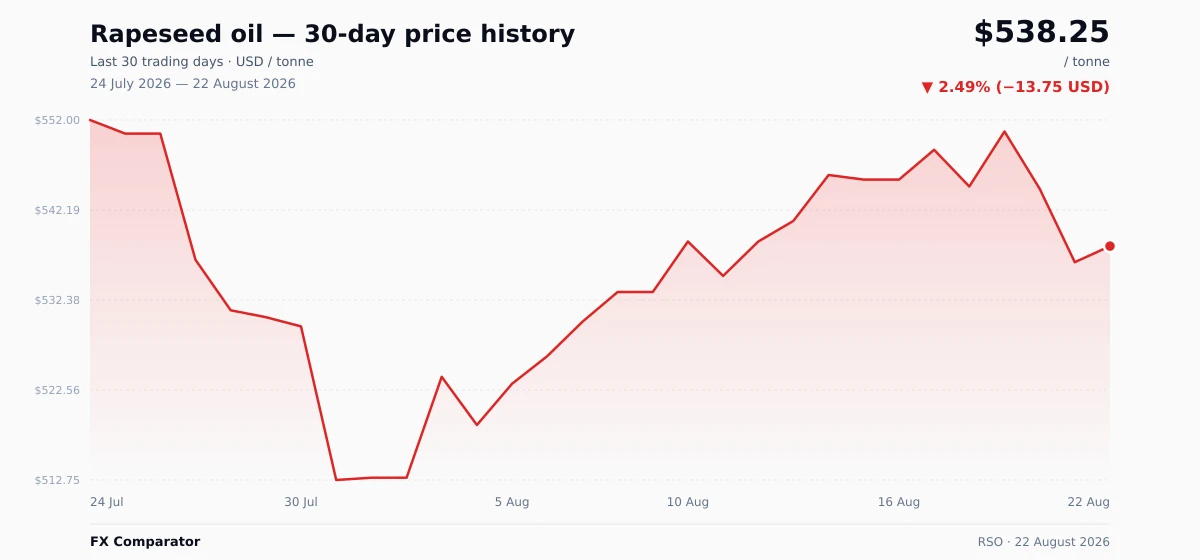
Download chart: WebP
Daily close
25 trading days
| Date | Price (USD) | Price (EUR) | Price (GBP) | Daily change |
|---|---|---|---|---|
| 8 Oct 2026 | US$557.30 | €498.21 | £421.98 | ▲ +0.96% |
| 7 Oct 2026 | US$552.00 | €493.47 | £417.96 | ▼ −1.65% |
| 6 Oct 2026 | US$561.25 | €501.74 | £424.97 | ▲ +0.90% |
| 5 Oct 2026 | US$556.25 | €497.27 | £421.18 | ▲ +3.63% |
| 3 Oct 2026 | US$536.75 | €479.84 | £406.42 | ▼ −0.37% |
| 2 Oct 2026 | US$538.75 | €481.63 | £407.93 | ▲ +0.14% |
| 1 Oct 2026 | US$538.00 | €480.96 | £407.36 | ▲ +0.37% |
| 30 Sept 2026 | US$536.00 | €479.17 | £405.85 | ▼ −1.97% |
| 29 Sept 2026 | US$546.75 | €488.78 | £413.99 | ▲ +1.77% |
| 28 Sept 2026 | US$537.25 | €480.29 | £406.79 | ▼ −1.96% |
| 26 Sept 2026 | US$548.00 | €489.90 | £414.93 | ▼ −0.05% |
| 25 Sept 2026 | US$548.25 | €490.12 | £415.12 | ▼ −0.50% |
| 24 Sept 2026 | US$551.00 | €492.58 | £417.21 | ▼ −0.81% |
| 23 Sept 2026 | US$555.50 | €496.60 | £420.61 | ▲ +1.14% |
| 22 Sept 2026 | US$549.25 | €491.01 | £415.88 | ▼ −1.08% |
| 21 Sept 2026 | US$555.25 | €496.38 | £420.42 | ▲ +1.00% |
| 19 Sept 2026 | US$549.75 | €491.46 | £416.26 | ▲ +0.27% |
| 18 Sept 2026 | US$548.25 | €490.12 | £415.12 | ▼ −0.63% |
| 16 Sept 2026 | US$551.75 | €493.25 | £417.77 | ▼ −0.54% |
| 15 Sept 2026 | US$554.75 | €495.93 | £420.05 | ▲ +0.68% |
| 14 Sept 2026 | US$551.00 | €492.58 | £417.21 | ▲ +0.05% |
| 12 Sept 2026 | US$550.75 | €492.35 | £417.02 | ▲ +0.23% |
| 11 Sept 2026 | US$549.50 | €491.24 | £416.07 | ▼ −1.83% |
| 10 Sept 2026 | US$559.75 | €500.40 | £423.83 | ▲ +0.45% |
| 9 Sept 2026 | US$557.25 | €498.16 | £421.94 | — |