Sunflower oil price
Sunflower oil currently trades at US$1,515 per tonne (≈ €1,354 · £1,147) — 10.57% below the 12-month high. Over the past 12 months the price has gained 7.83%, with the annual range running from US$1,399 to US$1,694. In the past 24 hours the price has risen by 0.55%.


Invest in commodity ETFs from just $50
Gold, oil and even whole commodity sectors through ETFs, all in one account, kept simple.
eToro is a multi-asset investment platform. The value of your investments may go up or down. Your capital is at risk.
Sunflower oil chart
Interactive chart and 30-day overview
The Sunflower oil chart shows how the sunflower oil price has moved over time. The interactive view lets you switch the timeframe (from 7 days up to MAX), the currency (USD / EUR / GBP) and overlay moving averages. Click any two points to measure the percentage change between those dates.
How is sunflower oil priced?
Sunflower oil is priced per metric tonne (1 t = 1,000 kg) — the standard unit for industrial and bulk commodities on the London Metal Exchange (LME), CME and major European exchanges. Wholesale shipments move in containers or bulk vessels, typically in 25-tonne or 100-tonne lots.
At US$1,515 per tonne, one kilogram is worth US$1.52. End-user pricing for processed goods includes refining margins, transport and tariffs on top of the wholesale benchmark.
What drives the price of sunflower oil?
Ukrainian and Russian supply is the main driver of the market. Global sunflower oil production is in the ~22 million tonnes range. Ukraine produces ~6 Mt and Russia also produces ~6 Mt, together accounting for about 55% of output. Export concentration is even higher. Ukraine alone accounts for almost 30% of global sunflower oil exports, while Russia adds another ~25%. As a result, any Ukrainian or Russian planting, harvest or port disruption feeds directly into Black Sea FOB pricing. The main market sources are the FAO Oilcrops Market Monitor, USDA WASDE Oilseeds and monthly data from the Ukrainian Agribusiness Club (UCAB).
The reliability of Black Sea shipping is the second key factor. Ukrainian sunflower oil exports have relied on Black Sea ports such as Odesa, Chornomorsk and Yuzhne. Since the start of the war, the maritime corridor has repeatedly been suspended or restricted for shorter and longer periods. Insurance premiums, mine risk, strikes on port infrastructure and the risk of a Russian blockade all lift prices. Supply shocks are usually reflected quickly in Argus and Platts daily assessments. Alternative routes — Danube river transport, Romanian and Bulgarian ports such as Constanta and Varna, and Polish rail transit — operate at a premium and with lower throughput.
Prices of competing vegetable oils and Indian and Chinese import demand are the other two main factors. Palm oil, soybean oil and sunflower oil are largely interchangeable in cooking oil, food manufacturing and biodiesel markets. During sunflower oil shocks, the spread between the three oils widens as buyers switch to cheaper palm or soybean oil. The Indonesian and Malaysian palm oil markets, tracked through MPOB and GAPKI data, and CBOT soybean oil prices therefore also affect sunflower oil indirectly. On the demand side, India is the world’s largest sunflower oil importer at about ~3 Mt a year, according to the Solvent Extractors' Association of India. China and the EU are also major buyers. The EU remains a net importer despite its own production of about ~3 Mt.
How to invest in sunflower oil
There is no exchange-traded futures contract for crude sunflower oil. European regulated brokers therefore do not offer direct CFD or futures exposure. Neither XTB nor eToro lists a sunflower oil product. Retail investors can gain indirect exposure through vegetable oil and agribusiness shares. Global oilseed processors such as Archer Daniels Midland — ADM, Bunge — BG and Wilmar International — F34.SI operate at different points in the value chain, while Ukrainian agribusiness stocks such as MHP — MHPC.L are directly exposed to the Black Sea region. Two regulated brokers where these shares, as well as related soybean and palm oil products, may be available:
30-day price history
Chart and daily closing prices
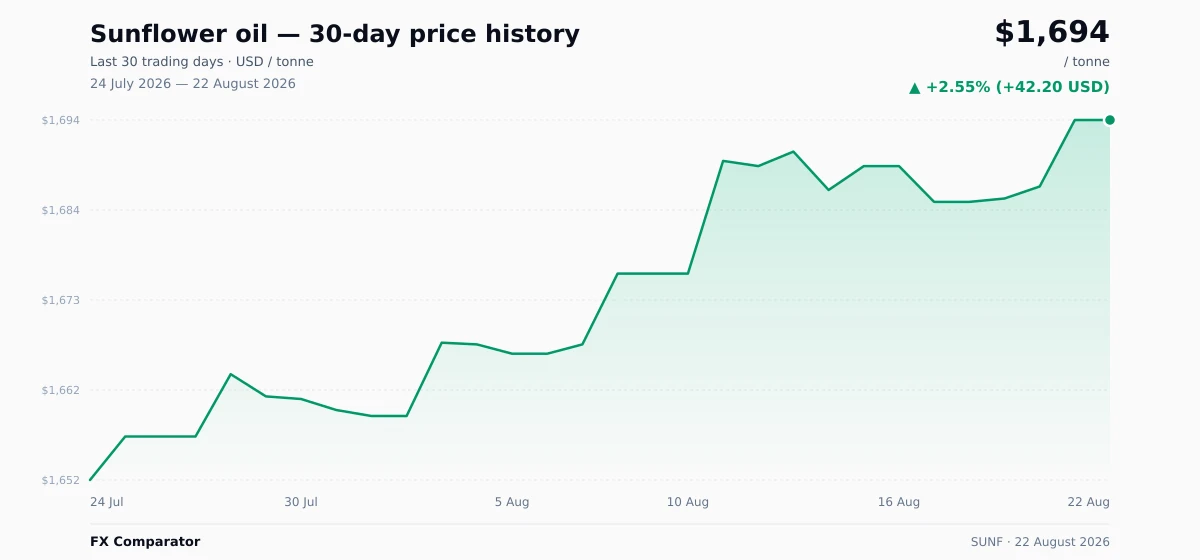
Download chart: WebP
Daily close
20 trading days
| Date | Price (USD) | Price (EUR) | Price (GBP) | Daily change |
|---|---|---|---|---|
| 8 Oct 2026 | US$1,515 | €1,354 | £1,147 | ▲ +0.55% |
| 7 Oct 2026 | US$1,507 | €1,347 | £1,141 | ▼ −0.62% |
| 6 Oct 2026 | US$1,516 | €1,355 | £1,148 | ▲ +0.32% |
| 2 Oct 2026 | US$1,511 | €1,351 | £1,144 | ▲ +0.27% |
| 1 Oct 2026 | US$1,507 | €1,348 | £1,141 | ▼ −0.19% |
| 30 Sept 2026 | US$1,510 | €1,350 | £1,144 | ▼ −0.01% |
| 29 Sept 2026 | US$1,511 | €1,350 | £1,144 | ▲ +0.61% |
| 26 Sept 2026 | US$1,501 | €1,342 | £1,137 | ▼ −3.24% |
| 25 Sept 2026 | US$1,552 | €1,387 | £1,175 | ▼ −1.82% |
| 24 Sept 2026 | US$1,580 | €1,413 | £1,197 | ▼ −0.11% |
| 23 Sept 2026 | US$1,582 | €1,414 | £1,198 | ▼ −0.52% |
| 22 Sept 2026 | US$1,590 | €1,422 | £1,204 | ▼ −0.80% |
| 19 Sept 2026 | US$1,603 | €1,433 | £1,214 | ▼ −0.19% |
| 18 Sept 2026 | US$1,606 | €1,436 | £1,216 | ▼ −0.59% |
| 17 Sept 2026 | US$1,616 | €1,444 | £1,223 | ▼ −0.04% |
| 16 Sept 2026 | US$1,616 | €1,445 | £1,224 | ▼ −1.23% |
| 12 Sept 2026 | US$1,637 | €1,463 | £1,239 | ▼ −0.44% |
| 11 Sept 2026 | US$1,644 | €1,470 | £1,245 | ▼ −0.50% |
| 10 Sept 2026 | US$1,652 | €1,477 | £1,251 | ▼ −0.52% |
| 9 Sept 2026 | US$1,661 | €1,485 | £1,257 | — |