Uranium price
Uranium currently trades at US$89.85 per pound (≈ €80.32 · £68.03) — 11.52% below the 12-month high. Over the past 12 months the price has gained 13.88%, with the annual range running from US$75.85 to US$101.55. 24-hour movement is minimal (±0.00%).


Invest in commodity ETFs from just $50
Gold, oil and even whole commodity sectors through ETFs, all in one account, kept simple.
eToro is a multi-asset investment platform. The value of your investments may go up or down. Your capital is at risk.
Uranium chart
Interactive chart and 30-day overview
The Uranium chart shows how the uranium price has moved over time. The interactive view lets you switch the timeframe (from 7 days up to MAX), the currency (USD / EUR / GBP) and overlay moving averages. Click any two points to measure the percentage change between those dates.
How is uranium priced?
What drives the uranium price?
The demand side is driven by the restart of nuclear power. About 440 reactors operate worldwide across 32 countries, and many units are returning to the grid after the shutdown wave that followed Fukushima. European operators are extending reactor lifetimes, with Germany the main exception, while Japan continues to restart selected reactors. Small modular reactor projects (SMRs) are part of the demand story. Hyperscale data-centre operators have also signed direct reactor-power purchase agreements for round-the-clock supply, including Microsoft–Constellation at Three Mile Island, Amazon–Talen and Google–Kairos Power. According to the IAEA’s tracking, new reactor completions are not keeping pace with planned capacity additions.
Geographic concentration on the supply side is the second defining feature of the market. Almost 40% of global uranium comes from Kazakhstan (Kazatomprom, about 21,000 tonnes a year), with a further roughly 11% from Canada (Cameco, about 7,000 tonnes a year), 8–10% from Australia (BHP Olympic Dam) and about 9% from Namibia (Husab, Rössing). Western mine output has recovered only partly from earlier lows. Several projects, including Cameco’s McArthur River and Paladin’s Langer Heinrich, spent years in care and maintenance. Geopolitical exposure is material: Kazatomprom’s logistics partly rely on the Russian rail network, while US HALEU (high-assay low-enriched uranium) supply remains heavily dependent on Rosatom.
The third factor is the contract cycle and the role of physical buyers. Nuclear-plant operators cover 70–85% of their inventories through long-term contracts (LTCs), and waves of contract renegotiation create cyclical demand peaks. In the spot market, the Sprott Physical Uranium Trust (SPUT) is an important buyer. The closed-end fund, listed on the Toronto Stock Exchange, holds physical U₃O₈ in multi-tonne lots and has been a persistent purchaser since launch. Trust-sized spot buying can move prices in a structurally thin market.
How can investors get uranium exposure?
Direct yellowcake trading is not available to private investors. Physical uranium is a licensed product under strict IAEA controls and can be received only by licensed nuclear-plant operators and traders. A European retail investor can access the uranium market through three main routes: closed-end funds backed by physical U₃O₈, such as SPUT; shares of uranium miners, including Cameco, Kazatomprom, Denison, NexGen and Paladin; and uranium-focused ETFs, such as URA and URNM. Below are two regulated brokers with English-language platforms.
30-day price history
Chart and daily closing prices
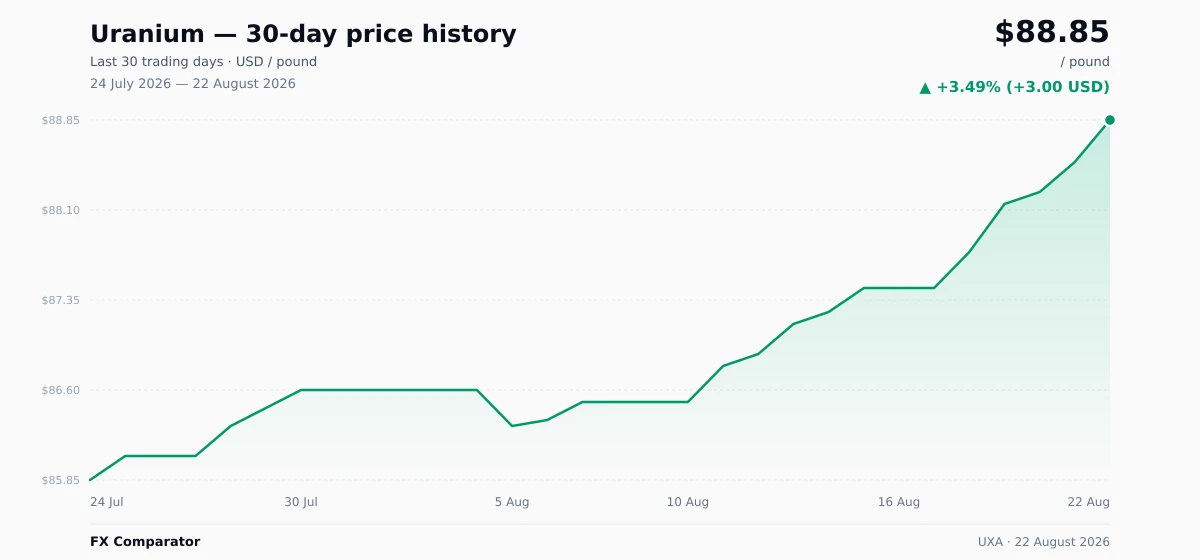
Download chart: WebP
Daily close
18 trading days
| Date | Price (USD) | Price (EUR) | Price (GBP) | Daily change |
|---|---|---|---|---|
| 7 Oct 2026 | US$89.85 | €80.32 | £68.03 | ▲ +0.17% |
| 6 Oct 2026 | US$89.70 | €80.19 | £67.92 | ▼ −0.28% |
| 3 Oct 2026 | US$89.95 | €80.41 | £68.11 | ▲ +0.56% |
| 1 Oct 2026 | US$89.45 | €79.97 | £67.73 | ▼ −0.06% |
| 30 Sept 2026 | US$89.50 | €80.01 | £67.77 | ▲ +0.22% |
| 29 Sept 2026 | US$89.30 | €79.83 | £67.62 | ▼ −0.22% |
| 26 Sept 2026 | US$89.50 | €80.01 | £67.77 | ▲ +0.06% |
| 25 Sept 2026 | US$89.45 | €79.97 | £67.73 | ▼ −0.11% |
| 24 Sept 2026 | US$89.55 | €80.06 | £67.81 | ▼ −0.22% |
| 23 Sept 2026 | US$89.75 | €80.23 | £67.96 | ▲ +0.06% |
| 18 Sept 2026 | US$89.70 | €80.19 | £67.92 | ▼ −0.06% |
| 17 Sept 2026 | US$89.75 | €80.23 | £67.96 | ▼ −0.22% |
| 16 Sept 2026 | US$89.95 | €80.41 | £68.11 | ▼ −0.06% |
| 15 Sept 2026 | US$90.00 | €80.46 | £68.15 | ▼ −0.17% |
| 12 Sept 2026 | US$90.15 | €80.59 | £68.26 | ▼ −0.06% |
| 11 Sept 2026 | US$90.20 | €80.64 | £68.30 | ▲ +0.22% |
| 10 Sept 2026 | US$90.00 | €80.46 | £68.15 | ▲ +0.39% |
| 9 Sept 2026 | US$89.65 | €80.14 | £67.88 | — |