Wool price
Wool currently trades at US$1,266 per 100 kg (≈ €1,132 · £958.39) — close to the 12-month high. Over the past 12 months the price has gained 16.63%, with the annual range running from US$979.82 to US$1,379. In the past 24 hours the price has fallen by 0.14%.

Invest in commodity ETFs from just $50
Gold, oil and even whole commodity sectors through ETFs, all in one account, kept simple.
eToro is a multi-asset investment platform. The value of your investments may go up or down. Your capital is at risk.
Wool chart
Interactive chart and 30-day overview
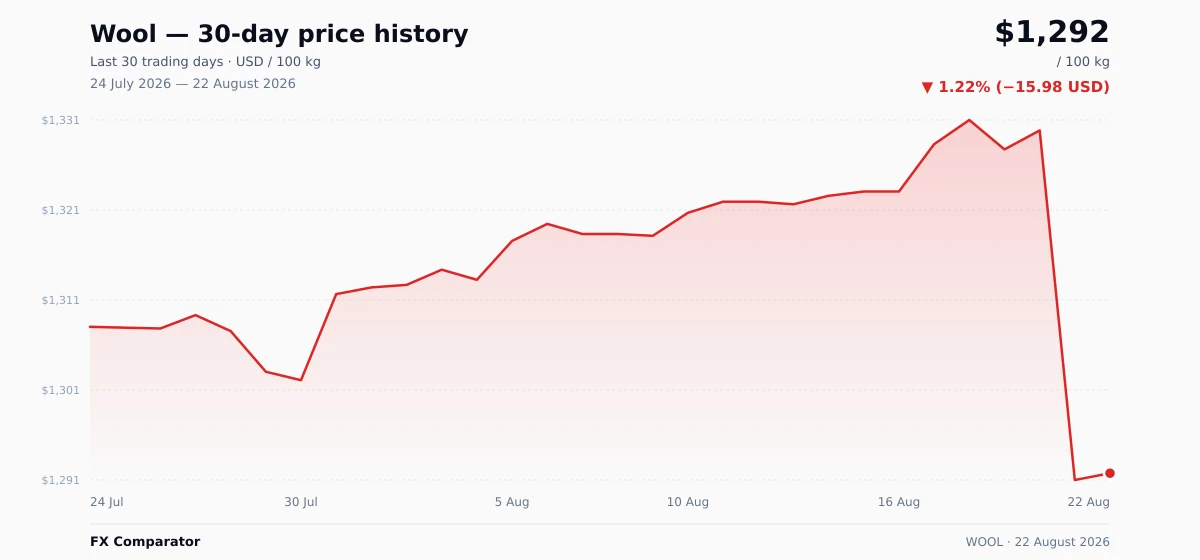
The Wool chart shows how the wool price has moved over time. The interactive view lets you switch the timeframe (from 7 days up to MAX), the currency (USD / EUR / GBP) and overlay moving averages. Click any two points to measure the percentage change between those dates.
How is wool priced?
Wool is priced per 100 kg on European exchanges — the legacy quintal-based unit common in EU agricultural pricing. The unit makes per-tonne and per-kilogram conversion straightforward.
At US$1,266 per 100 kg, one tonne is worth US$12,657 and one kilogram US$12.66. Most international wholesale trade now references the metric tonne, but the 100 kg unit persists in EU spot markets.
What drives the price of wool?
The main demand driver for wool is the Chinese textile industry. According to the IWTO (International Wool Textile Organisation), China absorbs about 75% of global apparel-grade wool imports. Chinese spinning and weaving mills are the world’s main wool processors, and some premium Italian, British and Japanese suiting mills rely on semi-finished yarn from China. The weekly AWEX auction price is therefore directly affected by the Chinese textile cycle and the yuan/Australian dollar exchange rate. When Chinese textile exports weaken or Chinese mill yarn inventories fill up, buyers step back and the EMI can correct quickly. The global apparel-wool market is about ~1.1 million tonnes in clean fibre equivalent. Compared with global polyester production of about 65 Mt, it is a narrow but high-value premium segment.
Supply is dominated by the size and condition of the Australian sheep flock. ABARES (Australian Bureau of Agricultural and Resource Economics) estimates that Australia accounts for about 25% of global apparel-wool output, or roughly 280 kt a year in clean fibre equivalent. In the fine merino premium segment, that is effectively a market-leading share. New Zealand (~120 kt) is also a significant producer, but most of its clip is coarser carpet wool. Meat & Livestock Australia publications regularly show that the Australian sheep flock, and therefore wool supply, is structurally sensitive to prolonged drought, especially in inland New South Wales and Victoria. It is also sensitive to lamb-meat pricing: when lamb is relatively expensive compared with wool, farmers shift towards meat production and flock sizes can fall for years.
Over the longer term, the market is shaped by competitive pressure from synthetic fibres. Polyester (PET) and acrylic are direct substitutes for wool in carpets, upholstery textiles and entry-level clothing. They are cheaper, easier to mechanise and can be pre-dyed. Wool’s share of the global textile-fibre market is now only around 1%; mass-market textiles are dominated by polyester and cotton. Wool’s defence is premium and sustainability positioning. Superfine merino (16–18.5 μm) is used by Italian luxury suiting mills such as Loro Piana, Ermenegildo Zegna and Reda, and by high-end menswear brands such as Brioni, Brunello Cucinelli and Burberry. Fashion’s shift towards natural fiber, ESG requirements and regulatory pressure over microplastic pollution support wool demand among premium buyers. In mass-market apparel, however, synthetics remain dominant.
How to invest in wool
Wool has no public futures contract. Neither XTB nor eToro offers a direct wool CFD, because physical trade is based on Australian auctions through AWEX rather than a standardised exchange contract. For a European retail investor, wool exposure is therefore usually indirect, through shares in the premium apparel and luxury value chain. The most direct listed exposure is the Italian luxury knitwear company Brunello Cucinelli (BC.MI), whose business model is built on cashmere and superfine merino and is sensitive to wool-price movements. Burberry (BRBY.L) represents the British wool tradition, including gabardine and coat fabrics. LVMH (MC.PA) owns Loro Piana, a major merino-wool fabric producer. Two regulated brokers with English-language platforms:
30-day price history
Chart and daily closing prices
Download chart: WebP
Daily close
28 trading days
| Date | Price (USD) | Price (EUR) | Price (GBP) | Daily change |
|---|---|---|---|---|
| 8 Oct 2026 | US$1,266 | €1,132 | £958.39 | ▼ −0.14% |
| 7 Oct 2026 | US$1,268 | €1,133 | £959.73 | ▲ +0.03% |
| 6 Oct 2026 | US$1,267 | €1,133 | £959.46 | ▲ +0.24% |
| 5 Oct 2026 | US$1,264 | €1,130 | £957.13 | ▲ +0.10% |
| 3 Oct 2026 | US$1,263 | €1,129 | £956.14 | ▼ −0.01% |
| 2 Oct 2026 | US$1,263 | €1,129 | £956.20 | ▼ −0.19% |
| 1 Oct 2026 | US$1,265 | €1,131 | £958.00 | ▼ −1.79% |
| 30 Sept 2026 | US$1,288 | €1,152 | £975.49 | ▼ −0.39% |
| 29 Sept 2026 | US$1,293 | €1,156 | £979.32 | ▼ −0.18% |
| 28 Sept 2026 | US$1,296 | €1,158 | £981.11 | ▼ −0.03% |
| 27 Sept 2026 | US$1,296 | €1,159 | £981.45 | ▲ +0.02% |
| 26 Sept 2026 | US$1,296 | €1,159 | £981.24 | ▼ −0.04% |
| 25 Sept 2026 | US$1,296 | €1,159 | £981.66 | ▼ −0.95% |
| 24 Sept 2026 | US$1,309 | €1,170 | £991.10 | ▼ −0.65% |
| 23 Sept 2026 | US$1,317 | €1,178 | £997.58 | ▼ −0.30% |
| 22 Sept 2026 | US$1,322 | €1,181 | £1,001 | ▼ −0.06% |
| 21 Sept 2026 | US$1,322 | €1,182 | £1,001 | ▲ +0.09% |
| 19 Sept 2026 | US$1,321 | €1,181 | £1,000 | ▲ +0.01% |
| 18 Sept 2026 | US$1,321 | €1,181 | £1,000 | ▼ −0.02% |
| 17 Sept 2026 | US$1,321 | €1,181 | £1,000 | ▼ −1.26% |
| 16 Sept 2026 | US$1,338 | €1,196 | £1,013 | ▼ −0.04% |
| 15 Sept 2026 | US$1,339 | €1,197 | £1,014 | ▼ −0.33% |
| 14 Sept 2026 | US$1,343 | €1,201 | £1,017 | ▼ −0.33% |
| 13 Sept 2026 | US$1,347 | €1,205 | £1,020 | ▼ −0.03% |
| 12 Sept 2026 | US$1,348 | €1,205 | £1,021 | ▼ −0.06% |
| 11 Sept 2026 | US$1,349 | €1,206 | £1,021 | ▼ −0.99% |
| 10 Sept 2026 | US$1,362 | €1,218 | £1,031 | ▼ −0.11% |
| 9 Sept 2026 | US$1,364 | €1,219 | £1,032 | — |