Soft commodities · RUBBER

Rubber price

Rubber currently trades at US$2.21 per kg (≈ €1.88 · £1.65) — close to the 12-month high. Over the past 12 months it has gained 30.27%, with the annual range running from US$1.57 to US$2.32. 24-hour movement is minimal (±0.00%).

US$2.21 / kg
≈ €1.88 ≈ £1.65 Unchanged 24h 86% within the 52-week range
FX Editorial Team · Data updated: · Editorially verified
Rubber (RUBBER) price today US$2.21 / kg, ↑ +0.00% (24h)

Rubber chart

Interactive chart and 30-day overview

7 days
▼ −0.67%
−US$0.0150
30 days
▲ +7.55%
+US$0.1550
1 year
▲ +30.27%
+US$0.5130
52-week range
US$1.57 86% US$2.32
Rubber (RUBBER) 30-day price chart — USD, EUR, GBP

The Rubber chart shows how the rubber price has moved over time. The interactive view lets you switch the timeframe (from 7 days up to MAX), the currency (USD / EUR / GBP) and overlay moving averages. Click any two points to measure the percentage change between those dates.

How is rubber priced?

Rubber is priced per kilogram — the standard metric unit for high-value or specialty commodities including industrial gases and rare-earth metals. The kilogram unit reflects retail and small-batch industrial pricing rather than bulk wholesale.

At US$2.21 per kilogram, 100 grams costs US$0.2208 and one tonne US$2,208. Larger industrial buyers typically negotiate volume discounts off the published kilogram benchmark.

What drives the price of natural rubber?

A structural feature of natural rubber supply is its geographical concentration in South-East Asia. The Hevea brasiliensis rubber tree belongs to the equatorial tropics. Commercial latex production needs high and steady rainfall, constant heat and nutrient-rich soil. Thailand, with about 4.7 million tonnes a year, accounts for ~33% of global natural rubber output. Indonesia, with about 3.1 million tonnes a year, adds another ~22%. Vietnam, with about 1.3 million tonnes a year, supplies about ~9%. Together, the three countries produce ~64% of global natural rubber supply. India (~0.85 Mt) and Malaysia produce largely for domestic use, while Côte d’Ivoire (~0.95 Mt and growing quickly) is the emerging African producer. Total global natural rubber output is roughly 14 million tonnes a year, according to the Association of Natural Rubber Producing Countries (ANRPC). This concentration brings risks, including Pestalotiopsis leaf disease, which has caused material yield losses on Indonesian and Thai plantations, and ageing plantations. Many estates still use trees from before the latest generation of cloned varieties.

On the demand side, the main driver is the global tyre industry, which accounts for ~70% of natural rubber use. The market is dominated by four global manufacturers: Bridgestone (Tokyo Stock Exchange ticker: 5108.T), Michelin (Euronext Paris ticker: ML.PA), Continental (Frankfurt ticker: CON.DE) and Goodyear (Nasdaq ticker: GT). Together they represent a large share of the global tyre market. Demand for natural rubber is particularly strong in truck, bus and aircraft tyres. These applications cannot be fully replaced by synthetic rubber because they require higher heat resistance, stronger load-bearing performance and lower wear rates. Passenger-car tyres, by contrast, already contain a significant share of synthetic rubber. Demand is cyclical. Global vehicle sales, commercial fleet traffic and air-traffic volumes have a direct effect on rubber consumption.

The third structural factor is substitution by synthetic rubber. Synthetic rubber, mainly SBR (styrene-butadiene rubber) and BR (polybutadiene rubber), is made from butadiene and styrene, both oil-derived feedstocks. Oil prices therefore have a direct effect on the production cost of synthetic rubber and, through that, on its competitiveness against natural rubber. When Brent and WTI prices are low, synthetic rubber can be produced cheaply, and tyre makers can raise the synthetic share in their blends. This weighs on natural rubber prices. When oil is expensive, natural rubber gains a relative cost advantage, putting sustained upward pressure on TSR20 prices. Most global synthetic rubber capacity is operated by Chinese, Japanese and German petrochemical companies, including Sinopec, JSR and Lanxess. Industry statistics are tracked by the International Rubber Study Group (IRSG).

How to invest in rubber

Holding physical natural rubber is not practical for retail investors. Latex and granulated TSR20 are industrial raw materials that require climate-controlled storage and a B2B logistics chain. A European retail investor can get rubber exposure mainly in three ways: rubber CFDs that track the SGX TSR20 price directly, listed on some platforms under the RUBBER or TSR20 ticker; individual tyre-maker shares such as Bridgestone — 5108.T, Michelin — ML.PA, Continental — CON.DE and Goodyear — GT; and shares in the plantation sector, such as Malaysia’s Sime Darby Plantation, a large integrated rubber and palm-oil plantation group. Two EU-regulated brokers where these instruments are available are:

30-day price history

Chart and daily closing prices
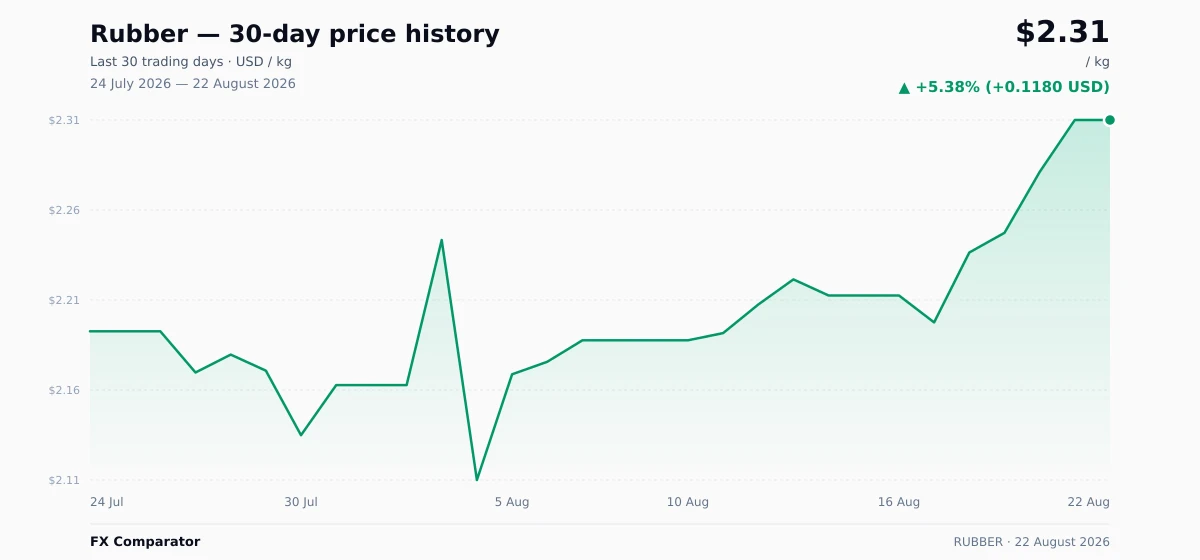
Rubber (RUBBER) 30-day price chart — USD, EUR, GBP

Daily close

30 trading days

Date Price (USD) Price (EUR) Price (GBP) Daily change
22 May 2026 US$2.21 €1.88 £1.65 ▼ −0.54%
21 May 2026 US$2.22 €1.89 £1.65 ▼ −0.72%
20 May 2026 US$2.24 €1.90 £1.67 ▲ +0.40%
19 May 2026 US$2.23 €1.89 £1.66 ▲ +0.63%
18 May 2026 US$2.21 €1.88 £1.65 ▼ −0.45%
15 May 2026 US$2.22 €1.89 £1.66 ▼ −4.02%
14 May 2026 US$2.32 €1.97 £1.73 ▲ +4.42%
13 May 2026 US$2.22 €1.89 £1.65 ▼ −0.67%
12 May 2026 US$2.23 €1.90 £1.66 ▲ +1.09%
11 May 2026 US$2.21 €1.88 £1.65 ▼ −0.76%
10 May 2026 US$2.23 €1.89 £1.66 ▲ +2.20%
6 May 2026 US$2.18 €1.85 £1.62 ▲ +0.28%
5 May 2026 US$2.17 €1.85 £1.62 ▲ +0.42%
4 May 2026 US$2.16 €1.84 £1.61 ▲ +0.42%
30 Apr 2026 US$2.15 €1.83 £1.61 ▲ +1.27%
29 Apr 2026 US$2.13 €1.81 £1.59 ▲ +0.42%
27 Apr 2026 US$2.12 €1.80 £1.58 ▲ +0.76%
25 Apr 2026 US$2.10 €1.79 £1.57 ▲ +2.39%
21 Apr 2026 US$2.05 €1.75 £1.53 ▲ +0.93%
20 Apr 2026 US$2.03 €1.73 £1.52

Rubber: frequently asked questions

Why is rubber priced by the kilogram? +
Natural rubber is an industrial raw material. Its global reference price, the Singapore Exchange (SGX) TSR20 contract, is quoted in US cents per kilogram, unlike several other commodities that use different quotation units. The contract size is 5 tonnes. The parallel TOCOM RSS3 contract is also kilogram-based and quoted in JPY per kilogram. In physical procurement by processors such as tyre, glove and rubber-products manufacturers, rubber prices are usually expressed per kilogram or per tonne, depending on the size of the supply contract.
What is the difference between TSR20 and RSS3? +
Both are natural rubber, but they represent different processed forms and market roles. TSR20 (Technically Specified Rubber, grade 20) is natural rubber processed into a technically specified, granulated form. It is the preferred feedstock of the global tyre industry and is listed on the Singapore Exchange. RSS3 (Ribbed Smoked Sheet, grade 3) is a traditional smoked sheet form of natural rubber. It is the Tokyo Commodity Exchange (TOCOM) reference and a benchmark for the Japan-Thailand-Malaysia trading axis. A normal spread exists between the two prices. It is driven by exchange rates (USD/JPY), physical delivery costs and the regional balance of supply between granulated and sheet rubber.
Why do Thailand, Indonesia and Vietnam dominate the rubber market? +
Commercial natural rubber production depends on the Hevea brasiliensis rubber tree, a species of the equatorial tropics. It requires high and stable rainfall, constant warmth and nutrient-rich soil. South-East Asia’s climate, especially the coastal and inland areas of Thailand, Indonesia and Vietnam, is well suited to the crop. Thailand, with about 4.7 million tonnes a year, accounts for ~33% of global production. Indonesia, with about 3.1 million tonnes a year, accounts for ~22%. Vietnam, with about 1.3 million tonnes a year, supplies ~9%. Together they produce ~64%. Rubber exports are also an important source of rural employment and export revenue in all three countries.
How does synthetic rubber compete with natural rubber? +
Synthetic rubber, mainly SBR (styrene-butadiene rubber) and BR (polybutadiene rubber), is made from oil-derived butadiene and styrene. Oil prices therefore have a direct effect on the cost of producing synthetic rubber. When Brent and WTI prices are low, synthetic rubber can be produced cheaply, which creates substitution pressure on natural rubber prices. When oil prices are high, the relative competitiveness of natural rubber improves. Global tyre compounds typically contain both natural and synthetic rubber. Truck and aircraft tyres require a higher natural-rubber component because of better heat resistance and load-bearing properties, while passenger-car tyres use a larger share of synthetic rubber.
What is Pestalotiopsis leaf disease? +
Pestalotiopsis is a fungal disease that attacks rubber-tree leaves and creates characteristic dead spots. It has previously caused severe yield losses on South-East Asian plantations, especially in Indonesia and Thailand. Infection reduces a tree’s photosynthetic capacity, directly cutting latex yield per hectare. Longer wet periods and older tree stock can worsen the spread of the pathogen. Control measures include varietal replacement with resistant hybrids, fungicide spraying and removal of infected material. The disease can structurally reduce global supply, so the SGX TSR20 price is sensitive to ANRPC quarterly plantation reports.
How much rubber is needed for a tyre? +
It depends on the type of tyre. An average passenger-car tyre contains about ~7 kg of rubber components, typically a mix of ~30–40% natural and ~60–70% synthetic rubber. A truck tyre, by contrast, uses 50–70 kg of rubber components, and the natural rubber share is typically above 80% because of the higher load-bearing and heat-resistance requirements. An aircraft tyre is made almost entirely from natural rubber because of landing heat and extreme stress. This explains why natural rubber demand is driven heavily by commercial fleet traffic and air-traffic volumes, rather than only by passenger-car sales.
Who are the largest tyre manufacturers? +
The global tyre market is dominated by four global groups: Japan’s Bridgestone (Tokyo Stock Exchange ticker: 5108.T) and France’s Michelin (Euronext Paris ticker: ML.PA) are the two market leaders, followed by Germany’s Continental (Frankfurt ticker: CON.DE) and the US-based Goodyear Tire & Rubber Company (Nasdaq ticker: GT). The next tier includes Japan’s Sumitomo Rubber, Korea’s Hankook and China’s ZC Rubber. The purchasing volumes of the four largest groups directly affect TSR20 and RSS3 prices. Quarterly tyre-industry production and sales statistics are closely watched market data points.
How can European retail investors access the rubber market? +
There are three main routes for a European retail investor. First: rubber CFDs, which track the SGX TSR20 price directly and are listed on some platforms under the RUBBER or TSR20 ticker. These are leveraged products and can be traded long or short. Second: tyre-maker shares, including Bridgestone (5108.T), Michelin (ML.PA), Continental (CON.DE) and Goodyear (GT). Third: rubber plantation and tropical agribusiness shares, such as Malaysia’s Sime Darby Plantation, a large integrated natural rubber and palm-oil plantation group. Tax treatment varies by jurisdiction; consult a local tax adviser.