Ethanol price
Ethanol currently trades at US$2.04 per gallon (≈ €1.82 · £1.54) — close to the 12-month high. Over the past 12 months the price has gained 9.09%, with the annual range running from US$1.53 to US$2.13. 24-hour movement is minimal (±0.00%).


Invest in commodity ETFs from just $50
Gold, oil and even whole commodity sectors through ETFs, all in one account, kept simple.
eToro is a multi-asset investment platform. The value of your investments may go up or down. Your capital is at risk.
Ethanol chart
Interactive chart and 30-day overview
The Ethanol chart shows how the ethanol price has moved over time. The interactive view lets you switch the timeframe (from 7 days up to MAX), the currency (USD / EUR / GBP) and overlay moving averages. Click any two points to measure the percentage change between those dates.
How is ethanol priced?
What drives the price of ethanol?
The largest source of demand support for the US ethanol market is the Renewable Fuel Standard (RFS), a mandate administered by the US Environmental Protection Agency (EPA) under earlier energy laws. The rule requires about 15 billion gallons of corn-based ethanol to be blended into the US fuel pool each year, plus additional volumes of advanced biofuels, including cellulosic and sugarcane-based fuels. Refiners meet the obligation either by blending ethanol physically or by buying RIN credits (Renewable Identification Numbers). Daily moves in the RIN market feed directly into EH ethanol futures pricing. The number of Small Refinery Exemptions granted by the EPA is politically contested each year and can cause short-term price swings.
The main swing factor on the global supply side is the Brazilian sugar-ethanol production switch. Brazilian sugarcane mills operate with a dual model: the same cane can be used to produce sugar or ethanol, and mills reset the production mix weekly based on relative world prices. When sugar prices are high on the London and New York exchanges, less cane goes into ethanol and global ethanol supply tightens. Brazil is the world’s second-largest ethanol producer, at about 8 billion gallons a year, and UNICA (União da Indústria de Cana-de-Açúcar) publishes weekly data on production ratios in the centre-south region. Brazilian ethanol is traded on the B3 exchange in São Paulo and is cheaper to produce than US corn ethanol.
Over the longer term, US producer margins are measured by the ethanol crush spread: the ethanol price per gallon minus the cost of the corn needed for processing, with about 0.36 bushel of corn required per gallon, plus revenue from the co-product DDGS (Distillers Dried Grains with Solubles), used as animal feed. If corn prices rise on the Chicago exchange without a corresponding rise in ethanol, mills cut utilisation and supply falls. On the substitution side, the petrol price, reflected in RBOB futures, also affects pricing. When petrol is cheap, refiners tend to blend only the mandated minimum ethanol volume; when petrol is expensive, higher blend rates can become economic. Weekly US ethanol production data are published every Wednesday in the EIA Weekly Petroleum Status Report.
How to invest in the ethanol industry
Ethanol is a specialist market. Because liquidity in the CBOT EH futures contract is thin, large retail brokers, including XTB and eToro, do not offer a direct ethanol CFD. A European retail investor usually gains ethanol exposure through companies in the supply chain: a pure US ethanol producer (Green Plains — GPRE), a refiner with a large ethanol division (Valero — VLO, one of the world’s biggest ethanol producers alongside its oil-refining business), an integrated agribusiness (Archer Daniels Midland — ADM, one of the largest US ethanol producers), or Brazilian sugarcane ethanol (Cosan — CSAN3, the parent company of Brazil’s Raízen). There is no separate pure-play ethanol ETF, but some renewable-fuels and agribusiness sector ETFs hold parts of this equity universe. The sector is heavily exposed to policy rules such as the RFS, RINs and EPA exemptions, so share prices tend to be cyclical.
30-day price history
Chart and daily closing prices
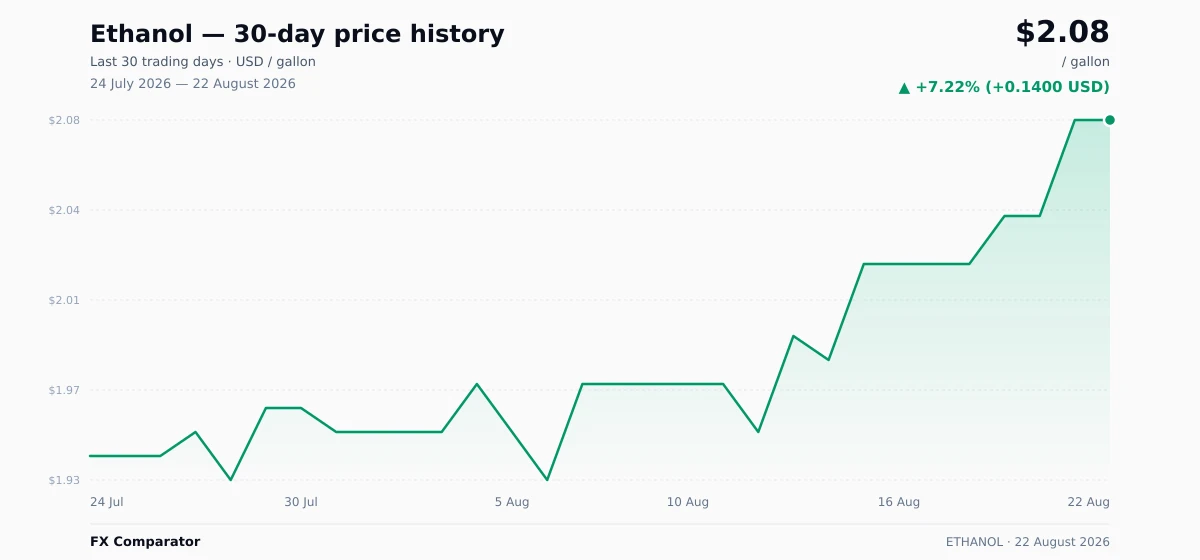
Download chart: WebP
Daily close
17 trading days
| Date | Price (USD) | Price (EUR) | Price (GBP) | Daily change |
|---|---|---|---|---|
| 7 Oct 2026 | US$2.04 | €1.82 | £1.54 | ▲ +2.00% |
| 6 Oct 2026 | US$2.00 | €1.79 | £1.51 | ▼ −0.99% |
| 1 Oct 2026 | US$2.02 | €1.81 | £1.53 | ▼ −2.42% |
| 30 Sept 2026 | US$2.07 | €1.85 | £1.57 | ▼ −1.90% |
| 29 Sept 2026 | US$2.11 | €1.89 | £1.60 | ▼ −0.94% |
| 26 Sept 2026 | US$2.13 | €1.90 | £1.61 | ▲ +1.43% |
| 25 Sept 2026 | US$2.10 | €1.88 | £1.59 | ▼ −0.94% |
| 23 Sept 2026 | US$2.12 | €1.90 | £1.61 | ▼ −0.47% |
| 22 Sept 2026 | US$2.13 | €1.90 | £1.61 | ▲ +1.43% |
| 21 Sept 2026 | US$2.10 | €1.88 | £1.59 | ▲ +3.96% |
| 19 Sept 2026 | US$2.02 | €1.81 | £1.53 | ▼ −3.35% |
| 18 Sept 2026 | US$2.09 | €1.87 | £1.58 | ▲ +0.97% |
| 17 Sept 2026 | US$2.07 | €1.85 | £1.57 | ▼ −0.48% |
| 16 Sept 2026 | US$2.08 | €1.86 | £1.57 | ▲ +0.97% |
| 11 Sept 2026 | US$2.06 | €1.84 | £1.56 | ▲ +1.48% |
| 10 Sept 2026 | US$2.03 | €1.81 | £1.54 | ▼ −1.46% |
| 9 Sept 2026 | US$2.06 | €1.84 | £1.56 | — |