Gallium price
Gallium currently trades at US$1,740 per kg (≈ €1,553 · £1,316) — 22.67% below the 12-month high. Over the past 12 months the price has gained 4.50%, with the annual range running from US$1,625 to US$2,250. 24-hour movement is minimal (±0.00%).


Invest in commodity ETFs from just $50
Gold, oil and even whole commodity sectors through ETFs, all in one account, kept simple.
eToro is a multi-asset investment platform. The value of your investments may go up or down. Your capital is at risk.
Gallium chart
Interactive chart and 30-day overview
The Gallium chart shows how the gallium price has moved over time. The interactive view lets you switch the timeframe (from 7 days up to MAX), the currency (USD / EUR / GBP) and overlay moving averages. Click any two points to measure the percentage change between those dates.
How is gallium priced?
What drives the price of gallium?
The defining feature of the gallium market is the Chinese supply monopoly. Global primary gallium production is roughly ~600 tonnes a year, of which ~590 tonnes — almost ~98% — comes from China (USGS Mineral Commodity Summaries: Gallium). The remainder is produced by a small number of non-Chinese alumina plants and zinc smelter by-product operations, together in the 10–15 tonne range. China has introduced an export licensing system for gallium and germanium. Each shipment requires approval from the Ministry of Commerce (MOFCOM). The measure immediately doubled or tripled Rotterdam spot prices for 4N gallium and left a persistent shortage in the market. The EU’s Critical Raw Materials Act aims to strengthen non-Chinese gallium supply chains.
The second pillar is power-electronics demand. Gallium nitride (GaN) power devices are increasingly replacing silicon where high switching frequency, high efficiency and compact size matter: EV fast chargers, data-centre power supplies, solar inverters and RF amplifiers in 5G base stations. Gallium arsenide (GaAs) is used in mobile RF components, space and defence electronics, multi-junction (III-V tandem) solar cells and the LED industry. A typical GaN device contains only a few milligrams of gallium, but the industry requires 6N (99.9999%) purity feedstock. That ties the whole supply chain to the capacity of Chinese ultra-high-purity processors, even if raw gallium were to come from elsewhere.
The third driver is the bauxite–alumina cycle. Gallium is extracted as a by-product of the Bayer process, from the sodium aluminate solution used in alumina production. Extraction is typically done with ion-exchange resin, with yields of about 50–80 grams of gallium per tonne of alumina. This is both a strength and a vulnerability on the supply side. Gallium supply cannot be adjusted independently. It depends on aluminium smelter utilisation and global alumina demand. A deep downturn in aluminium markets, marked by low LME prices and capacity curbs, also tightens gallium supply, while semiconductor demand follows a separate cycle. On the bauxite side, China accounts for almost half of global alumina output, so gallium capacity linked to Bayer-process plants is naturally concentrated there.
How to invest in gallium
Gallium is a classic hard-to-access minor metal for retail investors. Pure gallium CFDs are not available from major European brokers such as XTB or eToro. There is no liquid exchange-traded futures contract on which a CFD could be based. There is also no pure gallium ETF, because the market is too small and too concentrated for listed products. A European retail investor can gain exposure only indirectly. One route is through bauxite, alumina and aluminium producers such as Alcoa, Rio Tinto and Norsk Hydro, where gallium is a by-product of the Bayer process. Another route is through GaN/GaAs semiconductor makers and power-electronics companies such as Wolfspeed/CREE, Navitas Semiconductor, Infineon Technologies and Texas Instruments. In that case, the investor is buying exposure to end-markets for gallium-containing devices, not to the metal itself.
30-day price history
Chart and daily closing prices
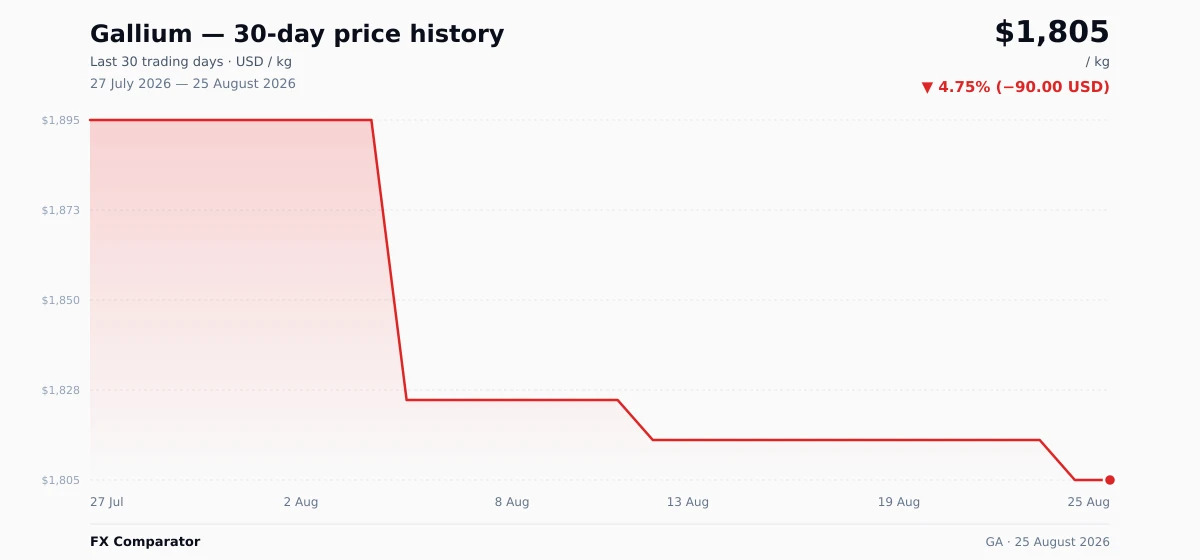
Download chart: WebP
Daily close
4 trading days
| Date | Price (USD) | Price (EUR) | Price (GBP) | Daily change |
|---|---|---|---|---|
| 28 Sept 2026 | US$1,740 | €1,553 | £1,316 | ▼ −0.57% |
| 23 Sept 2026 | US$1,750 | €1,562 | £1,324 | ▼ −0.57% |
| 14 Sept 2026 | US$1,760 | €1,571 | £1,331 | ▼ −0.85% |
| 11 Sept 2026 | US$1,775 | €1,584 | £1,343 | — |