Industrial metals · TIOC

Iron ore price

Iron ore currently trades at US$109.67 per tonne (≈ €93.27 · £81.74) — effectively at the 12-month high. Over the past 12 months it has gained 9.88%, with the annual range running from US$93.41 to US$111.28. 24-hour movement is minimal (±0.00%).

US$109.67 / tonne
≈ €93.27 ≈ £81.74 Unchanged 24h 91% within the 52-week range
FX Editorial Team · Data updated: · Editorially verified
Iron ore (TIOC) price today US$109.67 / tonne, ↑ +0.00% (24h)

Iron ore chart

Interactive chart and 30-day overview

7 days
▼ −0.99%
−US$1.10
30 days
▲ +2.64%
+US$2.82
1 year
▲ +9.88%
+US$9.86
52-week range
US$93.41 91% US$111.28
Iron ore (TIOC) 30-day price chart — USD, EUR, GBP

The Iron ore chart shows how the iron ore price has moved over time. The interactive view lets you switch the timeframe (from 7 days up to MAX), the currency (USD / EUR / GBP) and overlay moving averages. Click any two points to measure the percentage change between those dates.

How is iron ore priced?

Iron ore is priced per metric tonne (1 t = 1,000 kg) — the standard unit for industrial and bulk commodities on the London Metal Exchange (LME), CME and major European exchanges. Wholesale shipments move in containers or bulk vessels, typically in 25-tonne or 100-tonne lots.

At US$109.67 per tonne, one kilogram is worth US$0.1097. End-user pricing for processed goods includes refining margins, transport and tariffs on top of the wholesale benchmark.

What drives the price of iron ore?

The main factor is Chinese property and infrastructure demand. China accounts for more than 50% of global steel production, about 1 billion tonnes of crude steel a year. Steelmaking accounts for more than 90% of iron ore use. The Chinese construction cycle therefore largely sets the iron ore price. Property-market stimulus from Beijing, such as looser mortgage lending and local-government bond issuance for railways and metro networks, can lift the price by $5–15 a tonne within days. In the other direction, developer defaults such as Evergrande and Country Garden, and weaker housing starts, put sustained downward pressure on prices. Weekly inventory and production data from Mysteel and CISA, the China Iron and Steel Association, are the market’s main short-term indicators.

Supply is dominated by four groups: Vale in Brazil, and Rio Tinto, BHP and Fortescue Metals in Western Australia’s Pilbara region. Together they account for about 80% of seaborne iron ore exports. Australia exports about 870 Mt of iron ore a year, Brazil about 380 Mt, while total global seaborne trade is about 1.6 billion tonnes. This concentration makes the market highly sensitive to individual events. The Brumadinho dam disaster at Vale, cyclones in the Pilbara, rail disruption or port strikes at Port Hedland can move prices by $20–30 a tonne within days. China has worked for years to reduce import dependence by developing Guinea’s Simandou project, with about 120 Mt a year of planned capacity. It is treated in market analysis as a potential new source of supply.

Over the longer term, decarbonisation and changes in steelmaking routes are the largest structural force. The traditional blast furnace/basic oxygen furnace route, or BF/BOF, emits about 1.8 tonnes of CO₂ per tonne of steel. Hydrogen-based direct reduced iron, or DRI, produces sponge iron with a much lower carbon footprint. It requires very high-grade iron ore, typically 65–67% Fe pellets, rather than the standard 62% fines used for sintering. This technology shift can raise the quality premium for high-grade pellets and DR-grade ore, while widening the discount on lower-grade material. European HBI and SSAB Hybrit projects, as well as DRI projects in the Middle East, are long-term factors in pricing the quality segments of the iron ore market.

How to invest in iron ore

A European retail investor typically gets iron ore exposure through iron ore mining shares. Pure iron ore CFDs are offered by only a limited number of brokers, and liquidity is usually lower than in crude oil or natural gas CFDs. There is effectively no widely used international ETF focused solely on iron ore. The sector is more commonly accessed through diversified mining groups such as Vale, Rio Tinto, BHP and Fortescue, and through broader mining ETFs such as iShares MSCI Global Metals & Mining Producers ETF — PICK. Internationally listed shares may also be held in tax-efficient accounts, such as a UK ISA or similar EU wrappers, where available. Dividend yields can be material, but payouts from the Big 4 miners are highly cyclical.

30-day price history

Chart and daily closing prices
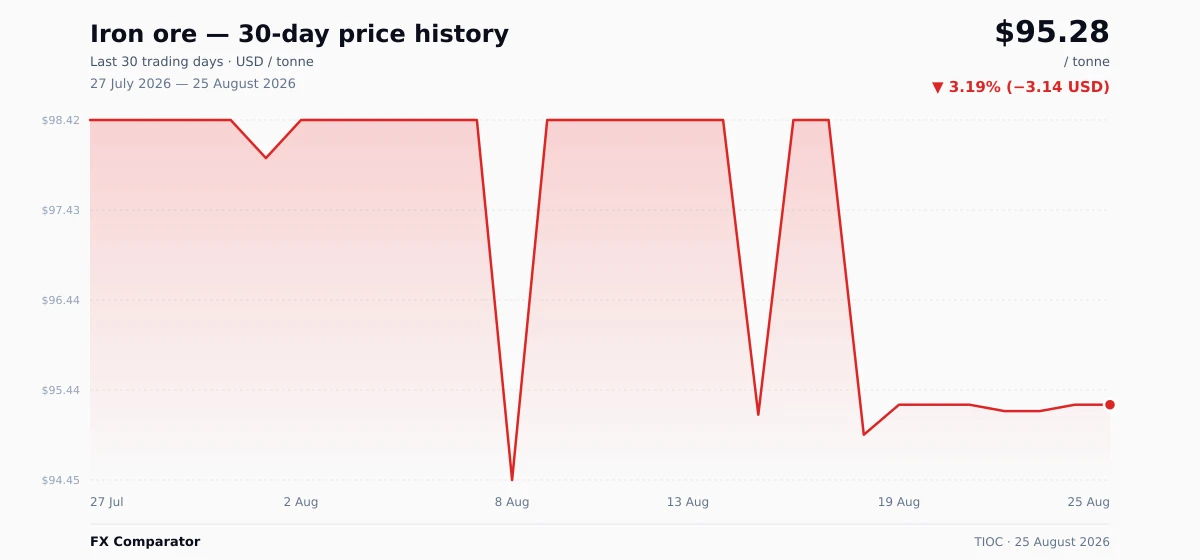
Iron ore (TIOC) 30-day price chart — USD, EUR, GBP

Daily close

30 trading days

Date Price (USD) Price (EUR) Price (GBP) Daily change
23 May 2026 US$109.67 €93.27 £81.74 ▼ −0.11%
21 May 2026 US$109.79 €93.37 £81.83 ▼ −0.49%
20 May 2026 US$110.33 €93.83 £82.23 ▼ −0.19%
19 May 2026 US$110.54 €94.01 £82.39 ▼ −0.21%
16 May 2026 US$110.77 €94.21 £82.56 ▼ −0.31%
15 May 2026 US$111.12 €94.50 £82.82 ▼ −0.14%
14 May 2026 US$111.28 €94.64 £82.94 ▲ +0.15%
12 May 2026 US$111.11 €94.50 £82.81 ▲ +0.16%
10 May 2026 US$110.93 €94.34 £82.68 ▲ +2.16%
6 May 2026 US$108.58 €92.34 £80.92 ▲ +0.38%
5 May 2026 US$108.17 €92.00 £80.62 ▲ +0.29%
1 May 2026 US$107.86 €91.73 £80.39 ▲ +0.66%
30 Apr 2026 US$107.15 €91.13 £79.86 ▲ +0.03%
29 Apr 2026 US$107.12 €91.10 £79.84 ▼ −0.01%
28 Apr 2026 US$107.13 €91.11 £79.84 ▲ +0.03%
25 Apr 2026 US$107.10 €91.09 £79.82 ▲ +0.23%
22 Apr 2026 US$106.85 €90.87 £79.64 ▼ −0.22%
21 Apr 2026 US$107.09 €91.08 £79.81 ▲ +0.22%
20 Apr 2026 US$106.85 €90.87 £79.64

Iron ore FAQ

What is Platts IODEX 62% Fe CFR China, and why is it the global benchmark for iron ore? +
The Platts IODEX, or Iron Ore Index, is a daily price index published by S&P Global Platts. It tracks the price of seaborne iron ore fines with 62% Fe content, quoted in US dollars per dry metric tonne on a CFR China basis. That means delivered to a Chinese port, including ocean freight. The index is based on a daily assessment of physical transactions and bid-offer levels in China’s iron ore market. It became the global benchmark because China consumes about 70% of seaborne iron ore trade, making the Chinese buyer price the effective world price. SGX in Singapore and DCE in Dalian also base their futures contracts on this index.
How much do 1 kg and 100 kg of iron ore cost using a sample quoted price? +
At a price of $110 a tonne, 1 kg of 62% iron ore is about $0.11 (110 ÷ 1,000), while 100 kg is about $11. This is the seaborne export price, delivered to a Chinese port. It is not the price of steel leaving a mill or of a processed product. Producing 1 tonne of pig iron requires about 1.6 tonnes of iron ore plus 0.5 tonnes of coking coal. Iron ore alone is therefore only a small part of the final steel price. Metallurgical processing costs, energy and coke make up a larger share of the cost of the finished steel product.
Who are the world’s largest iron ore producers and exporters? +
Global iron ore exports are dominated by four companies, which together account for about 80% of seaborne trade. Vale of Brazil produces about 300 Mt a year, mainly higher-grade ore of about 64–65% Fe. Rio Tinto produces about 330 Mt a year from the Pilbara region of Western Australia. BHP produces about 280 Mt a year, also from the Pilbara. Fortescue Metals (FMG) produces about 190 Mt a year, with lower-grade ore of about 57–58% Fe but lower production costs. By country, Australia exports about 870 Mt a year and Brazil about 380 Mt. Total global seaborne trade is about 1.6 billion tonnes. China imports about 1.1 billion tonnes of iron ore a year, mostly from Australia and Brazil.
How does steelmaking use iron ore: BF/BOF vs EAF vs DRI? +
There are three main steelmaking routes. The blast furnace/basic oxygen furnace route (BF/BOF) is dominant globally at about 70%. Iron ore, coke and limestone are heated in a blast furnace. The resulting pig iron is then refined into steel in a basic oxygen furnace. Producing 1 tonne of pig iron requires about 1.6 tonnes of iron ore and about 0.5 tonnes of coking coal. The electric arc furnace route (EAF), about 30% globally and more than 70% in the US, melts scrap steel using electricity and does not directly use iron ore. The direct reduced iron route (DRI) reduces iron ore in solid form into sponge iron using natural gas or hydrogen. The sponge iron is then melted into steel in an EAF. DRI requires high-grade 65–67% Fe pellets and has much lower carbon emissions.
Why is the iron ore price so sensitive to China’s property market? +
China accounts for more than 50% of global steel production, about 1 billion tonnes a year, while steelmaking represents more than 90% of iron ore use. Chinese steel consumption therefore translates directly into iron ore demand. Construction, including housing and property development, accounts for about 30% of Chinese steel consumption. Infrastructure, such as railways, metros and bridges, adds another roughly 25%. When defaults by developers such as Country Garden or Evergrande slow new housing construction, steel demand falls and the iron ore price can drop by $20–40 a tonne. Conversely, when Beijing launches infrastructure stimulus through local-government bond issuance, the ore price can rise quickly. Weekly inventory data from Mysteel and production statistics from CISA, the China Iron and Steel Association, are the market’s main short-term indicators.
What is the difference between 62% Fe and 65% Fe iron ore, and why does the quality premium matter? +
62% Fe ore, usually fines, is the market’s reference grade and is sintered before being charged into blast furnaces. 65% ore, typically pellet and often sourced from Brazil’s Vale, is purer and contains less waste material. It is therefore more efficient in the blast furnace, needs less coke and results in lower CO₂ emissions. As a result, 65% Fe pellet can command a $10–25 per tonne premium over 62% fines, known as the quality premium. The spread may change as direct reduction, or DRI, technology expands. DR-grade pellet requires 65–67% Fe content and very low impurity levels, including low aluminium, phosphorus and silicon. That favours suppliers such as Vale and some Scandinavian producers, including LKAB.
What does Big 4 dominance mean, and what risk does it create for price stability? +
About 80% of global seaborne iron ore supply comes from four companies: Vale, Rio Tinto, BHP and Fortescue. This is one of the highest levels of supply concentration in commodity markets. The advantage is stable, predictable supply and high operating efficiency, which keeps average production costs low. The Big 4 have cash production costs of about $15–25 a tonne. The risk is that a single disruption at one supplier can cause a price spike. The Brumadinho dam disaster at Vale’s Córrego do Feijão mine removed about 90 Mt of production and lifted iron ore from $70 to $125 within a few months. Australian cyclones, which hit the Pilbara 2–4 times a year, port strikes at Port Hedland, or rail-line outages can create similar supply shocks.
How are iron ore CFDs or iron ore mining shares taxed? +
Tax treatment of gains on CFDs and listed shares, dividends from Vale, Rio Tinto, BHP and Fortescue, and holdings in tax-efficient accounts such as a UK ISA or similar EU wrappers varies by jurisdiction; rules on loss relief also differ, so consult a local tax adviser.