Lumber price
Lumber currently trades at US$519.55 per Mbf (≈ €464.46 · £393.39) — 21.10% below the 12-month high. Over the past 12 months the price has lost 13.62%, with the annual range running from US$496.51 to US$658.47. In the past 24 hours the price has risen by 0.30%.


Invest in commodity ETFs from just $50
Gold, oil and even whole commodity sectors through ETFs, all in one account, kept simple.
eToro is a multi-asset investment platform. The value of your investments may go up or down. Your capital is at risk.
Lumber chart
Interactive chart and 30-day overview
The Lumber chart shows how the lumber price has moved over time. The interactive view lets you switch the timeframe (from 7 days up to MAX), the currency (USD / EUR / GBP) and overlay moving averages. Click any two points to measure the percentage change between those dates.
How is lumber priced?
Lumber is priced per Mbf (thousand board feet) on the CME lumber futures contract. One Mbf approximates 2.36 m³ of finished lumber.
At US$519.55 per Mbf, one cubic metre wholesales for about US$220.15. Lumber prices are highly sensitive to US housing starts, mortgage rates and Canadian export tariffs — the volatility runs significantly higher than other building-material commodities.
What moves lumber prices?
The most important demand variable in the lumber market is US homebuilding. Annual US softwood lumber consumption is roughly 50 billion board feet (Bbf), of which about 75% is tied to residential construction, mainly the framing of single-family homes. A typical North American single-family home contains about 15 Mbf of lumber. The market therefore has a close correlation with the monthly US Census Bureau Housing Starts series: a rise in housing starts lifts demand for lumber quickly, while a decline weighs on prices. The transmission channel is the mortgage rate: when the 30-year fixed rate rises, homebuyer demand weakens, builders delay new projects, and demand for lumber falls quickly. Industrial use, such as pallets and packaging, and the renovation segment are more stable, but smaller in terms of total market size.
On the supply side, the market is shaped by the US-Canada softwood lumber dispute. The two countries have been in a recurring trade conflict for decades. The US Department of Commerce imposes a countervailing duty and an anti-dumping duty on Canadian softwood lumber imports, arguing that stumpage fees paid for timber harvested on Canadian provincial Crown land amount to unfair state support. Canada produces about 25 Bbf of softwood lumber a year, while the United States produces 35 Bbf. A significant share of Canadian output has traditionally been exported to the US market. Changes in duty rates are priced directly into CME quotations: higher duties reduce available supply in the US market and push prices higher.
A structural factor is the forest damage caused by the British Columbia mountain pine beetle (Dendroctonus ponderosae). Over recent decades, the infestation has destroyed about 50% of the harvestable lodgepole pine stock in interior British Columbia. According to Natural Resources Canada Forest Sector statistics, the province’s Annual Allowable Cut has had to be reduced on a lasting basis. This narrows Canadian supply capacity over the long term. Several sawmills in British Columbia have closed, while the remaining industry has shifted more output towards the US South and Québec. The market follows weekly Random Lengths industry prices and Natural Resources Canada forestry data because CME futures cover only the construction benchmark grade, while actual mill gate prices differ by region and quality.
How to invest in lumber
A lumber CFD is rarely available directly from retail brokers. After the contract redesign, liquidity in CME Lumber Futures fell, and lumber is typically not offered as a standalone CFD by XTB or eToro. Retail exposure is therefore usually built indirectly through equities. There are two main routes. US homebuilders sit at the demand end of the lumber market: D.R. Horton (DHI), Lennar (LEN) and PulteGroup (PHM) are the three largest US single-family homebuilders, and their earnings are linked directly to housing starts and lumber procurement costs. Lumber producers represent the supply side: Weyerhaeuser (WY) is one of the world’s largest timberland owners and is structured as a REIT, while Toronto-listed Canfor (CFP.TO) and West Fraser Timber (WFG) are major players in western Canadian and US South lumber. Two regulated brokers where both homebuilder and timber-related shares are available:
30-day price history
Chart and daily closing prices
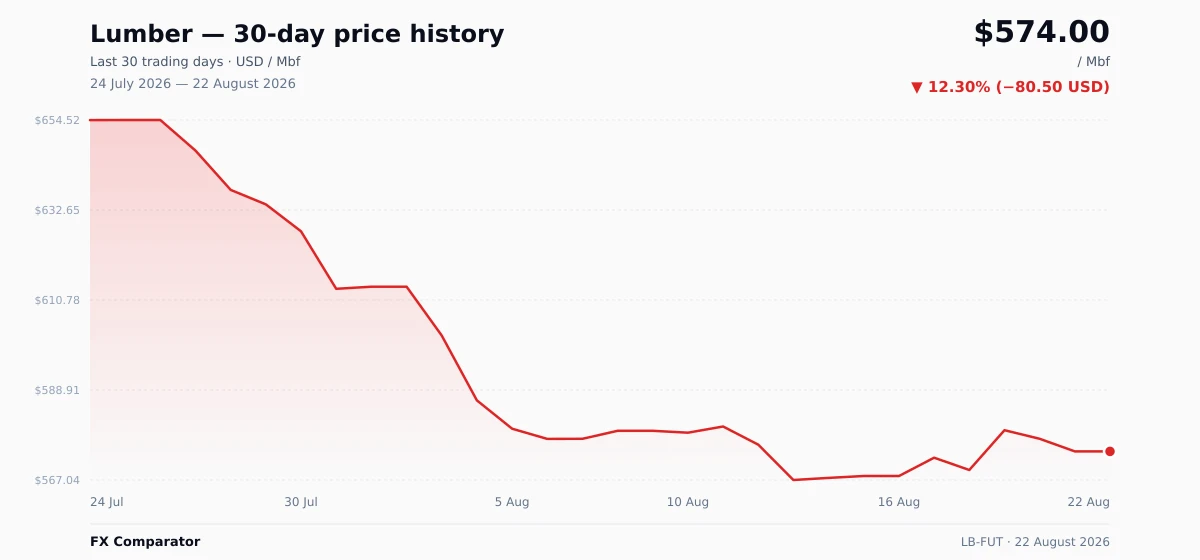
Download chart: WebP
Daily close
25 trading days
| Date | Price (USD) | Price (EUR) | Price (GBP) | Daily change |
|---|---|---|---|---|
| 8 Oct 2026 | US$519.55 | €464.46 | £393.39 | ▲ +0.30% |
| 7 Oct 2026 | US$518.01 | €463.09 | £392.23 | ▼ −0.96% |
| 6 Oct 2026 | US$523.04 | €467.58 | £396.04 | ▼ −0.10% |
| 5 Oct 2026 | US$523.54 | €468.03 | £396.41 | ▼ −0.56% |
| 3 Oct 2026 | US$526.50 | €470.68 | £398.66 | ▼ −0.01% |
| 2 Oct 2026 | US$526.53 | €470.70 | £398.68 | ▼ −0.47% |
| 1 Oct 2026 | US$529.01 | €472.92 | £400.56 | ▼ −1.94% |
| 30 Sept 2026 | US$539.50 | €482.30 | £408.50 | ▲ +0.17% |
| 29 Sept 2026 | US$538.56 | €481.46 | £407.79 | ▲ +1.43% |
| 28 Sept 2026 | US$530.97 | €474.67 | £402.04 | ▼ −1.31% |
| 26 Sept 2026 | US$538.00 | €480.96 | £407.36 | ▲ +0.84% |
| 24 Sept 2026 | US$533.52 | €476.95 | £403.97 | ▼ −0.56% |
| 23 Sept 2026 | US$536.51 | €479.62 | £406.23 | ▲ +0.19% |
| 22 Sept 2026 | US$535.51 | €478.73 | £405.48 | ▲ +0.19% |
| 21 Sept 2026 | US$534.52 | €477.84 | £404.73 | ▼ −0.46% |
| 19 Sept 2026 | US$537.00 | €480.06 | £406.61 | ▲ +0.27% |
| 18 Sept 2026 | US$535.53 | €478.75 | £405.49 | ▼ −2.36% |
| 17 Sept 2026 | US$548.47 | €490.32 | £415.29 | ▼ −0.12% |
| 16 Sept 2026 | US$549.14 | €490.91 | £415.80 | ▼ −2.29% |
| 15 Sept 2026 | US$562.00 | €502.41 | £425.54 | ▼ −3.36% |
| 14 Sept 2026 | US$581.53 | €519.87 | £440.32 | ▲ +0.52% |
| 12 Sept 2026 | US$578.50 | €517.16 | £438.03 | ▲ +0.34% |
| 11 Sept 2026 | US$576.52 | €515.39 | £436.53 | ▼ −0.08% |
| 10 Sept 2026 | US$576.97 | €515.79 | £436.87 | ▲ +0.16% |
| 9 Sept 2026 | US$576.02 | €514.94 | £436.15 | — |