Polyethylene price
Polyethylene currently trades at US$1,312 per tonne (≈ €1,171 · £992.16) — close to the 12-month high. Over the past 12 months the price has gained 26.68%, with the annual range running from US$919.08 to US$1,352. 24-hour movement is minimal (±0.01%).


Invest in commodity ETFs from just $50
Gold, oil and even whole commodity sectors through ETFs, all in one account, kept simple.
eToro is a multi-asset investment platform. The value of your investments may go up or down. Your capital is at risk.
Polyethylene chart
Interactive chart and 30-day overview
The Polyethylene chart shows how the polyethylene price has moved over time. The interactive view lets you switch the timeframe (from 7 days up to MAX), the currency (USD / EUR / GBP) and overlay moving averages. Click any two points to measure the percentage change between those dates.
How is polyethylene priced?
Polyethylene is priced per metric tonne (1 t = 1,000 kg) — the standard unit for industrial and bulk commodities on the London Metal Exchange (LME), CME and major European exchanges. Wholesale shipments move in containers or bulk vessels, typically in 25-tonne or 100-tonne lots.
At US$1,312 per tonne, one kilogram is worth US$1.31. End-user pricing for processed goods includes refining margins, transport and tariffs on top of the wholesale benchmark.
What moves the price of polyethylene?
The price of polyethylene is mainly driven by the cracking margin. PE is made from ethylene monomer, produced in steam crackers using naphtha, a crude oil fraction, or ethane, a natural gas liquid. Naphtha-based crackers, common in Europe and Asia, have higher and more volatile costs because naphtha is closely linked to Brent crude. Ethane-based crackers, common on the US Gulf Coast and in the Middle East, use much cheaper feedstock. Since the US shale gas boom in the Marcellus and Permian basins, ethane has usually traded below 200–300 USD/t, while naphtha is typically 500–700 USD/t. That structural spread gives US PE exporters a lasting cost advantage over European producers.
Demand is dominated by China. Of the world’s roughly 110 Mt of annual polyethylene consumption, about 30 Mt comes from China, or roughly 30%, mainly in packaging film, agricultural film, drinking-water and gas pipes, and chemical containers. China’s construction cycle, agricultural season and the operating schedules of Sinopec and PetroChina crackers therefore feed directly into the Dalian LLDPE contract, ticker L, and global FOB prices. India and South-East Asia, including Vietnam, Indonesia and Thailand, form a fast-growing second demand bloc, together using another roughly 15 Mt a year. Europe and North America are mature markets at about 15 Mt each, where growth is shifting largely towards recycled PE content, or rPE.
Over the longer term, recycling regulation is the main structural risk for the PE market. The EU Packaging and Packaging Waste Regulation, or PPWR, sets minimum recycled-content requirements for plastic packaging by product type. This directly reduces demand for virgin PE and supports premiums for mechanically recycled rPE pellets. In the United States, similar mandatory rPE-content rules have been introduced at state level, including in California, New Jersey and Washington. Large PE producers such as Dow, LyondellBasell and ExxonMobil are therefore investing in dedicated chemical recycling capacity, including pyrolysis. The PE product mix is structurally shifting towards circular grades. Global PE production is split roughly as follows: HDPE ~50 Mt, LLDPE ~35 Mt and LDPE ~25 Mt.
How to invest in polyethylene?
Polyethylene resin has no direct exchange-traded futures contract on western markets. Physical trade is based on Platts, Argus and ICIS dollar-per-tonne assessments. The only significant futures product is the Dalian Commodity Exchange LLDPE contract, ticker L, which is a Chinese onshore market and is effectively inaccessible to most European retail investors. In CFD format, neither XTB nor eToro offers a PE quote. Polyethylene exposure is therefore usually built through petrochemical equities. The largest relatively focused PE and polyolefin name is LyondellBasell (LYB), one of the world’s major polyethylene producers. Dow Inc (DOW) is an integrated chemicals group with a large PE segment. ExxonMobil (XOM) is also a major PE producer through its chemicals business, including its Baytown and Singapore crackers. Among Middle Eastern and Chinese producers, SABIC (2010.SR — Saudi Exchange) and Sinopec (600028.SS — Shanghai Stock Exchange) are also significant. There is currently no pure polyethylene-focused ETF on the market.
30-day price history
Chart and daily closing prices
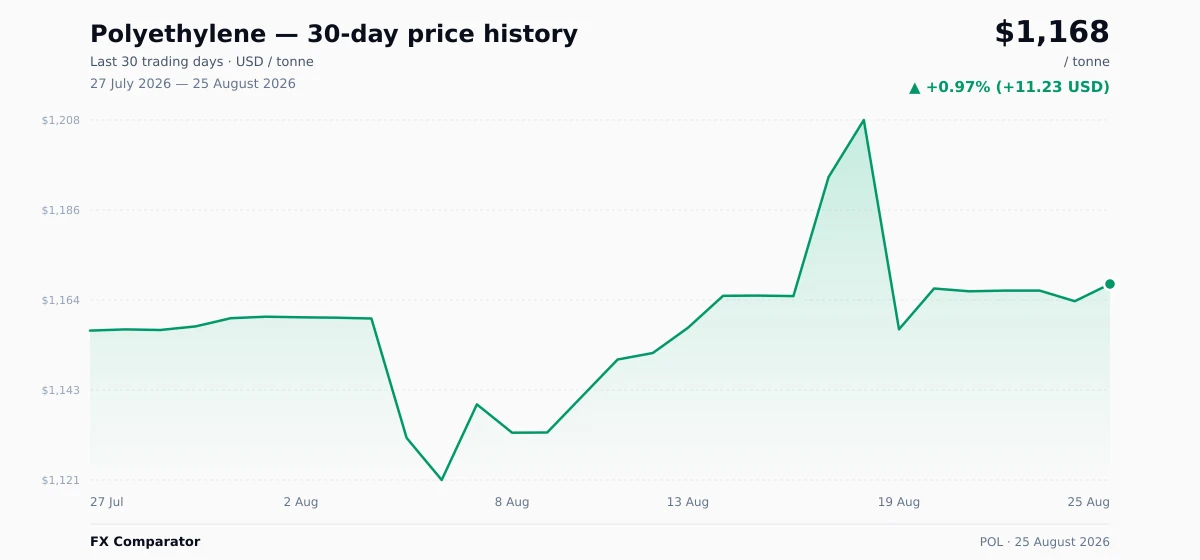
Download chart: WebP
Daily close
26 trading days
| Date | Price (USD) | Price (EUR) | Price (GBP) | Daily change |
|---|---|---|---|---|
| 10 Oct 2026 | US$1,312 | €1,171 | £992.16 | ▲ +0.01% |
| 9 Oct 2026 | US$1,312 | €1,170 | £992.09 | ▲ +2.55% |
| 8 Oct 2026 | US$1,279 | €1,141 | £967.40 | ▲ +4.46% |
| 7 Oct 2026 | US$1,224 | €1,093 | £926.10 | ▼ −0.01% |
| 5 Oct 2026 | US$1,224 | €1,093 | £926.11 | ▼ −0.01% |
| 2 Oct 2026 | US$1,224 | €1,093 | £926.16 | ▲ +0.18% |
| 1 Oct 2026 | US$1,222 | €1,091 | £924.46 | ▼ −0.01% |
| 30 Sept 2026 | US$1,222 | €1,091 | £924.53 | ▼ −0.13% |
| 29 Sept 2026 | US$1,224 | €1,092 | £925.71 | ▲ +0.82% |
| 28 Sept 2026 | US$1,214 | €1,083 | £918.21 | ▲ +0.15% |
| 27 Sept 2026 | US$1,212 | €1,082 | £916.81 | ▲ +0.04% |
| 26 Sept 2026 | US$1,212 | €1,081 | £916.41 | ▼ −0.01% |
| 25 Sept 2026 | US$1,212 | €1,081 | £916.50 | ▼ −0.03% |
| 24 Sept 2026 | US$1,212 | €1,082 | £916.78 | ▲ +0.33% |
| 23 Sept 2026 | US$1,208 | €1,078 | £913.77 | ▼ −1.50% |
| 22 Sept 2026 | US$1,226 | €1,094 | £927.71 | ▼ −1.36% |
| 21 Sept 2026 | US$1,243 | €1,110 | £940.50 | ▼ −2.07% |
| 20 Sept 2026 | US$1,270 | €1,133 | £960.36 | ▲ +0.01% |
| 18 Sept 2026 | US$1,269 | €1,133 | £960.24 | ▼ −0.54% |
| 17 Sept 2026 | US$1,276 | €1,139 | £965.41 | ▼ −0.08% |
| 16 Sept 2026 | US$1,277 | €1,140 | £966.22 | ▲ +0.01% |
| 15 Sept 2026 | US$1,277 | €1,140 | £966.16 | ▼ −0.78% |
| 14 Sept 2026 | US$1,287 | €1,149 | £973.73 | ▼ −0.93% |
| 13 Sept 2026 | US$1,299 | €1,160 | £982.86 | ▲ +1.06% |
| 12 Sept 2026 | US$1,286 | €1,147 | £972.52 | ▼ −1.00% |
| 11 Sept 2026 | US$1,299 | €1,159 | £982.37 | — |