HRC steel price
HRC steel currently trades at US$1,316 per tonne (≈ €1,174 · £995.50) — effectively at the 12-month high. Over the past 12 months the price has gained 61.68%, with the annual range running from US$802.07 to US$1,323. 24-hour movement is minimal (±0.00%).

Invest in commodity ETFs from just $50
Gold, oil and even whole commodity sectors through ETFs, all in one account, kept simple.
eToro is a multi-asset investment platform. The value of your investments may go up or down. Your capital is at risk.
HRC steel chart
Interactive chart and 30-day overview
The HRC steel chart shows how the HRC steel price has moved over time. The interactive view lets you switch the timeframe (from 7 days up to MAX), the currency (USD / EUR / GBP) and overlay moving averages. Click any two points to measure the percentage change between those dates.
How is HRC steel priced?
HRC steel is priced per metric tonne (1 t = 1,000 kg) — the standard unit for industrial and bulk commodities on the London Metal Exchange (LME), CME and major European exchanges. Wholesale shipments move in containers or bulk vessels, typically in 25-tonne or 100-tonne lots.
At US$1,316 per tonne, one kilogram is worth US$1.32. End-user pricing for processed goods includes refining margins, transport and tariffs on top of the wholesale benchmark.
What drives the price of HRC steel?
The margin in integrated steelmaking (BF/BOF, blast furnace plus basic oxygen furnace) comes directly from the input costs of iron ore and coking coal: one tonne of HRC requires about 1.6 tonnes of iron ore and 0.6 tonnes of coking coal. The gap between the HRC price and input costs is the “metal spread” — the main measure of profitability for integrated mills such as ArcelorMittal, POSCO, Nippon Steel and Cleveland-Cliffs. Australian iron ore spot prices (62% Fe, CFR Qingdao) and Australian premium hard coking coal prices are therefore leading indicators for HRC. The electric arc furnace (EAF) route, by contrast, depends on the price of steel scrap, including HMS and busheling. The US market, where EAF producers such as Nucor and Steel Dynamics dominate, is therefore priced differently from BF/BOF-heavy markets in China and Europe.
The global supply side revolves around Chinese export behaviour. China produces about 1 billion tonnes of steel a year — more than half of global output of about 1.9 billion tonnes — and its exports rise sharply when domestic construction demand is weak. Chinese steel exports move in an 85–100 million tonne range, and every 10 million tonne increase puts visible pressure on global HRC prices. India, at about 140 Mt, Japan, at about 85 Mt, the US, at about 80 Mt, and the EU, at about 125 Mt, are the other large producers. For European processors, ArcelorMittal, Voestalpine, Thyssenkrupp and Tata Steel Europe are among the main suppliers.
Regional price distortions mainly come through two regulatory channels. The US Section 232 tariff adds a 25% duty to most steel imports, so US Midwest HRC trades at a persistent premium to global benchmarks — often $200–$400 per tonne higher than EU or Asian prices. In the EU, the CBAM (Carbon Border Adjustment Mechanism) applies a carbon charge based on the emissions intensity of imported steel, raising the cost of high-carbon Chinese and Indian BF/BOF material. On the demand side, the two largest sectors are construction, at about 50% — structural sections, rebar and pipes — and the automotive industry, at about 12% — body panels and sheet components. The shift in carmaking towards advanced high-strength steel (AHSS) and lightweighting affects HRC demand per vehicle.
How to invest in HRC steel
Retail investors can get steel exposure in several ways. The most direct route is an HRC steel CFD (“STEEL”), which tracks US Midwest HRC futures, uses leverage and can be traded in both directions, but carries high risk. Individual steel stocks include Nucor (NUE), the largest US EAF producer; Cleveland-Cliffs (CLF), an integrated BF/BOF producer and Ford supplier; Steel Dynamics (STLD), an EAF producer; Luxembourg-based ArcelorMittal (MT), a global integrated steelmaker; and South Korea’s POSCO (PKX). In ETF form, the VanEck Steel ETF (SLX) offers the broadest exposure, with Vale, Rio Tinto, Nucor, ArcelorMittal and POSCO among its main holdings. Physical HRC coil is not common as a retail investment because storage costs, corrosion risk and coil-handling logistics make it uneconomic.
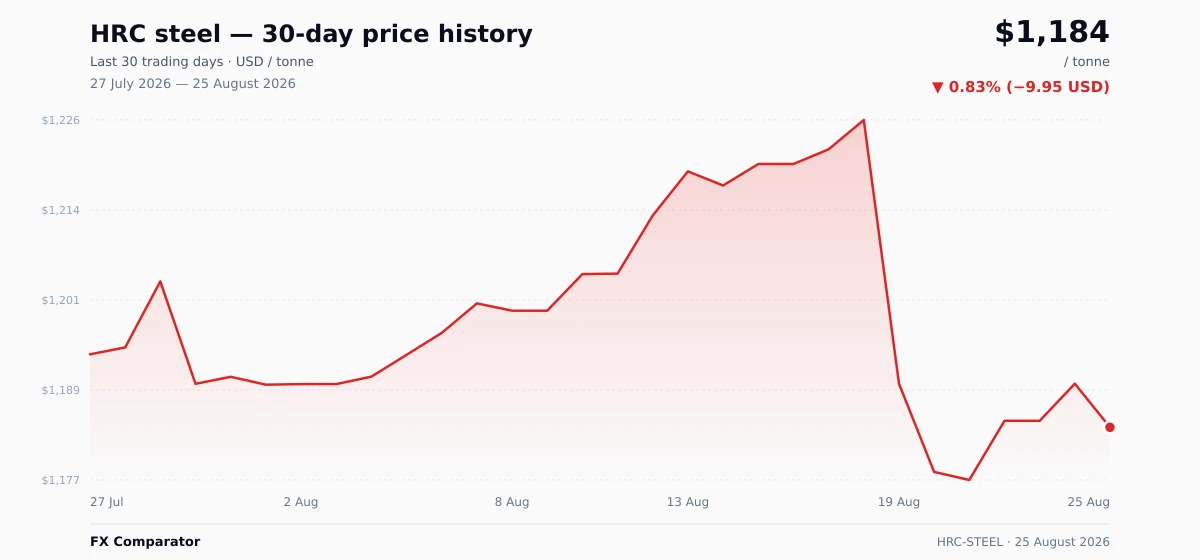
30-day price history
Chart and daily closing prices
Download chart: WebP
Daily close
23 trading days
| Date | Price (USD) | Price (EUR) | Price (GBP) | Daily change |
|---|---|---|---|---|
| 9 Oct 2026 | US$1,316 | €1,174 | £995.48 | ▲ +0.23% |
| 8 Oct 2026 | US$1,313 | €1,172 | £993.20 | ▼ −0.39% |
| 7 Oct 2026 | US$1,318 | €1,176 | £997.05 | ▼ −0.22% |
| 5 Oct 2026 | US$1,321 | €1,179 | £999.22 | ▲ +0.84% |
| 3 Oct 2026 | US$1,310 | €1,169 | £990.90 | ▼ −0.16% |
| 2 Oct 2026 | US$1,312 | €1,171 | £992.51 | ▲ +0.09% |
| 1 Oct 2026 | US$1,311 | €1,170 | £991.65 | ▲ +0.60% |
| 30 Sept 2026 | US$1,303 | €1,163 | £985.69 | ▼ −1.36% |
| 29 Sept 2026 | US$1,321 | €1,179 | £999.31 | ▲ +0.23% |
| 28 Sept 2026 | US$1,318 | €1,176 | £997.00 | ▼ −0.30% |
| 26 Sept 2026 | US$1,322 | €1,180 | £999.97 | ▲ +0.22% |
| 24 Sept 2026 | US$1,319 | €1,177 | £997.74 | ▲ +0.01% |
| 23 Sept 2026 | US$1,319 | €1,177 | £997.65 | ▼ −0.23% |
| 22 Sept 2026 | US$1,322 | €1,180 | £999.97 | ▼ −0.08% |
| 21 Sept 2026 | US$1,323 | €1,181 | £1,001 | ▲ +1.77% |
| 19 Sept 2026 | US$1,300 | €1,160 | £983.33 | ▼ −0.16% |
| 18 Sept 2026 | US$1,302 | €1,162 | £984.94 | ▲ +1.25% |
| 17 Sept 2026 | US$1,286 | €1,148 | £972.76 | ▲ +0.70% |
| 16 Sept 2026 | US$1,277 | €1,140 | £965.95 | ▲ +1.19% |
| 15 Sept 2026 | US$1,262 | €1,126 | £954.63 | ▼ −0.54% |
| 14 Sept 2026 | US$1,269 | €1,132 | £959.85 | ▼ −0.40% |
| 12 Sept 2026 | US$1,274 | €1,137 | £963.67 | ▲ +0.07% |
| 11 Sept 2026 | US$1,273 | €1,136 | £962.97 | — |