Livestock & dairy · LC1

Live cattle price

Live cattle currently trades at US$2.49 per pound (≈ €2.12 · £1.86) — close to the 12-month high. Over the past 12 months it has gained 15.49%, with the annual range running from US$1.90 to US$2.57. 24-hour movement is minimal (±0.00%).
US$2.49 / pound
≈ €2.12 ≈ £1.86 Unchanged 24h 88% within the 52-week range
FX Editorial Team · Data updated: · Editorially verified
Live cattle (LC1) price today US$2.49 / pound, ↑ +0.00% (24h)

Live cattle chart

Interactive chart and 30-day overview

7 days
▼ −1.81%
−US$0.0460
30 days
▼ −0.16%
−US$0.0040
1 year
▲ +15.49%
+US$0.3345
52-week range
US$1.90 88% US$2.57
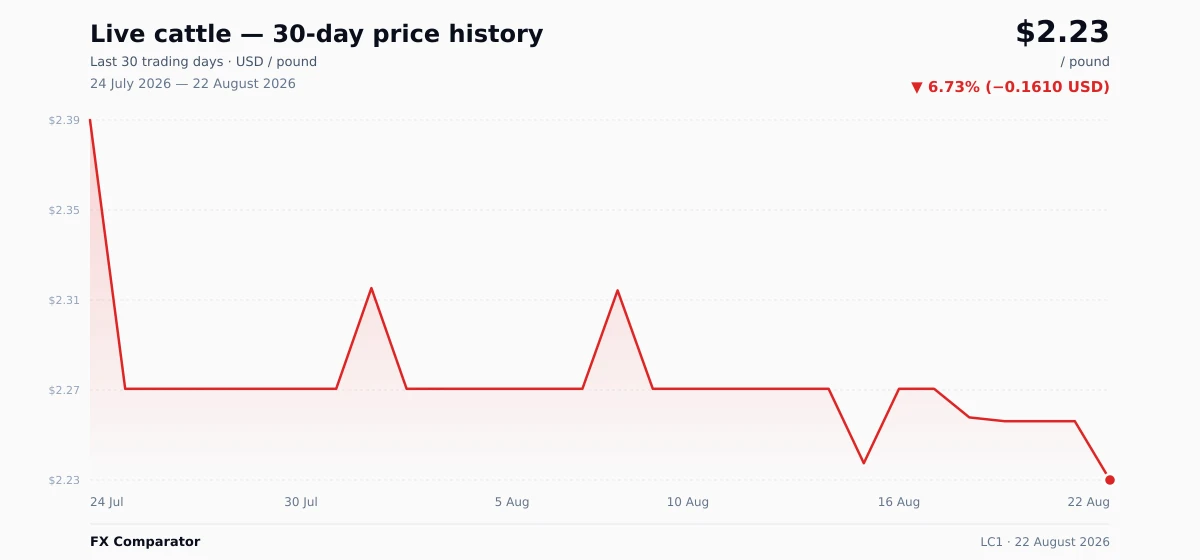
Live cattle (LC1) 30-day price chart — USD, EUR, GBP

The Live cattle chart shows how the live cattle price has moved over time. The interactive view lets you switch the timeframe (from 7 days up to MAX), the currency (USD / EUR / GBP) and overlay moving averages. Click any two points to measure the percentage change between those dates.

How is live cattle priced?

What drives the price of live cattle?

The main structural factor in live cattle is the cyclical movement of the US beef cow herd. The US beef cow herd moves in roughly a 10-year cycle. In the expansion phase, breeders increase the cow herd, which leads to more slaughter cattle after a 2–3 year lag and puts downward pressure on prices. In the liquidation phase, breeders cull cows, which lifts supply in the short term but creates shortages and higher prices over the medium term. According to the USDA Cattle Inventory report, the total US cattle herd is about ~87 million head, of which the beef cow herd is around ~28 million. It recently fell to a multi-decade low after drought-driven slaughter, and the industry is now in the rebuilding phase. The market is therefore highly sensitive to the semi-annual Cattle Inventory data: changes in the cow herd point to supply conditions 2–3 years ahead.

In the short term, the largest price driver is the feedlot margin, meaning the economics of fattening cattle in feedlots. A slaughter-ready steer needs roughly 3–4 kg of feed / 1 kg of liveweight in concentrate feed, mainly corn and soybean meal. Corn prices (CME Corn, ticker ZC) and soybean meal prices (Soybean Meal, ZM) are therefore priced directly into feedlot margins. Higher feed costs reduce feedlots’ willingness to buy feeder cattle and weigh on feedlot replenishment. Pasture conditions and drought in the US Plains region (Texas, Oklahoma, Kansas, Nebraska) are direct supply-shock factors. During prolonged drought, breeders are forced to send cows to slaughter earlier: more cattle in the short term, a smaller herd in the long term. The USDA publishes the monthly Cattle on Feed report on feedlot inventories at yards with capacity of 1,000+ head. It is one of the market’s main reference points.

Export demand is an important addition to the supply picture. Annual US beef production is about 12 Mt in carcass weight, of which exports are about 1.5 Mt, or close to 12% of output. The three largest destination markets are Japan, South Korea and Mexico. China has become a growing export destination after partial easing of market-access restrictions, but access remains politically sensitive and subject to periodic constraints, including BSE protocols, hormone-use rules and traceability requirements. The USDA Foreign Agricultural Service Livestock and Poultry: World Markets and Trade publication updates the global beef export and import balance. It also shows the competitive position of Brazil, the world’s largest beef exporter, Australia and the US. The market therefore watches not only domestic US supply but also herd trends in Brazil and Australia.

How to invest in live cattle

Retail investors can access the live cattle market in several ways. The most direct route is a Live Cattle CFD on the CME Chicago listing, shown on some platforms as "CATTLE", for leveraged, short-term speculation. Indirect exposure is available through meat processor, or packer, shares: Tyson Foods (TSN) is one of the largest US beef slaughtering and packing companies, JBS S.A. is the world’s largest meat processor (listed in Brazil as JBSS3.SA, with an ADR under JBSAY), and Marfrig (MRFG3.SA) is another major Brazilian beef processor. The cow-calf breeding and feedlot operating segments are largely privately owned and rarely available on public markets. Two regulated brokers where both Live Cattle CFDs and meat processor shares are available are:

30-day price history

Chart and daily closing prices
Live cattle (LC1) 30-day price chart — USD, EUR, GBP

Daily close

30 trading days

Date Price (USD) Price (EUR) Price (GBP) Daily change
23 May 2026 US$2.49 €2.12 £1.86 ▲ +0.69%
22 May 2026 US$2.48 €2.11 £1.85 ▼ −0.93%
21 May 2026 US$2.50 €2.13 £1.86 ▼ −0.83%
20 May 2026 US$2.52 €2.14 £1.88 ▼ −0.90%
19 May 2026 US$2.54 €2.16 £1.90 ▼ −0.03%
18 May 2026 US$2.54 €2.16 £1.90 ▲ +0.18%
16 May 2026 US$2.54 €2.16 £1.89 ▲ +0.30%
15 May 2026 US$2.53 €2.15 £1.89 ▼ −0.20%
14 May 2026 US$2.54 €2.16 £1.89 ▲ +0.63%
13 May 2026 US$2.52 €2.14 £1.88 ▲ +1.05%
12 May 2026 US$2.49 €2.12 £1.86 ▼ −0.99%
11 May 2026 US$2.52 €2.14 £1.88 ▲ +1.12%
10 May 2026 US$2.49 €2.12 £1.86 ▼ −1.95%
6 May 2026 US$2.54 €2.16 £1.89 ▲ +0.65%
5 May 2026 US$2.52 €2.15 £1.88 ▲ +0.46%
4 May 2026 US$2.51 €2.14 £1.87 ▼ −0.66%
2 May 2026 US$2.53 €2.15 £1.89 ▼ −0.97%
1 May 2026 US$2.55 €2.17 £1.90 ▼ −0.72%
30 Apr 2026 US$2.57 €2.19 £1.92 ▲ +1.84%
29 Apr 2026 US$2.53 €2.15 £1.88 ▲ +0.90%
28 Apr 2026 US$2.50 €2.13 £1.87 ▲ +0.03%
27 Apr 2026 US$2.50 €2.13 £1.87 ▲ +0.83%
25 Apr 2026 US$2.48 €2.11 £1.85 ▼ −0.59%
22 Apr 2026 US$2.50 €2.12 £1.86 ▲ +0.06%
21 Apr 2026 US$2.50 €2.12 £1.86 ▼ −0.06%
20 Apr 2026 US$2.50 €2.12 £1.86

Live cattle: frequently asked questions

Why is the live cattle price quoted in pounds? +
The Chicago CME Group Live Cattle futures contract, the reference point for the global slaughter cattle market, is quoted in US cents per pound (US¢/Lb) because it comes from US agricultural futures market convention and uses the US measurement system. 1 pound = 0.4536 kg, so the pound-to-kilogram conversion factor is about 2.2046 (1 kg = 2.2046 pounds). 1 tonne of live cattle = 2,204.6 pounds. In European physical procurement, prices are usually quoted per kg of liveweight or carcass weight. Transport, slaughtering and quality premiums explain much of the difference from the Chicago quotation.
What is Live Cattle and how does it differ from the Feeder Cattle contract? +
The Live Cattle contract (ticker: LE) refers to slaughter-ready steers and heifers of about 1,350 pounds (612 kg) liveweight and USDA Choice quality grade. These animals move directly from feedlot to slaughterhouse. The parallel Feeder Cattle contract (ticker: FC) refers to younger weaned calves in the 650–850 pound weight range that have not yet entered the feedlot. Feedlots feed them concentrate rations for 4–6 months before they reach slaughter weight. The two markets move closely together, but Feeder Cattle is more sensitive to corn prices, a feedlot input cost, while Live Cattle is more exposed to slaughterhouse and retail demand.
How much meat comes from one slaughter animal? +
A standard slaughter animal with 1,350 pounds (612 kg) liveweight produces about 830 pounds (~376 kg) of carcass weight after slaughter. This is a 62% dressing percentage, meaning the carcass weight after removing hide, blood, organs and head. Bone, fat and trimmings further reduce the final retail output from carcass weight. The actual saleable retail cuts are about 518 pounds (~235 kg), or roughly 38% of total liveweight, known as retail yield. The Chicago liveweight quote is therefore not directly comparable with the retail price of beef. Slaughtering, deboning, packaging and retail margins dominate the final price.
What is the US beef cow herd cycle and why does it matter for the market? +
The US beef cow herd cycle is the long-term cyclical movement of the US beef breeding herd. It is the result of collective decisions by breeders and repeats at roughly a 10-year pace. In the expansion phase, high prices encourage breeders to retain heifers, increasing the cow herd. With a 2–3 year lag, this creates more slaughter cattle and puts downward pressure on prices. In the liquidation phase, often triggered by drought or a feed-cost shock, breeders cull cows, increasing supply in the short term but reducing breeding stock and tightening future supply over the medium term, which supports prices. The US beef cow herd recently fell to a multi-decade low after drought-driven liquidation, and the industry is now in the rebuilding phase.
How are feed costs priced into the feedlot margin? +
A slaughter-ready steer needs roughly 3–4 kg of feed / 1 kg of liveweight in concentrate feed, mainly corn and soybean meal, with some hay supplement. A feedlot buys a weaned calf (feeder cattle, around 700 pounds) and fattens it to slaughter weight, around 1,350 pounds, over 4–6 months. The feedlot margin formula is simple: selling price (Live Cattle) minus purchase price (Feeder Cattle) minus feed cost (corn + soybean meal) minus overheads. When corn prices rise (CME Corn, ZC), margins narrow and feedlots become less willing to buy feeder cattle, feeding back into the whole supply chain. The market is therefore closely linked to grain markets.
What does the USDA Cattle on Feed report show and why does the market follow it? +
The USDA Cattle on Feed report is a monthly publication from the US Department of Agriculture. It updates the feedlot inventory at yards with capacity of 1,000+ head, as well as new placements and marketings, meaning animals sent to slaughter. It includes inventory changes by contract range, age and weight breakdowns, and placement patterns used to assess the medium-term supply picture. On release days, usually in the second half of the month, CME Live Cattle and Feeder Cattle prices can move sharply if the data differ from the average of market surveys. The market also closely follows the semi-annual USDA Cattle Inventory report, published in January and July on the total US herd, and the regular USDA Foreign Agricultural Service Livestock and Poultry: World Markets and Trade publication.
Which countries are the most important export markets for US beef? +
Annual US beef production is about 12 Mt in carcass weight, of which exports are about 1.5 Mt, or close to 12% of output. The three largest destination markets are Japan, South Korea and Mexico, which together account for the bulk of US beef exports. China has become a growing export destination after partial easing of market-access restrictions, but access remains politically sensitive and subject to periodic constraints: BSE protocols, bans on hormone use and traceability requirements. In the global beef market, the US competes with Brazil, the world’s largest beef exporter, and Australia. The Brazilian real and the Australian dollar directly affect the competitiveness of US exports.
Live Cattle CFD or meat processor shares — how do they differ? +
They have different risk-return profiles. A Live Cattle CFD tracks the Chicago CME quotation directly and is a leveraged instrument used for short-term speculation. Financing costs and the risk of leveraged losses are significant, while rolling futures exposure can create losses when the curve is in contango or backwardation. Meat processor, or packer, sharesTyson Foods (TSN), JBS ADR (JBSAY), Marfrig (MRFG3.SA) — provide indirect and partly inverse exposure. Packer margins are strongest when slaughter cattle purchase prices are low and beef selling prices are high. They also carry substantial company-specific risks, including product recalls, food-safety issues and exposure to the Brazilian political environment.