Livestock & dairy · POUL

Poultry price

Poultry currently trades at US$7.49 per kg (≈ €6.37 · £5.58) — 13.21% below the 12-month high. Over the past 12 months it has lost 13.21%, with the annual range running from US$6.87 to US$8.63. 24-hour movement is minimal (±0.00%).

US$7.49 / kg
≈ €6.37 ≈ £5.58 Unchanged 24h 35% within the 52-week range
FX Editorial Team · Data updated: · Editorially verified
Poultry (POUL) price today US$7.49 / kg, ↑ +0.00% (24h)

Poultry chart

Interactive chart and 30-day overview

7 days
▼ −1.71%
−US$0.1300
30 days
▲ +1.77%
+US$0.1300
1 year
▼ −13.21%
−US$1.14
52-week range
US$6.87 35% US$8.63
Poultry (POUL) 30-day price chart — USD, EUR, GBP

The Poultry chart shows how the poultry price has moved over time. The interactive view lets you switch the timeframe (from 7 days up to MAX), the currency (USD / EUR / GBP) and overlay moving averages. Click any two points to measure the percentage change between those dates.

How is poultry priced?

Poultry is priced per kilogram — the standard metric unit for high-value or specialty commodities including industrial gases and rare-earth metals. The kilogram unit reflects retail and small-batch industrial pricing rather than bulk wholesale.

At US$7.49 per kilogram, 100 grams costs US$0.7490 and one tonne US$7,490. Larger industrial buyers typically negotiate volume discounts off the published kilogram benchmark.

What drives poultry prices?

The cost structure of broiler chicken production is dominated by feed: corn and soybean meal together account for about 60-70% of operating costs. The feed conversion ratio (FCR) for modern broiler hybrids is around 1.7:1, meaning about 1.7 kg of feed is needed to produce 1 kg of live weight. As a result, any sustained move in CBOT corn and soybean futures tends to feed into wholesale chicken prices with a lag of several weeks to several months. During peaks in corn and soybean prices, Brazilian broiler production costs per kg rose by 25-30%, according to ABPA data, with the increase also reflected in FOB Santos export prices.

The second structural factor is highly pathogenic avian influenza (HPAI). Periodic outbreaks of H5N1 and H5N8 strains lead to flock culls, regional transport restrictions and import bans covering entire countries. After a single affected farm is reported, the country concerned typically loses its markets with major importers such as China, Saudi Arabia, Japan and the EU until disease-free status is restored under regionalisation agreements or World Organisation for Animal Health (WOAH) rules. The USDA Foreign Agricultural Service and the FAO Meat Market Review track the HPAI map closely because trade flows and price differentials respond quickly.

The third driver is global export competition and demand. Global broiler production is about ~135 million tonnes a year: the United States produces ~21 Mt, China ~15 Mt, mostly for domestic consumption, Brazil ~14 Mt and the EU ~13 Mt. Global export trade is about ~13 Mt a year, of which Brazil alone supplies ~4.5 Mt. Brazilian export availability therefore has a direct bearing on international price levels. Export supply is dominated by Brazil’s BRF, JBS, through its Seara brand, and Aurora, Thailand’s CP Foods, and US groups Tyson Foods and Pilgrim’s Pride. On the demand side, import needs in China, Mexico, Saudi Arabia, Japan and the EU matter, as does the Brazilian real (BRL) against the dollar: a weaker real supports exports and weighs on FOB quotations.

How to invest in the poultry market

Direct retail CFDs on broiler chicken are typically not available to European retail investors. The global broiler market has no liquid futures contract, so exposure is usually built through shares in large companies across the value chain. In the US, Tyson Foods (TSN) and Pilgrim’s Pride (PPC) are the two largest integrated broiler processors. In Brazil, BRF (BRFS) and JBS give more direct exposure to the export market; JBS trades as JBSAY on the US OTC market and as JBSS3 on São Paulo’s B3 exchange. Hormel Foods (HRL) provides a more diversified meat-sector exposure. Two regulated brokers where these shares are available:

30-day price history

Chart and daily closing prices
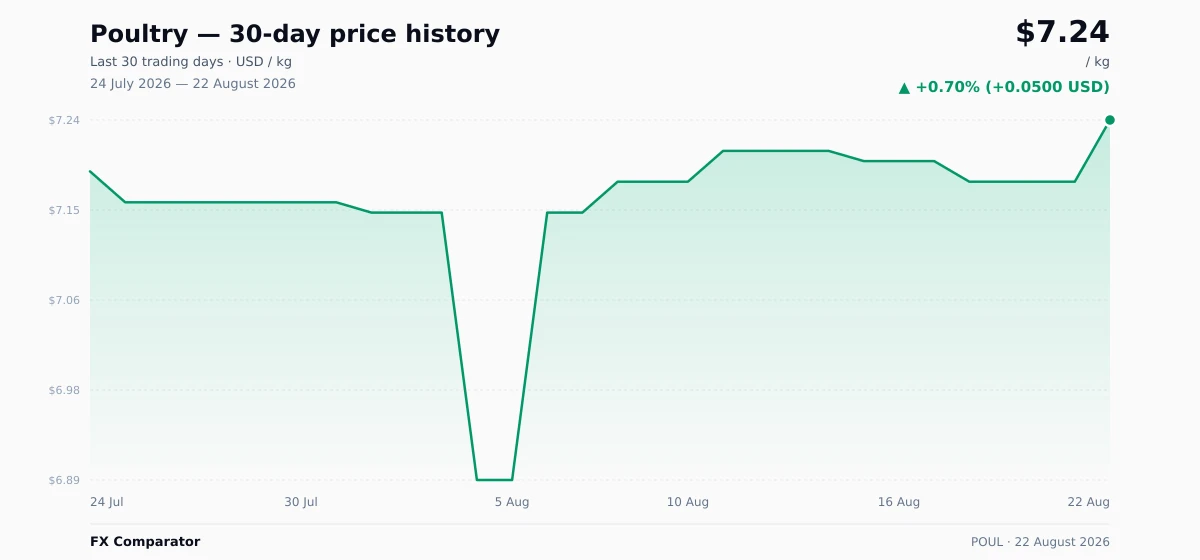
Poultry (POUL) 30-day price chart — USD, EUR, GBP

Daily close

30 trading days

Date Price (USD) Price (EUR) Price (GBP) Daily change
21 May 2026 US$7.49 €6.37 £5.58 ▼ −1.32%
20 May 2026 US$7.59 €6.46 £5.66 ▼ −0.26%
19 May 2026 US$7.61 €6.47 £5.67 ▼ −0.13%
16 May 2026 US$7.62 €6.48 £5.68 ▼ −0.78%
12 May 2026 US$7.68 €6.53 £5.72 ▲ +0.79%
10 May 2026 US$7.62 €6.48 £5.68 ▲ +5.54%
6 May 2026 US$7.22 €6.14 £5.38 ▲ +0.70%
28 Apr 2026 US$7.17 €6.10 £5.34 ▼ −0.42%
25 Apr 2026 US$7.20 €6.12 £5.37 ▼ −2.17%
20 Apr 2026 US$7.36 €6.26 £5.49

Poultry: frequently asked questions

Why is there no global futures contract for broiler chicken? +
Poultry meat, unlike cattle, hogs or wheat, does not have a liquid globally traded futures contract. There are several reasons: the product is perishable, the frozen and fresh markets are separate, trade is dominated by vertically integrated companies such as Tyson, Pilgrim’s, BRF, JBS and CP Foods, and physical delivery is complicated. The market therefore relies on reference prices: Brazil’s FOB Santos export quotation, the USDA Composite Broiler Price and Urner Barry wholesale indices provide guidance. In the wider meat market around CME Group Live Cattle and Lean Hog contracts, the closer broiler proxies are corn and soybean meal futures.
What is the world market price of 1 kg of Brazilian frozen whole chicken? +
The Brazilian FOB Santos export benchmark, based on ABPA (Brazilian Animal Protein Association) and Cepea/Esalq data, typically moves in a range of 1.20-1.60 USD / kg for frozen whole chicken. At about 1.30 USD / kg, 1 pound (lb) of broiler is roughly 0.59 USD, while 1 tonne of frozen whole chicken is about 1,300 USD. This port export price excludes ocean freight, import duties in the destination market, VAT or sales tax, and retail margins. Chicken breast or thighs sold in a European or UK supermarket can therefore cost several times the FOB whole-bird price on a final consumer basis.
What are the slaughter weight and dressed weight of a broiler? +
A modern broiler hybrid such as Ross 308, Cobb 500 or Hubbard typically reaches ~2.5 kg live weight before slaughter after a ~35-42 day growing cycle. After slaughter, plucking, evisceration and cleaning, the dressed weight is about ~1.7 kg, or roughly 68-72% of live weight. Cutting into parts such as boneless breast, thighs and wings, and further processing, cause additional weight loss. The resulting products, however, carry much higher prices per kg than the FOB quotation for a whole bird.
What is FCR and why does it matter in the poultry market? +
FCR (Feed Conversion Ratio) measures how many kg of feed are needed to produce 1 kg of live weight. Modern broiler hybrids have an FCR of about ~1.7:1, meaning roughly 1.7 kg of feed produces about 1 kg of live chicken weight. That makes broilers one of the most efficient converters of feed into animal protein, compared with cattle at about ~6-8:1 and pigs at about ~3:1. The direct result is that feed accounts for 60-70% of broiler production costs, mainly corn and soybean meal. Moves in CBOT corn and soybean prices therefore tend to show up in wholesale chicken prices with a lag of several months.
How does avian influenza (HPAI) affect the poultry market? +
Highly pathogenic avian influenza (HPAI), mainly H5N1 and H5N8 strains, causes periodic outbreaks that lead to flock culls, regional transport restrictions and export bans. After a single affected farm is reported, the country concerned typically loses its markets with major importers such as China, Saudi Arabia and Japan until disease-free status under World Organisation for Animal Health (WOAH) rules is restored or a regionalisation agreement applies. The virus spreads through migratory birds, making it a structural and recurring risk. The USDA Foreign Agricultural Service and the FAO Meat Market Review publish regularly updated HPAI maps.
Who is the world’s largest broiler producer and exporter? +
Global broiler production is about ~135 million tonnes a year. The largest producers are the US at ~21 Mt, China at ~15 Mt, mostly for domestic consumption, Brazil at ~14 Mt and the EU at ~13 Mt. Exports look different: global broiler export trade is about ~13 Mt a year, of which Brazil alone supplies ~4.5 Mt, or about 30% of global broiler exports. The US is second with ~3-3.5 Mt and Thailand third with ~1.5 Mt, or around 10% of global exports. Exports are dominated by Brazil’s BRF, JBS through Seara, Aurora, US groups Tyson and Pilgrim’s, and Thailand’s CP Foods.
Tyson, Pilgrim’s, BRF or JBS — what exposure does each stock provide? +
Tyson Foods (TSN) is the largest integrated meat processor in the US, with operations in poultry, beef and pork. It offers more diversified exposure but remains sensitive to US feed costs. Pilgrim’s Pride (PPC) is more purely focused on broilers, is the second-largest US chicken processor and is a subsidiary of JBS. It provides more direct broiler exposure. BRF (BRFS, New York listing) is Brazil’s export champion, with Sadia and Perdigão among its main brands, and is closely tied to global export pricing. JBS is the world’s largest meat conglomerate across beef, broiler and pork. It dominates broilers through Seara and its ownership of Pilgrim’s; it trades as JBSAY on the US OTC market and as JBSS3 on São Paulo’s B3 exchange.
Why can retail chicken prices rise when the Brazilian FOB quotation falls? +
The FOB Santos export price is only one part of the value chain. Ocean freight, destination-market tariffs and quotas, VAT or sales tax, importer and wholesaler margins, and retail margins must be added to the port export quotation. Retail chicken breast or thighs in Europe or the UK also reflect exchange rates against the dollar and the euro. A weaker local currency can lift final consumer prices even when the FOB price falls. Fresh domestically produced chicken also competes on supermarket shelves, and its price is driven by local corn, soybean meal and energy costs, as well as slaughterhouse and logistics costs.